Tuesday, July 9, 2024

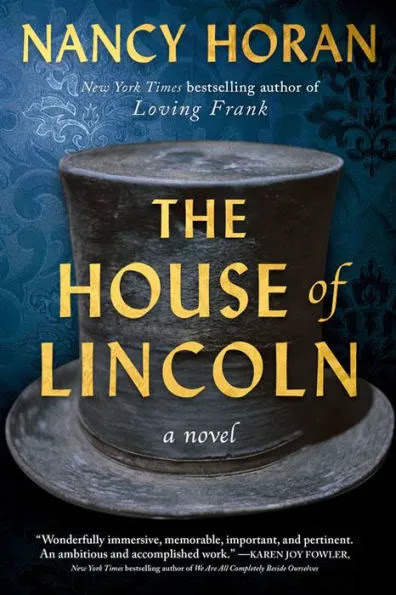
The House of Lincoln by Nancy Horan

The House of Lincoln
by Nancy Horan
Read by Sarah Welborn
10 hours, 30 minutes
Published June 2023 by Sourcebooks

Publisher's Summary: 
Nancy Horan returns with a sweeping historical novel, which tells the story of Abraham Lincoln's ascendance from rumpled lawyer to U.S. president to the Great Emancipator through the eyes of a young asylum-seeker who arrives in Lincoln's home of Springfield from Madeira, Portugal.

Showing intelligence beyond society's expectations, fourteen-year-old Ana Ferreira lands a job in the Lincoln household assisting Mary Lincoln with their boys and with the hostess duties borne by the wife of a rising political star. Ana bears witness to the evolution of Lincoln's views on equality and the Union and observes in full complexity the psyche and pain of his bold, polarizing wife, Mary.

Along with her African American friend Cal, Ana encounters the presence of the underground railroad in town and experiences personally how slavery is tearing apart her adopted country. Culminating in an eyewitness account of the little-known Springfield race riot of 1908, The House of Lincoln takes listeners on a journey through the historic changes that reshaped America and that continue to reverberate today.

My Thoughts: 
In all honesty, I didn't even read the summary of this book before I checked it out from the library. I should have. In an effort to get it "read," I chose the audiobook version. I shouldn't have. 

What Didn't Work For Me:
  • Sarah Welborn's narration so grated on my nerves that I raised the speed of the audiobook to get through it sooner. For me it felt so stilted. 
  • The story telling felt disjointed to me and I was unclear much of the time as to whose story this is. Is it the Lincolns, as told through Ana's eyes? If so, why didn't Horan have her travel with them to Washington? Is it the blacks and how Lincoln ended up effecting their lives? If so, why wasn't the lead character Cal? 
  • Once we really got into the story of political Lincoln, the book felt like it was racing along out of control as Horan got to her ending when things slowed back down to get to the part of the story most readers will be unfamiliar with. There wasn't much new material here for me, except that ending. 
What I Liked: 
  • The ending of the book and the look at the Springfield race riot of 1908. It was not only a great learning experience for me but a great reminder that the enslaved people may have been emancipated, but that didn't change the way all too many people felt about them. In fact, it may have made life worse for some as whites became fearful of what emancipation might mean for them. 
  • Learning the immigrant experience of the Portuguese Protestants, through Ana's family. 
  • Horan working in the Douglass/Lincoln debates which allowed for a comparison to present day politics. 
While this wasn't necessarily the book for me (although reading it in print might have helped), I do still believe that there would be a lot here for book clubs to discuss. Horan's Loving Frank was one of my book clubs reads the year it came out and it led to one of our best ever discussions. Certainly, there are a lot of readers who might not read as much (or have been raised with history ever-present, as I was) and who might find a lot to learn from this book. 

Sunday, July 7, 2024

Life: It Goes On - July 7

Happy Sunday! Were you all lucky enough to have a four-day weekend, thanks to the Fourth falling on a Thursday? I have thoroughly enjoyed the nice long break but still would like another couple of days since Thursday and Friday flew by. 

Miss H arrived Wednesday night for a short visit; long enough to celebrate both the Fourth and Miss C's birthday. Miss H, Mini-him, Miss C, Big Guy and myself took breakfast to my dad on the Fourth since he is no longer able to get to Lincoln for his old neighborhood's Fourth of July breakfast. We didn't shoot off a single firework (much to Miss H's disappointment) but saw plenty and ate our way through the day. 

Last Week I: 


Listened To: Ella Berman's Before We Were Innocent. Will finish that one this week then I don't know what will be next. My next hold won't become available for eight weeks so I'll either do a little searching today for something that will be available sooner or spend the next few weeks catching up on podcasts. 


Watched: Penelope with Miss H, something we'd watched when she was young but neither or us have seen since. It's got quite the cast but I can see why it never made it big - it's a tough one to put in a handy niche. 


Read: I finally finished Julia Phillip's Bear and I started Elizabeth Strout's latest, Tell Me Everything. I'm only about 25 pages in, but I'm loving being back in the world of Lucy Barton. 


Made: Onion dip, maple bacon dip, steak and chicken kebabs, egg casserole, vanilla ice cream, chocolate syrup, red velvet cake and my first ever German chocolate cake. Miss C requested German chocolate for her bday and I always make whatever someone requests, but I've had to rely on other people's opinions as to how it turned out since I don't eat coconut. Or pecans. 


Enjoyed: Lots of time with my family, including an unplanned visit from my brother Friday night

------------------------------------------------------------------------------------------------------------------------

This Week I’m:  


Planning: My sister and her husband arrive for a long weekend visit to see their fathers. So this week is all about getting ready for more company. 


Thinking About: As I rearranged and Tetris'd things into my fridge this past week, I couldn't help but wonder how in the world home organizers, who show us those beautifully organized refrigerators,  account for things like a couple of cakes and extra groceries that need to fit in. And what about containers of leftovers? I've pretty much given up on the idea that I could ever make my refrigerator look organizer beautiful - the best I can hope for is to keep the expired food out of it. 


Feeling: Tired. Haven't been sleeping well the past couple of nights and I'd like nothing more than to sleep for a couple of hours this afternoon. Instead I'll probably pull out a furniture piece to work on and power through. 


Looking forward to: Having my sister here. 


Question of the week: How did you celebrate the Fourth this year? 

Thursday, July 4, 2024

Happy Fourth of July

As you gather today with friends and family to celebrate the Fourth of July, I hope you'll take some time to remember that what we're really meant to be celebrating is the signing of the Declaration of Independence, which says: 


We hold these truths to be self-evident, that all men are created equal, that they are endowed by their Creator with certain unalienable Rights, that among these are Life, Liberty and the pursuit of Happiness.--That to secure these rights, Governments are instituted among Men, deriving their just powers from the consent of the governed, --That whenever any Form of Government becomes destructive of these ends, it is the Right of the People to alter or to abolish it, and to institute new Government, laying its foundation on such principles and organizing its powers in such form, as to them shall seem most likely to effect their Safety and Happiness. 


Let us not forget that the men who wrote these words, the men who signed this document, and the men and women who fought to make it a reality, were fighting against tyranny in any form and for a government that listened to the will of the people so that those people might be allowed their inalienable rights of life, liberty, and the pursuit of happiness. 

Wednesday, July 3, 2024

The Keeper of Hidden Books by Madeline Martin

The Keeper of Hidden Books
by Madeline Martin
Read by Saskia Maarleveld
10 hours, 53 minutes
Published August 2023 by Hanover Square Press

Publisher's Summary: 
All her life, Zofia has found comfort in two things during times of hardship: books and her best friend, Janina. But no one could have imagined the horrors of the Nazi occupation in Warsaw. As the bombs rain down and Hitler's forces loot and destroy the city, Zofia finds that now books are also in need of saving.

With the death count rising and persecution intensifying, Zofia jumps to action to save her friend and salvage whatever books she can from the wreckage, hiding them away, and even starting a clandestine book club. She and her dearest friend never surrender their love of reading, even when Janina is forced into the newly formed ghetto.

But the closer Warsaw creeps toward liberation, the more dangerous life becomes for the women and their families - and escape may not be possible for everyone. As the destruction rages around them, Zofia must fight to save her friend and preserve her culture and community using the only weapon they have left - literature.

My Thoughts: 
Aggghh! This is one of those books that I didn't write a review for soon enough and my thoughts have kind of been lost to me so I'm going to piece things together as best I can. As always, let's start with the things that didn't work for me and work our way to what I liked about this book (I always like to end things on a positive note, when I can!).

What Didn't Work For Me: 
  • Books played a major role in this book, and Zofia's life, until they didn't. Suddenly, she became a resistance fighter for that last quarter (?) of the book. Nothing wrong with that, it felt true to Zofia's nature, but it seemed to veer away from what the premise of the book had been. 
  • Even before the Nazis invade Poland, Zofia, Janina and another friend are already reading, as a group, books that Hitler has banned in Germany. A couple of other girls in their school horn in on their group, girls it's clear that Zofia doesn't really like. But it quickly becomes clear that these girls have interesting thoughts about the books and are really contributing to the discussions. I never felt like they really became part of Zofia's circle or that she acknowledged that she may have misjudged them so it felt odd to me that they brought into the story and remained there, as peripheral characters, to the end. 
  • Things began to feel rushed to me as the book went on and time sort of collapsed. 
What I Liked: 
  • Of course, I loved that so much of this book centered around books being a driving force in educating people, in being a part of their culture, and in being a way to help them survive the worst. I loved seeing these people so passionate about saving these books not only because books are so important to them but also as an act of rebellion. These people were, quite literally, willing to put down their lives in defense of books. 
  • Zofia's and Janina's relationship. Their friendship never wavered and Zofia was willing to do anything (and did) to protect and help Janina. 
  • In fact, a lot of the relationships, including Zofia's and her mother's, which changed tremendously throughout the book. Also, I appreciated that while Zofia and a young man who joins their group are clearly falling in love, nothing happens between them until the very end - it's logical that strong emotions would occur but a romance in the middle of the book would have felt out of place. 
  • I've read a lot about what the Nazis did to the Jews in Germany, much less about what happened in Poland so I found this book a good reminder of what it was like to be in Warsaw and Poland, not just as a Jew but as a Pole. And, if I'd known, I'd forgotten, that the Soviets came into Poland, not so much to chase out the Germans but to take over. 
Overall, I enjoyed the book and would definitely recommend it for book clubs as there is so much to discuss in the book. 

Monday, July 1, 2024

The Cemetery of Untold Stories by Julia Alvarez

The Cemetery of Untold Stories
by Julia Alvarez
256 pages
Published Algonquin Books of Chapel Hill
Source: my copy courtesy of the publisher, through Netgalley, in exchange for an honest review

Publisher's Summary: 
Alma Cruz, the celebrated writer at the heart of The Cemetery of Untold Stories, doesn’t want to end up like her friend, a novelist who fought so long and hard to finish a book that it threatened her sanity. So when Alma inherits a small plot of land in the Dominican Republic, her homeland, she has the beautiful idea of turning it into a place to bury her untold stories—literally. She creates a graveyard for the manuscript drafts and the characters whose lives she tried and failed to bring to life and who still haunt her. 

 Alma wants her characters to rest in peace. But they have other ideas and soon begin to defy their author: they talk back to her and talk to one another behind her back, rewriting and revising themselves. Filomena, a local woman hired as the groundskeeper, becomes a sympathetic listener to the secret tales unspooled by Alma's characters. Among them, Bienvenida, dictator Rafael Trujillo's abandoned wife who was erased from the official history, and Manuel Cruz, a doctor who fought in the Dominican underground and escaped to the United States.
 
The Cemetery of Untold Stories asks: Whose stories get to be told, and whose buried? Finally, Alma finds the meaning she and her characters yearn for in the everlasting vitality of stories. Julia Alvarez reminds us that the stories of our lives are never truly finished, even at the end.

My Thoughts: 
A little more than five years ago, my husband and I went to hear Julia Alvarez speak. At that time, I had a couple of her books on my to-be-read list, but hadn't actually read anything she'd written. I was so impressed with her that I knew I needed to rectify that. This is now my third of her books and I've several things to be true of her books: 
  • The themes of family (especially sisters), the immigrant experience, home, and storytelling will appear. 
  • The writing will be beautiful. 
  • The book will make me really think and I'm bound to learn from it. 
  • It's possible that I may feel like I'm in over my head. 
This book was no exception. I'll admit to wondering, in the beginning, if this book might be more cerebral than what I was up to when I began reading. But I also knew that I wanted to see how it would play out so I continued reading and Alvarez began pulling me in, even when it became apparent that magical elements were going to be involved (and you all know how tricky that it for me!). 

For a bit I felt pulled about, from one person's story to another's, from Alma's story to Filomena's story. Gradually they became one and the need for that background for each of them became apparent as the stories told by those buried characters begin to emerge. 

Manuel Cruz is Alma's father, a man who long ago spoke of a of mysterious place, a place his daughters mocked him about. Then one day he stopped speaking of it and, as he slipped into dementia, he stopped telling his girls anything about his past. 

Bienvenida is based on the real wife of Rafael Trujillo. Her she is a woman who gets swept up in the make-believe world Trujillo creates in wooing her and remains blind to the person he really is until she is forced to leave the country so that he can marry a new woman who can give him children. 

Filomena is a woman who grew up in the slums, whose mother abandoned her as a child and whose father was abusive. She and her sister, Perla, get tricked into coming into the city and working as maids for a wealthy family. When Perla becomes pregnant by the family's son, they are forced to marry. When he lands in trouble for going against Trujillo, the young family is sent to New York City and Filomena is deprived of the sister she's become estranged from and her beloved nephew. 

As Filomena listens to the stories in the cemetery, we begin to see how Alma's father's, Bienvenida's, and, eventually, Filomena's mother's stories are intertwined. 

As the book moved between the stories told by the characters in the cemetery and the real lives of Alma and Filomena, I never found myself confused or trying to race through one story to get to the next. For me, everything was laid out and unfolded perfectly. I grew to care deeply about these characters, even those who were more deeply flawed. In just 256 pages, Alvarez took me from doubting this book to wishing it were longer, not because it didn't feel complete; but because I wanted to hear more of the stories.