Tuesday, October 11, 2011

Waiting for Robert Capa by Susana Fortes

Waiting For Robert Capa by Susana Fortes
208 pages
Published September 2011 by HarperCollins Publishers
Source: the publisher and TLC Book Tours

Gerta Pohorylle and AndrĂ© Friedmann and are young Jewish refugees who arrive in Paris in 1935. Caught up in the scene that is Paris on the cusp of World War II,  the two were first friends, then business partners and finally lovers. Friedmann taught Pohorylle the art of photography and she, in turn, remade him into Robert Capa, launching his career, and remade herself into Gerda Taro. She became one of the first female combat photographers and he became internationally known for his photograph, The Fallen Soldier. taken early during the Spanish Civil War.


Capa and Taro found themselves caught up in political movements in Paris as much because of what they stood against as because of what they stood for - they were both fiercely opposed to Facism. When the Spanish Civil War broke out, it was only logical that the pair would find themselves drawn to the country, throwing themselves as close to danger as was possible.


 In her author notes, Fortes who is Spanish, stated that she's been drawn to the work of Capa for years. It was in 2008, when 127 undeveloped rolls of film that Capa, Taro, and their friend David Seymour had taken during the war, that Fortes decided it was time to write the story. Interestingly, I found the book to be much more Gerda's story.

Waiting For Robert Capa struggles to find it's voice. Sometimes, it's almost overly poetic as Fortes writes about the environment of Paris. Other times it reads much more as if it were a work of non-fiction, detailing movements in battles and dropping names of other well-known participants in the Paris and/or Spanish settings. For me, I far preferred when Fortes cut back on the descriptiveness and got to the meat of the story. It's a story I've been interested in for a couple of years and it felt as if Fortes and written fully-developed characters who may very well be much like the people on which they are based. I find myself even more interested in this pair whose relationship seems as if it truly were one with origins in the pages of a novel.

Thanks to TLC Book Tours for giving me the opportunity to read this one. For more opinions, please see the full list of reviews.

Monday, October 10, 2011

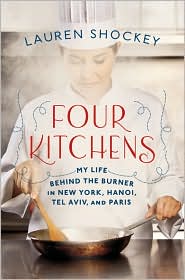
Four Kitchens: My Life Behind The Burner In New York, Hanoi, Tel Aviv, and Paris by Lauren Shockey

Four Kitchens: My Life Behind The Burner In New York, Hanoi, Tel Aviv, and Paris by Lauren Shockey
352 pages
Published July 2011 by Grand Central Publishing
Source: the publisher

When she graduated from college with a perfectly serviceable four-year degree, Lauren Shockey discovered with a start that she really had no passion for working a nine-to-five job in a corporate environment. Instead, she told her parents, she wanted to go to culinary school. Not surprisingly, her parents encouraged her to get a job. But sitting in a office day after day only convinced Shockey that she needed to pursue her passion so off to culinary school she went. Upon leaving culinary school, Shockey knew that her education wasn't complete; she needed a job in a real kitchen so pursued a job as a stagiaire (STAH-zjee-air). A stage is "an apprenticeship offering hands on experience and familiarity with new techniques and cuisines." Shockey did her first stage in a small restaurant in France but quickly realized that it was not going to give her what she needed so she determined that she would spend the next year working in four different kitchens, in four different countries.

First stop, wd-50 in New York, owned by Wylie Dufresne who some of you may know from his guest judging appearances on Top Chef on Bravo. Dufresne is one of the masters of molecular gastronomy, a type of cooking which puts a lot of emphasis on technique, science and innovation. Day one, Shockey learned that she had not learned anything she needed to know about working in a restaurant while she was in culinary school and it was an uphill climb to earn respect from the nearly all-male staff. Next stop, La Verticale in Hanoi, Vietnam. Here the emphasis was entirely on flavor. Then is was on to Carmella Bistro in Tel Aviv, Israel. Shockey learned about foods that had been developed over centuries by pulling together foods from all of the cultures that have touched the region.Finally, Shockey found herself working Senderens in Paris, a Michelin 3-star restaurant, firmly rooted in the traditional foods of France.

If you were to look at the Barnes and Noble page for this book, you'd find lots of reviews highly recommending  it, including Kirkus Reviews where I have frequently read reviews bashing books I've loved.  Once again, Kirkus and I disagree. Shockey's journey made for a terrific idea for a book, and I appreciated that she included not just her experiences in each kitchen, but her experiences in each city/country as well. But in both the professional and personal aspects, I felt that she often went into much too much detail and was frequently repetitive. I lost track of the number of times, for example, that she talked about prepping crab in Paris and I believe I might be able to prep some of the food at wd-50 since I have detailed instruction on how certain foodstuffs must be cut. Considering that Shockey was going to be visiting four different kitchens, I was disappointed that she spent over 90 pages devoted to New York and wd-50. By the time that section was finally done, I was almost ready to abandon the book. I get it, I get it - working in a restaurant kitchen in New York is hard work and long hours for little if any pay, the climate can often be hostile, and at wd-50 there is a ridiculous amount of time and effort spent on things that may never be apparent to anyone not on the staff.

To be fair, I don't entirely blame Shockey. I think a much more vigorous editing would have helped tremendously. I didn't need to know the names of everyone she met along the way or the details of many of her evenings overseas but I very much enjoyed her explorations of cultures other than her own. I certainly had no idea how dull much of the work in a professional kitchen can be, nor that it remains a male-centric environment, nor that much of the staff works for nothing. I found it interesting to learn about the different mind-sets of the employees in the different countries as well, the different kinds of ingredients that other countries use in their cooking and the amount of work that goes into every dish on most menus. I was happy to see that, in the end, Shockey found that the most passionate chefs are those who are cooking in their own homes for people that they care about.

If you're willing to make special trips to grocery stores you don't usually frequent (or maybe you do), there are a lot of very interesting recipes in the book. Shockey has modified a lot of the recipes she worked with in the restaurants to fit the kind of cooking most of us do and the type of equipment most of us have. Most of them, I will warn you, are the kinds of recipes you'll save for the weekends or special occasions when cooking a meal is a day long event.

Sunday, October 9, 2011

Sunday Salon - October 9


What a crazy week I've had...again! Prefer not to have another one like it but, on the plus side, I've had something of my own reading marathon the past four days. I managed to finished the better part of one book and two more and I've gotten a good start on a fourth book. Now that does feel good!


My month of Fall Feasting will finally kick off this week with a reviews of Four Kitchens by Lauren Shockey and Table of Contents by Judy Gelman and Vicki Levy Krupp. Next up for my foodie reading is (finally!) Julie Powell's Julie and Julia. I might just have to follow this one up with a girls' movie night. My sister, niece, daughter and I all went to see the movie in the theater and loved it. I'm thinking we'll kick the guys out, get some popcorn and candy, and create the fun.

This week I'll also be reviewing Waiting for Robert Capa by Susana Fortes for a TLC Book Tour. Capa was a Hungarian combat photographer; the story of Capa and his love, Gerta Taro, have interested me since I first learned about him a couple of years ago so I jumped at the chance to read this one.

Next weekend is the Omaha Lit Fest. I believe I've mentioned (a few hundred times) how impressed I was with last year's event. Needless to say I'm really looking forward to this year's event and getting a chance to introduce myself to Mary Helen Stefaniak (The Cailiffs of Baghdad, GA). Ms. Stefaniak teaches at Creighton University, here in Omaha, and I'm so excited that she's agreed to meet with the Omaha Bookworms in person this month!

Next up for me this week is The Kitchen Counter Cooking School: How a Few Simple Lessons Transformed Nine Culinary Novices into Fearless Home Cooks by Kathleen Flinn. I'm hearing great things about this one so I'm really looking forward to it. What are you reading this week?

Tuesday, October 4, 2011

The Three Weissmanns of Westport by Cathleen Schine

The Three Weissmanns of Westport by Cathleen Schine
292 pages
Published February 2010 by Farrar, Strauss and Giroux
Source: bought this one for my mom for Christmas last year

If you are one of the three Weissman women, life has suddenly taken a dramatic left turn. When Betty's husband of fifty years, Joseph, announces that he wants a divorce, she suddenly finds herself needing a place to live. When her cousin Lou suggests he come stay in a cottage he owns in Westport, daughter Miranda (going through a professional crisis that has her funds all tied up, perhaps never to be seen again) suggests that she and her sister Anne also move into the cottage. Anne, a single mother, who is a librarian, balks at the idea but, as she always has, she eventually agrees. It's only for a short while, after all, until Joseph either comes to his senses and comes back to Betty or agrees to let her leave in the apartment. Besides, Anne knows that between them, Miranda and Betty will never be able to manage financially. Even with her constant admonitions, the pair have a hard time understanding that a new suit or a new kayak are not in their new budget.

When Miranda takes that new kayak out for the first time, she suddenly finds herself flipped upside down and in danger of being pulled out into the Atlantic. That is until she is rescued by the oh so very handsome Kit Maybank. Miranda is soon smitten, not just with Kit but also with his young son, Henry. Miranda's always one to fall fast and hard but this time Anne senses that Henry is the one Miranda is most in love with.

Anne, in the meantime, is spending all of her daydreams on author Frederick Barrows, a man she has had a brief fling with. A man who still seems to be interested but also a man who has made almost not attempt to contact Anne for the longest time. It seems that his grown children are not wild about the idea of his spending time with a librarian.

Betty is going through all of the phases of grief. Yes, grief. Betty insists that she is a widow despite that fact that she is spending a tremendous amount of time with lawyers trying to get the settlement her husband has promised her will be "very generous" but which he doesn't seem to be producing. To top it all off, Betty soon discovers that Joseph didn't just wake up one day and decide he was tired of being married to her. There's another woman who, as it turns out, is also Frederick Barrow's sister.

Throw in a parade of characters who congregate at Cousin Lou's house, including his annoying wife Rosalyn, and friend Roberts and you've got the makings for conflict, humor and misunderstanding.

Taking Jane Austen's Sense and Sensibility and dropping it squarely onto the East Coast of the United States, Schine does a fine job of re-imagining Austen's characters and story lines while making changes that make the story her own. Fan of Austen's novel will enjoy comparing the two works throughout the novel and watching the stories blend then go off their own ways. Here there is no half-brother taking the family home away from the Dashwoods; there is always the hope that Betty will be able to return to her own home. The daughters are older, and, theoretically, able to make their own way in live without the help of a good marriage. But that doesn't stop all three of the Weissmanns from hoping for a happily ever after that includes a good man.

I thoroughly enjoyed this book, certainly owing, in no small part, to the fact that I love Austen's book. But I also relished Schine's observations about relationships.
"Over the years, Betty began to forget that she liked Joseph. The large breakfast seemed grotesque, the drink obsessive, the light super an affectation. This happened in their third decade together and lasted until their fourth. Then, Betty noticed, Joseph's routines somehow began to take on a comforting rhythm, like the heartbeat of a mother to a newborn baby. Betty was once again content, in love, even."
Come on, those of you who have been married this long, you have to admit that you've had thoughts like this yourself. The "oh my god, I'm stuck with this for the rest of my life" moments when you're not sure you can take it any longer.

Schine's central characters a well-rounded and the reader learns just enough about the supporting cast to make them interesting but not so much that it bogs down the plot. Perhaps my favorite parts of this book were not the ways in which it was like Austen's novel, but in the ways in which it took off on it's own. The Omaha Bookworms will be reading this one in December and I can't wait to discuss it with them and to see how the opinions might vary between those who have read both The Three Weissmanns of Westport and Sense and Sensibility and those who have only read this one. I'll keep you posted on how that discussion goes!

Sunday, October 2, 2011

Sunday Salon - October 2

As part of Banned Books Week this past week, BookBrowse.com offered these thoughts on reading:


9 Things That Happen When You Read
In a series of lectures, Nobel laureate Orhan Pamuk ruminated on what goes on in the mind of a person reading a novel. His thoughts are summarized by Susan K. Perry, Ph.D. below. Do these match your experiences? The point about finishing a (great) novel and feeling that it had been written just for me particularly struck home - it maybe irrational but it's so true!
  1. We observe the general scene and follow the narrative. Whether action-filled or more literary, we read all novels the same way: seeking out the meaning and main idea.
  2. We transform words into images in our mind, completing the novel as our imaginations picture what the words are telling us.
  3. Part of our mind wonders how much is real experience and how much is imagination. "A third dimension of reality slowly begins to emerge within us: the dimension of the complex world of the novel."
  4. We wonder if the novel depicts reality as we know it. Is this scene realistic, could this actually happen?
  5. We enjoy the precision of analogies, the power of narrative, the way sentences build upon one another, the music of the prose.
  6. We make moral judgments about the characters' behavior, and about the novelist for his own moral judgments by way of the characters' actions and their consequences.
  7. We feel successful when we understand the text, and we come to feel as though it was written just for us.
  8. Our memory works hard to keep track of all the details, and in a well-constructed novel, everything connects to everything.
  9. We search for the secret center of the novel, convinced that there is one. We hunt for it like a hunter searches for meaningful signs in the forest.

Yesterday kicked off two things; National Reading Group Month and my month for Fall Feasting, a month devoted to reading books about cooking and food.  Oh sure, National Reading Group Month has all kinds of gatherings and famous authors but I'm not going to get to go to any them. So I'll be looking forward to reading and talking about food. I just got a new refrigerator and swapped out my deep freeze with the old refrigerator so I've really taken stock this weekend of the food I have on hand and my mind is racing with the possibilities. Can't wait for the books to give me the final inspiration to get in the kitchen and make some delicious meals.

What are you looking forward to reading?