Showing posts with label translated work. Show all posts

Tuesday, June 6, 2023

Us Against You by Fredrik Backman

Us Against You
by Fredrik Backman
Published March 2019 by Washington Square Press
448 pages

Publisher's Summary: 
Have you ever seen a town fall? Ours did. Have you ever seen a town rise? Ours did that, too.

A small community tucked deep in the forest, Beartown is home to tough, hardworking people who don’t expect life to be easy or fair. No matter how difficult times get, they’ve always been able to take pride in their local ice hockey team. So it’s a cruel blow when they hear that Beartown ice hockey might soon be disbanded. What makes it worse is the obvious satisfaction that all the former Beartown players, who now play for a rival team in the neighboring town of Hed, take in that fact. As the tension mounts between the two adversaries, a newcomer arrives who gives Beartown hockey a surprising new coach and a chance at a comeback.

Soon a team starts to take shape around Amat, the fastest player you’ll ever see; Benji, the intense lone wolf; always dutiful and eager-to-please Bobo; and Vidar, a born-to-be-bad troublemaker. But bringing this team together proves to be a challenge as old bonds are broken, new ones are formed, and the town’s enmity with Hed grows more and more acute.

As the big game approaches, the not-so-innocent pranks and incidents between the communities pile up and their mutual contempt intensifies. By the time the last goal is scored, a resident of Beartown will be dead, and the people of both towns will be forced to wonder if, after everything, the game they love can ever return to something as simple and innocent as a field of ice, two nets, and two teams. Us against you.

My Thoughts: 
When you don't start reading a trilogy until after the third book is out in the world, it's easy to say that you knew there would be more books after the first one. I'm pretty sure, though, that I would have felt that way even before Us Against You was published. The characters in Beartown left us wanting to know more. How will Maya, Amat, and Benji move on? What friendships will survive what happened in the first book and which will fall apart? What new friendships will grow? It's a given that hockey will play a role, but how? And what new truths about community, family, friendship, and humanity will Backman explore?

This is the fifth novel by Backman that I've read and Backman's commentary about the human condition is something I've always loved about this books. As Kirkus Reviews says, "evident in all his novels is an apparent ability to state a truth about humanity with break taking elegance." Yes, one could argue that the story itself should revel those same truths. And this is the first time that I've actually felt like Backman should stop telling me so much and just show me through the actions of his characters. I really, really wanted to get to the people, to find out what was going to happen to them.  the Medium reviewer says, the novel was frequently "baggy and digressive." Even having said that, that same Medium reviewer said this novel was "impeccably written work that explores the love and passion, and the sense of community." Also true. Which makes this still a novel that I thoroughly enjoyed, even though I thought it was 50 pages too long. 
"People say that leadership is about making difficult decisions, unpalatable and unpopular decisions. "Do your job," leaders are constantly being told. The impossible part of the job is, of course, that a leader can carry on leading only as long as someone follow him, and people's reactions to leadership are always the same: if a decision of yours benefits me, you're fair, and if the same decision harms me, you're a tyrant. The truth about most people is as simple as it is unbearable: we rarely want what is best for everyone; we mostly want what's best for ourselves."
It's that kind of observation that makes readers face uncomfortable truths about themselves and makes readers forgive those 50 pages too man. 

One of the other things I've admired about Backman's writing is his ability to humanize all of his characters. Some of them are not a "good" as others, some more prone to violence, others more prone to be cruel. But Backman tends to readers see the reasons those characters have become those people, giving readers the ability to see them as fully human and to see the goodness in them (and, I'd add, push us to try to find the same in real people). In Us Against You, though, Backman has introduced a new character, a politician that is more one-dimensional. He is clearly the bad guy here, despite any thought that he is taking on the established political hierarchy. I kept waiting for that moment when Backman would revel a side of Richard Theo that would make him understandable. It never came. Perhaps that's a revelation of another sort. 

I may have become even more attached to some of the characters than I was in Beartown (I see you playing with my emotions, Mr. Backman). I had to race through this one to make sure all of them would be ok. Here's the thing with Backman's books - some of them won't be, some of them will flourish. Some that I didn't care for in the first book will become dear to me, others will fall out of favor. And hockey? Hockey is, once again, just a device to show us those truths about people. 

Did I love it as much as I did Beartown? No. But it's still a mighty fine encore. It could stand on its own but I wouldn't recommend reading it without reading Beartown first. 


Tuesday, August 31, 2021

A Long Petal of the Sea by Isabel Allende

A Long Petal of the Sea
by Isabel Allende
Published January 2020 by Random House Publishing Group

Publisher's Summary:
In the late 1930s, civil war grips Spain. When General Franco and his Fascists succeed in overthrowing the government, hundreds of thousands are forced to flee in a treacherous journey over the mountains to the French border. Among them is Roser, a pregnant young widow, who finds her life intertwined with that of Victor Dalmau, an army doctor and the brother of her deceased love. In order to survive, the two must unite in a marriage neither of them desires. 

Together with two thousand other refugees, Roser and Victor embark on the SS Winnipeg, a ship chartered by the poet Pablo Neruda, to Chile: “the long petal of sea and wine and snow.” As unlikely partners, the couple embraces exile as the rest of Europe erupts in world war. Starting over on a new continent, they face trial after trial, but they will also find joy as they patiently await the day when they might go home. Through it all, their hope of returning to Spain keeps them going. Destined to witness the battle between freedom and repression as it plays out across the world, Roser and Victor will find that home might have been closer than they thought all along.

My Thoughts:
Isabel Allende is one of my favorite authors - she is superb at writing sweeping sagas that span generations of captivating, unusual characters set in interesting times and places, most often set, at least in part, in Allende's homeland, Chile. Six decades, three generations, much of the book set in Chile - in that regard, A Long Petal of the Sea is no exception. 

This is by far the most political of the books by Allende that I've read and, while I'm not opposed to that in a book, it did overwhelm the story for me. That being said, I learned so much about the Spanish Civil War and the politics of Chile and it was fascinating to compare both of those political environments with the current state of affairs in this country. Allende condemns both sides for atrocities they commit but as the child of a man who headed a socialist government, it's not surprising that the working class is portrayed more sympathetically. A warning for some - the Catholic church does not fare well in Allende's hands in this book.

You are accustomed to me saying that books would have benefited from a pruning; here, with a story this big, I felt like more would have been better. There would have been more room to include the political stories that Allende wanted to include (some for quite personal reasons - her father was the president of Chile for three years in the 1970's) while also allowing room to flesh out the stories of the families. There were characters I definitely wanted to know more about, characters I wanted to understand better. 

Mind you, this book was named as one of the best books of 2020 by a number of publications so what do I know? Perhaps they all appreciated a decades-long saga that didn't go on for 800 pages. And Allende absolutely manages, in these 314 pages, to explore so many themes, tell us so many stories, and, hopefully, have us wanting to learn more. 


Source: checked out of my local library for August's book club selection

Tuesday, June 22, 2021

The Little Paris Bookshop by Nina George

The Little Paris Bookshop
by Nina George
Read by Steve West and Emma Bering with Cassandra Campbell
Published June 2015 by Crown Publishing Group
Source: audiobook checked out from my local library

Publisher's Summary:
Monsieur Perdu calls himself a literary apothecary. From his floating bookstore in a barge on the Seine, he prescribes novels for the hardships of life. Using his intuitive feel for the exact book a reader needs, Perdu mends broken hearts and souls. The only person he can't seem to heal through literature is himself; he's still haunted by heartbreak after his great love disappeared. She left him with only a letter, which he has never opened. 

After Perdu is finally tempted to read the letter, he hauls anchor and departs on a mission to the south of France, hoping to make peace with his loss and discover the end of the story. Joined by a bestselling but blocked author and a lovelorn Italian chef, Perdu travels along the country’s rivers, dispensing his wisdom and his books, showing that the literary world can take the human soul on a journey to heal itself.

My Thoughts:
“Books are more than doctors, of course. Some novels are loving, lifelong companions; some give you a clip around the ear; others are friends who wrap you in warm towels when you've got those autumn blues. And some...well, some are pink candy floss that tingles in your brain for three seconds and leaves a blissful voice. Like a short, torrid love affair.”

My bookclub read this one as our book about books; it's probably not something I would have picked up of my own accord. It's not the book I thought it was going to be and I'm thinking it's better for not having been that book but I'm still trying to decide if it's pink candy floss or something that will stay with me longer. There are some wonderful gems of writing here and some really wonderful characters. On the other hand, as one reviewer remarked George seems always to have used two words where one would do and there are a lot of places where you just have to suspend logic if you want to enjoy the book. And I did want to enjoy the book. I so wanted for Perdu to find peace and for Max (a young author who hitched a ride with Perdu) to find his muse. I enjoyed the many ways that George presented sensuality and passion from dance to food to books. There is a scene of tango dancing that's absolutely marvelous and the writing about food made my mouth water. The landscape comes alive and I certainly found myself thinking that a leisurely boat trip down the Seine might well be the perfect vacation. 

There are some diary pieces in the book that really pulled me out of the story and I felt could have been left out entirely without the book missing a beat. There are some cliches, a scene with a deer that felt really out of place even though George used it to move the characters to a new place. And there were, perhaps, a few too many quirky characters. On the other hand, it's one of those books that tackles tough subjects but mostly with a light touch and plenty of humor, the kind of book that's perfect for my mood right now. 

As a bookclub choice, I recommend The Little Paris Bookshop, even if very little time is spent in Paris and the bookshop is certainly not the focus of the book. I'm glad that I chose to listen to this book; Steve West, in particular, does a terrific job. 


Friday, February 5, 2021

Anxious People by Fredrik Backman

Anxious People
by Fredrik Backman
Translated by Neil Smith
Published September 2020 by Atria Books
Source: checked out from my local library

Publisher's Summary:
Looking at real estate isn’t usually a life-or-death situation, but an apartment open house becomes just that when a failed bank robber bursts in and takes a group of strangers hostage. The captives include a recently retired couple who relentlessly hunt down fixer-uppers to avoid the painful truth that they can’t fix their own marriage. There’s a wealthy bank director who has been too busy to care about anyone else and a young couple who are about to have their first child but can’t seem to agree on anything, from where they want to live to how they met in the first place. Add to the mix an eighty-seven-year-old woman who has lived long enough not to be afraid of someone waving a gun in her face, a flustered but still-ready-to-make-a-deal real estate agent, and a mystery man who has locked himself in the apartment’s only bathroom, and you’ve got the worst group of hostages in the world. 

Each of them carries a lifetime of grievances, hurts, secrets, and passions that are ready to boil over. None of them is entirely who they appear to be. And all of them—the bank robber included—desperately crave some sort of rescue. As the authorities and the media surround the premises these reluctant allies will reveal surprising truths about themselves and set in motion a chain of events so unexpected that even they can hardly explain what happens next.

My Thoughts:
Fredrik Backman has the ability to write about incredibly heavy themes with a light touch and sense of humor that never fails to have me laughing and crying, sometimes on the same page. His writing is uncomplicated and yet says so much. His characters are ridiculous, flawed, and some are downright unlikable. But Backman clearly loves his characters and readers can't help but care about them and reminds us that we are all connected.
"...most of us remain strangers, we never know what we do to each other, how your life is affected by mine."
As with so many books, communication plays a big role in this book, what we say that we shouldn't, what we don't say that we should. It's about the communication between married couples, therapists and patients, fathers and sons, and even strangers. Here again, Backman plays this both humorously and with a feeling of sadness.
"The other one said they'd started to hate each other after an argument that, as far as Jim could understand, started when they were unable to find a juicer in a color that reflected them both as individuals but also as a couple. That was when they realized that they couldn't live together another minute longer, and now they hated each other."

"It's so hard to find the words when all you really want to say is: "I can see you're hurting."

So many of the characters in this book come to see that others are hurting but can't find the words to say it. The saving grace in Backman's books is that they almost always find other ways to show that they see it and reach out to help.  

This is my third book by Backman and each of them has had a certain sense of mystery to them but this is by far the most complicated. It is a slow reveal that makes readers rethink assumptions they've made along the way, about the plot and the characters. 

I used to do posts periodically that I called Book Gems. I haven't done one in a while but I've saved so many quotes from this book that I think it's time to pick that up again. There were so many things that spoke to me about parenthood, being an adult, and about siblings. And so many things that were just too funny not to share. 

I raced through this book and wanted to start it all over again. Even knowing all of the revels and how it all ends up, I think I'd enjoy it nearly as much the second time. Clearly, this one's going on my favorite reads of the year list, where I expect to still find it in December. 

Monday, November 30, 2020

The Lying Life of Adults by Elena Ferrante

The Lying Life of Adults
by Elena Ferrante
Translated by Ann Goldstein
Read by Marisa Tomei
Published September 2020 (translated edition) by Europa Editions
Source: audiobook checked out from my local library

Publisher's Summary:
Giovanna’s pretty face is changing, turning ugly, at least so her father thinks. Giovanna, he says, looks more like her Aunt Vittoria every day. But can it be true? Is she really changing? Is she turning into her Aunt Vittoria, a woman she hardly knows but whom her mother and father clearly despise? Surely there is a mirror somewhere in which she can see herself as she truly is.

Giovanna is searching for her reflection in two kindred cities that fear and detest one another: Naples of the heights, which assumes a mask of refinement, and Naples of the depths, a place of excess and vulgarity. She moves from one to the other in search of the truth, but neither city seems to offer answers or escape.

Named one of 2016’s most influential people by TIME Magazine and frequently touted as a future Nobel Prize-winner, Elena Ferrante has become one of the world’s most read and beloved writers. With this new novel about the transition from childhood to adolescence to adulthood, Ferrante proves once again that she deserves her many accolades. In The Lying Life of Adults, readers will discover another gripping, highly addictive, and totally unforgettable Neapolitan story.

My Thoughts:
So that I don't forget, let's just start with the reader - Marisa Tomei is terrific. So often when a famous person is reading, it's hard to get past the fact that you know the voice and stop putting that person's face to the characters. But I completely forgot that I knew who was reading the book, Tomei's voice is unrecognizable. 

Now, as for the book, Ferrante juxtaposes the lower Naples lower class and the upper Naples bourgeoisie, here in a coming-of-age tale that has young Giovanna awakening to the lies her parents have been telling her and each other. Running from them, Giovanna only finds more disillusionment, from the aunt that she at first adored to the young man she has come to idolize and, eventually, to herself as she finds that lying now comes naturally to her as well. 

Looking back at what has transpired, from the beginning of the book, Giovanna tells us everything we need to know about what will transpire and about Ferrante's writing.
"I slipped away, and am still slipping away, within these lines that are intended to give me a story, while in fact I am nothing, nothing of my own, nothing that has really begun or really been brought to completion: only a tangled knot, and nobody, not even the one who at this moment is writing, knows if it contains the right thread for a story or is merely a snarled confusion of suffering, without redemption."
If you're a fan of Ferrante's (and Goldstein, who has translated all of her books), this one will not disappoint. 


Wednesday, November 14, 2018

The Traveling Cat Chronicles by Hiro Arikawa

The Travelling Cat Chronicles by Hiro Arikawa
Published October 2018 by Penguin Publishing Group
Source: my copy courtesy of the publisher, through Netgalley, in exchange for an honest review

Publisher's Summary:
With his crooked tail--a sign of good fortune--and adventurous spirit, Nana is the perfect companion for the man who took him in as a stray. And as they travel in a silver van across Japan, with its ever-changing scenery and seasons, they will learn the true meaning of courage and gratitude, of loyalty and love.


My Thoughts: 
Normally I wouldn't review a book I haven't finished. It seems a little unfair to the book and how much can I really say about a book I haven't given a full chance to impress me. This one seems different to me, for some reason. Maybe because it's, apparently, an international bestseller that's been made into a movie. Maybe because I really am a cat lover so this one should be right in my wheelhouse. I'm not writing the review to bash the book, although I am going to tell you my problems with it. Instead I'm writing to make you aware of it. Because, even if it is an international bestseller, I'd never heard about it before. Maybe you haven't either. And maybe you're someone who really likes books with a cat for a narrator. Maybe you're a fan of books written by Japanese authors, which have been translated into English and happen to feature a cat.

What a minute! I'm a person who likes books written by a Japanese author who regularly includes cats in his books. Here's the thing, though: Haruki Murakami may have his cats talk, even; but they are not the narrators of the books. That seems to have been my biggest problem with the book. Arikawa uses Nana as a pretense to take readers from one story about Saturi and a friend of his to another. Those stories interested me; I liked the way Arikawa was able to fully develop each new character, from the time he met Saturi to his adult self. It wasn't an altogether off-putting idea to use a cat as the narrator to tie the stories together. I mean, I do always wonder what my cat's thinking. But after twenty pages or so, it started to feel a bit like a childish to me, perhaps a little to gimmicky.

It's a short book, only about 150 pages; once I was half way in, I sort of felt like I might as well finish. But I have a lot of books I want to get to by the end of the year. I began to realize that I don't have time, or the desire, to read a book I'm not thoroughly enjoying. So I set this one aside. It wasn't for me, at least not at this time. Maybe if I were looking for something that was completely different from what I'd been reading, this one might have worked better for me. Which is why I wanted to bring it to your attention; this might just be the right book for you.

Friday, February 16, 2018

In Every Moment We Are Still Alive by Tom Malmquist

In Every Moment We Are Still Alive by Tom Malmquist
Published January 2018 by Melville House
Source: my copy courtesy of the publisher in exchange for an honest review

Publisher's Summary:
When Tom’s heavily pregnant girlfriend Karin is rushed to the hospital, doctors are able to save the baby. But they are helpless to save Karin from what turns out to be acute Leukemia. And in a cruel, fleeting moment Tom gains a daughter but loses his soul-mate. In Every Moment We Are Alive is the story of the year that changes everything, as Tom must reconcile the fury and pain of loss with the overwhelming responsibility of raising his daughter, Livia, alone.


My Thoughts:
Tom Malmquist is a poet which becomes immediately apparent. There is not a word wasted nor does Malmquist waste any time in pulling readers into the pain that is to become Tom's life. From the moment the consultant stamps down the wheel lock of Karin's hospital bed in the opening sentence to the moment he leaves his daughter off a preschool alone for the first time, Malmquist makes readers feel every moment of the balancing act that Tom's life becomes in a moment.

Because the book is more memoir than work of fiction, the pain feels so much more palpable. It's hard to read the vivid details of Karin's rapid decline, the agony of her parents who are kept, inexplicably, away from her deathbed, the mad pinball existence Tom lives as he watches his wife die and his premature daughter grow, and the terror he feels knowing he will be left to raise her on his own. But all of that is not where his sorrow ends because, just months after Karin dies, Tom must deal with the death of his father, a man he has had a complicated relationship with all of his life.

Although the book is only 240 pages long, so much is packed into it, and it is so intense, that it feels like a much longer book. But it is not just all of that pain that makes it read that way, it is also the style of Malmquist's writing. The book moves back and forth in time, allowing readers to visit Karin and Tom as they meet and become a couple. But that can be extremely jarring at times as it usually happens without a break in the writing. Also, be forewarned, those of you who must have quotation marks in your books, there are none here. Not only that but whole conversations are often lumped into a single paragraph. I often found myself re-reading passages to make sure I understood who was talking.

When the book moved into Tom's relationship with his father and his father's death, the back and forth in time became even more complicated and hard to follow. For me, it also overwhelmed the story, although, it retrospect, it seems it was important to understand Tom's relationship with his father to understand his fears about being a father himself.

The longer I've blogged, the less often I find myself taking chances on books, which is a shame. Because without doing that, I would not have discovered this book. Despite it being a tough read, it's a book I'm very glad to have read.

Thanks to the ladies at TLC Book Tours for including me on this tour. For other opinions about this book, check out the full tour.


Tom Malmquist is a poet and sportswriter. He has written two highly acclaimed poetry collections. In Every Moment We Are Still Alive is his first novel. He lives in Sweden.

Monday, May 1, 2017

My Brilliant Friend by Elena Ferrante and Mama Shepp's Family Recommends


December 21, 2013 - why, yes, that's when Rhody aunt wrote recommending author Elena Ferrante. She had just finished My Brilliant Friend, which she "adored" and recommended to our family's female readers. She was off to check out the rest of the books in the series as well as Ferrante's previous books, including Days of Abandonment. I made a note of the recommendation because she recommended it and because it definitely sounded like a book I'd enjoy. And then I forgot about it, so much so that even when it seemed like every blogger was talking about the Neapolitan novels, I didn't recall the recommendation at all. Until, thanks to 40 Bags In 40 Days, I was cleaning out my email account and found the recommendation and decided it was time to read Ferrante.

My Brilliant Friend (Neopolitan Novels #1) by Elena Ferrante
Published September 2012 by Europa
Source: bought it for book club

Publisher's Summary:
Beginning in the 1950s in a poor but vibrant neighborhood on the outskirts of Naples, Ferrante’s four-volume story spans almost sixty years, as its protagonists, the fiery and unforgettable Lila, and the bookish narrator, Elena, become women, wives, mothers, and leaders, all the while maintaining a complex and at times conflictual friendship. Book one in the series follows Lila and Elena from their first fateful meeting as ten-year-olds through their school years and adolescence.

Through the lives of these two women, Ferrante tells the story of a neighborhood, a city, and a country as it is transformed in ways that, in turn, also transform the relationship between her protagonists.

My Thoughts:
Okay, let me just say up front that some people may tell you that this book could be read as a stand alone book. Don't listen to them. Yes, there is something of an ending to this book. But it's also clear that it's merely the end of a chapter in the lives of Lenu and Lila and that things are going to get very interesting in the next novel.

Also, this book series has possibly got the worst covers. They are one of the reasons I didn't pick up these books sooner. Because, it turns out, I do judge books by their covers, no matter how many people recommend the book, apparently.

As it turns out, I should have listened to my aunt three years ago.

I liked this book. A lot. Ferrante makes the neighborhood come alive - the relationships between its denizens, the violence of their lives - but she also makes readers feel the insularity of the neighborhood. It's easy to forget the characters live in Naples and not a small village.
"I feel no nostalgia for our childhood: it was full of violence. Every sort of thing happened, at home and outside, every day, but I don't recall having ever thought that the life we had there was particularly bad. Life was like that, that's all, we grew up with the duty to make it difficult for others before they made it difficult for us...The women fought among themselves more than the men, they pulled each other's hair, they hurt each other. To cause pain was a disease."
I loved the relationship between Elena and Lila. Elena, who's telling us her story, struggles with her relationship with Lila. There is so much about Lila that Elena admires but often to the point that she becomes jealous of it. It's sometimes hard to tell if the girls are even still friends.
"I felt grieved at the waste, because I was compelled to go away, because she preferred the adventure of the shoes to our conversation, because she knew how to be autonomous whereas I needed her, because she had her things that I couldn't be a part of...because, in short, she would feel that I was less and less necessary."
We know from the beginning, as Elena looks back on their relationship, that it will remain rocky. Yet, the two seem to have a bond that cannot be broken. I can't wait to read the next book to see what life has in two for these girls and how their relationship will continue to influence their lives.


Monday, June 13, 2016

The Girl Who Kicked The Hornet's Nest by Stieg Larsson

The Girl Who Kicked The Hornet's Nest by Stieg Larsson
Narrated by: Simon Vance
Published May 2010 by Knopf Doubleday Publishing Group
Source: purchased audiobook at my local library book sale

Publisher's Summary: In the third volume of the Millennium series, Lisbeth Salander lies in critical condition in a Swedish hospital, a bullet in her head.

 But she's fighting for her life in more ways than one: if and when she recovers, she'll stand trial for three murders. With the help of Mikael Blomkvist, she'll need to identify those in authority who have allowed the vulnerable, like herself, to suffer abuse and violence. And, on her own, she'll seek revenge—against the man who tried to killer her and against the corrupt government institutions that nearly destroyed her life.

My Thoughts:
  • Except for Lisbeth's voice (which was kind of a problem given that she's the focus of the books), Simon Vance is amazing as a narrator. Gotta find me some more books he's read.
  • Stieg Larsson never met a tiny detail he didn't think he needed to include or a backstory he thought was necessary to the book. I really did not need to know the type of handheld device Salander was using every single time she picked it up nor the background of the man Blomkvist enlists to help him help Lisbeth when she is in the hospital.
  • There are a lot of characters in this book - it was sometimes hard to keep track of who people were and how they fit in, especially considering I was listening to the book while I was driving.
  • There's a secondary storyline in this book involving Blomkvist's sometime lover and business partner, Erika Berger. I kept waiting for it to somehow tie into the main story line. It didn't. It was, apparently, just another way for Larsson to talk about journalism plus the ways in which men hurt women.
  • In theory, you could read this as a stand alone book (Larsson does give some background from the first two books as you go), but I wouldn't recommend it. In fact, this trilogy would have benefitted from Larsson and the publisher just being willing to say "you have to read these in order." There's just too much going on that relies entirely on the previous books to catch up with here.
  • It's amazing that a man wrote these books, books that focus so strongly on how badly men treat women, books where the main character is a strong, highly intelligent woman who, despite her physical size, again and again kicks the mens' butts.
  • All that being said, I really did enjoy this book. The primary characters, who aren't necessarily flawed so much as just not fitting into the "norm," are honest and vulnerable and smart. The "bad" guys might be a little stereotyped but I was okay with that in the bigger picture since so many of them represented government run amok. There's a lot of action, a lot of "putting the pieces together" mental strategy, and the ending is oh so satisfying. 

Thursday, May 12, 2016

Britt-Marie Was Here by Fredrik Backman

Britt-Marie Was Here by Fredrik Bachman
Published May 2016 by Atria Books
Source: my copy courtesy of the publisher, through Netgalley, in exchange for an honest review

Publisher's Summary:
Britt-Marie can’t stand mess. A disorganized cutlery drawer ranks high on her list of unforgivable sins. She begins her day at 6 a.m., because only lunatics wake up later than that. And she is not passive-aggressive. Not in the least. It's just that sometimes people interpret her helpful suggestions as criticisms, which is certainly not her intention. She is not one to judge others—no matter how ill-mannered, unkempt, or morally suspect they might be.

But hidden inside the socially awkward, fussy busybody is a woman who has more imagination,bigger dreams, and a warmer heart that anyone around her realizes.

When Britt-Marie suddenly has to fend for herself in the miserable backwater town of Borg—of which the kindest thing one can say is that it has a road going through it—she is more than a little unprepared. Employed as the caretaker of a soon-to-be demolished recreation center, the fastidious Britt-Marie has to cope with muddy floors, unruly children, and a (literal) rat for a roommate. She finds herself being drawn into the daily doings of her fellow citizens, an odd assortment of miscreants, drunkards, layabouts.

My Thoughts:
I've edited that summary. I don't know why they wanted to tell you so much about the book. Were they afraid you wouldn't be interested if you just read what I've left? Maybe. Let's face it, people who are, as her husband said of Britt-Marie, "socially incompetent" don't necessarily draw readers in. Unless you've read and enjoyed Backman's previous books. Or you can tell by that cover that this one is going to have some fluff and fun.

Backman's debut, A Man Called Ove,  is one of my favorite books this year. In Britt-Marie Was Here Backman returns to the tale of a cantankerous older person who rubs people the wrong way until the right people come into her life, people who appreciate her for what she is and who bring out the softer side.  Along the way, Backman helps readers to understand why his characters have become the way the people they've become. Britt-Marie Was Here is filled with humor and quirky characters; on its surface, it seems light. But there is an underlying darkness that balances things out.

I had a harder time buying into all of the happenings in Britt-Marie Was Here and it felt a bit like there was too much going on, making it harder to connect to some of the characters than I would have liked. But I had a mother-in-law who swore by cleaning with baking soda and taught me to get down on my hands and knees and cleaning vinyl flooring with a paring knife decades ago. I couldn't help but have a real fondness for a character who swears by baking soda for cleaning everything. And who wouldn't cheer for someone who'd been so ill-used to find herself and happiness?


Wednesday, April 27, 2016

The Girl Who Played With Fire by Stieg Larsson

The Girl Who Played With Fire by Stieg Larsson
Published July 2009 by Knopf Doubleday Publishing Group
Source: borrowed from my parents
Narrated by: Simon Vance

Publisher's Summary:
Mikael Blomkvist, crusading journalist and publisher of the magazine Millennium, has decided to run a story that will expose an extensive sex trafficking operation between Eastern Europe and Sweden, implicating well-known and highly placed members of Swedish society, business, and government. But he has no idea just how explosive the story will be until, on the eve of publication, the two investigating reporters are murdered. And even more shocking for Blomkvist: the fingerprints found on the murder weapon belong to Lisbeth Salander - the troubled, wise-beyond-her-years genius hacker who previously came to his aid, and who becomes the focus and fierce heart of the current situation. As Blomkvist, alone in his belief in Salander's innocence, plunges into an investigation of the slayings, Salander herself is drawn into a murderous hunt in which she is the prey, and which compels her to revisit her dark past in an effort to settle with it once and for all.


My Thoughts:
Okay, you all were right. Simon Vance is amazing. Except...he really cannot do a convincing Swedish accent, particularly a Swedish woman. Shouldn't even have tried. Lisbeth Salander became a Cockney girl, and not a particularly tough one.

Why, yes, this is the bed Lisbeth bought
If that were the worst thing to be said about this book, it would be a minor quibble I could have gotten over. It isn't. I have no idea where Stieg Larsson's editor was when this book was being published. Perhaps they were, like Dickens, both being paid by the word. One could actually furnish their apartment with exactly the same furniture that Lisbeth bought from Ikea, right down to the lamps and bedding. Every shop anyone went into is named, every kind of food Lisbeth ate. And don't even get me started on the street names. I do believe I could navigate through Stockholm and surrounding environs.

It's a shame to burden the story with all of this nonsense. It's a complicated story and readers need to be able to stay focused. There are a lot of names and relationships to remember. If I'd been reading, rather than listening, I might well have made notes as I started. Eventually, I got it all straight in my head and was able to go along for the ride. It really is a great ride, if you can get over the fact that it would appear a good half of the men in Sweden are chauvinist pigs. Because Lisbeth Salander is just so damn interesting.

I'd be ready to jump right into the next book if I could just get over the idea that it's bound to be three discs longer than it should be.

Monday, February 8, 2016

A Man Called Ove by Fredrik Backman

A Man Called Ove  by Fredrik Backman
Published  July 2014 by Atria Books
Source: bought this for my Nook

Meet Ove. He’s a curmudgeon—the kind of man who points at people he dislikes as if they were burglars caught outside his bedroom window. He has staunch principles, strict routines, and a short fuse. People call him “the bitter neighbor from hell.” But must Ove be bitter just because he doesn’t walk around with a smile plastered to his face all the time?

Behind the cranky exterior there is a story and a sadness. So when one November morning a chatty young couple with two chatty young daughters move in next door and accidentally flatten Ove’s mailbox, it is the lead-in to a comical and heartwarming tale of unkempt cats, unexpected friendship, and the ancient art of backing up a U-Haul. All of which will change one cranky old man and a local residents’ association to their very foundations.

My Thoughts:
When one of my book club members pitched this book, she did so because it was recommended to her by a friend in another book club who compared it to The Unlikely Pilgrimage of Harold Fry. Not necessarily a selling point for at least one of our members, who found herself constantly wanting to slap Harold Fry.

Ove is not Harold Fry. Ove is a man lost without the love of his life, a woman who may have been the only person who ever really understood him. He is the very definition of "curmudgeon." He is a slave to routine, a stickler for the rules, and buried by his own opinions. "Ove was so weighed down with anger." He has no tolerance for other people and makes no bones about it. He is, frankly, a pain in the ass as a neighbor. Not the kind of guy you would want to befriend, even if you could.

But...

As Backman moves back and forth between Ove's past and the present, we begin to understand what has made Ove so bitter but also how it is that a wonderful woman could fall in love with him.
"...everywhere, sooner or later, he was stopped by men in white shirts with strict, smug expressions on their faces."
"He was a man of black and white. And she was color. All the color he had."
When a new woman comes into his life, she pushes every button he has. Then along comes another person that cracks Ove's hard shell. And another. We begin to see that, underneath that shell, there is a man with a heart.

I loved the way that phrases come back again and again in the book. "People said Ove saw the world in black and white. But she was color. All the color he had" just pages after the above quote. Again and again Backman uses some version of the phrase "chooses what sort of man he wants to be" to highlight the events that caused Ove to become who he would become. And this:
"Ove had never been asked how he lived before he met her. But if anyone had asked him, he would have answered that he didn't."
I didn't expect to love this book. I'd heard enough good things to assume that I would like it. But a book with a crabby widower at it's center? Not something I assumed I would be able to relate to...just goes to show that you don't have to be able to relate to a book to find the common humanity in it. This book spoke to me.
"...time is a curious thing. Most of us only live for the time that lies right ahead of us. A few days, weeks, years. One of the most painful moments in a person's life probably comes with the insight that an age has been reached when there is more to look back on than ahead. And when time no longer lies ahead of one, other things have to be lived for. Memories, perhaps."
Because no one warned me, I'm warning you. This is obviously a book meant to pull at your heartstrings. I knew that from the beginning. I did not see that it was a book that was going to make me cry for the last 25 pages. But then I'm a sucker for a sweet moment, a touching gesture. So be warned. And if you don't feel just a little bit sappy by the end of this book, I'm going to call you Ove.

Monday, June 4, 2012

The Girl With The Dragon Tattoo by Stieg Larsson

The Girl With The Dragon Tattoo by Stieg Larsson
Published in the U.S. September 2008 by Knopf Doubleday Publishing
Source: my copy courtesy of my parents

Carl Mikeal Blomkvist, a journalist facing prison time after an article he wrote for his magazine gets him convicted of libeling a wealthy businessman, has just been offered a most unusual job. Under the guise of writing a novel about his family, Henrick Vanger has hired Blomkvist to find the killer of his beloved niece. There are a few problems with the assignment - it means Blomkvist has to go live on the Swedish island most of the older members of the Vanger clan call home, no body was ever found, the girl went missing 30 years ago, and most of the family doesn't want the old man's obsession humored.

Lisbeth Salander is a 24-year-old computer hacker/private investigator who is hired by Vanger's lawyer to investigate Blomvkist before he is hired and who soon finds herself drawn into the case as well as into Blomvkist's life.

Blomkvist certainly has some moral-compass issues, sleeping his way through the book. Surprisingly, this didn't really seem to bother me as much as it probably should have. On the other hand, here is a guy who is greatly concerned with uncovering corruption and he does genuinely seem to have a soft spot for the women he is involved with.

Lizbeth Salander is one of the most profoundly damaged characters I've found in a book. Truly horrible things have happened to her all of her life so she may be forgiven for being a person who is utterly incapable of connecting with others and who has a major anger control problem.

Strangely, both of these characters managed to make me truly care about them. This despite, or maybe because, I'd already seen the Swedish adaptations of the books and knew more about these characters than someone who has just picked up the books knows as they are reading.

There were some very strange things about the writing of this book that made me think "whaaaa." Very detailed descriptions of particular computer models, an actual website address. These were things that had no purpose in the book and, frankly, will date the book in no time. There are so many characters in the book that someone (Larsson? his editor? the publisher?) thought a family tree at the front of the book was needed. Even then I had to make my own so that I could make notes about the characters and be able to track who was who without having to flip back and forth. Sure, the more characters, the greater the mystery. But did we really need to know about the Vanger family four or five generations back? A less compelling story line might not have survived being burdened with all of this. Fortunately for Larrson, he was able to craft a compelling plot with enough mystery to keep the reader guessing.

Larsson definitely created a unique set of characters to set up this series and I definitely got wrapped up in the story but I'm not sure that I "got" what made this book an international sensation over other books about serial killers. That being said, I'm eager to move onto the next book in the series.


Thursday, February 3, 2011

The Year of the Hare by Arto Paasilinna

The Year of the Hare by Arto Paasilinna
208 pages
First published 1975, published December 2010 by Penguin Group
Source: the publisher

Kaarlo Vatanen, Finnish journalist, and his photographer are headed by to Helsinki late one day when they accidentally hit a hare, injuring it.  Vatanen goes off in pursuit of the hare and  when he doesn't quickly return, the photographer leaves without him.  By the time the night has passed, Vatanen has made the decision that he will not be returning to life as he has known it.
"Early in his marriage his wife had single-mindedly set out to assemble a common domicile, a home. Their apartment had become an extravagant farrago of shallow and meretricious interior-decoration tips from women's magazines.  A pseudo-radicalism governed the design, with huge posters and clumsy modular furniture.  It was difficult to inhabit the rooms without injury; all the items were at odds.  The home was distinctly reminiscent of Vatanen's marriage."
Vatanen makes the decision that he is no longer content to just exist but really wants to enjoy his life.  So, taking odd jobs to support himself, Vatanen and the hare, make their way across the country.  Along the way, they meet an assortment of people, some very kind but so many more who are thoughtless and cruel.  It's truly a sign of happiness that Vatanen finds in this new life that despite all of the terrible people that he meets and all of the bureaucracy that he encounters, the book is filled with humor and never feels heavy.  The hare helps.  Seriously.  Vatanen is sleeping in a church when the minister comes in and finds the hare, who has left pellets, if you will, at the altar.  Incensed, the minister begins chasing the hare all over the church, even begins firing a pistol at it, eventually shooting himself in the foot.

Vatanen is no saint.  Besides walking out on his wife (okay, she was really no prize), when Vatanen volunteers to help scare the animals out of a forest and alert the humans in the path of a forest fire, he comes across a drunk and the two become so drunk they are unable to flee.  Another time he is purposely cruel to a raven, fixing a can of meat so that the raven's head becomes trapped in the can.
"There was more raven's blood in the tin than meat, he knew, and there was enough cruelty in him to laugh out loud at his foul play."
Publisher's Weekly calls it "baldly obvious in the way that parables often are."  To some extent that is true and yet I was often surprised by the story.  I'm a little surprised to find that this book is so popular world-wide, though.  Perhaps it's the spare translation, but I felt the story was  light and didn't pull me in; I found myself more curious to see what might happen next than particularly caring what happened to Vartanen himself.

Still it was an enjoyable journey and I'm glad that I read it as part of my effort to read more works by non-U.S. writers.

Wednesday, July 15, 2009

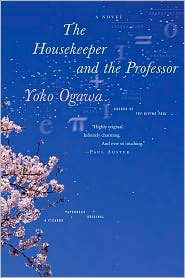
The Housekeeper and The Professor by Yoko Ogawa

The Housekeeper and The Professor by Yoko Ogawa
192 pages
Published February 2009 by Picador Books

Publisher's Summary:
He is a brilliant math Professor with a peculiar problem--ever since a traumatic head injury, he has lived with only eighty minutes of short-term memory.
She is an astute young Housekeeper, with a ten-year-old son, who is hired to care for him.
And every morning, as the Professor and the Housekeeper are introduced to each other anew, a strange and beautiful relationship blossoms between them. Though he cannot hold memories for long (his brain is like a tape that begins to erase itself every eighty minutes), the Professor’s mind is still alive with elegant equations from the past. And the numbers, in all of their articulate order, reveal a sheltering and poetic world to both the Housekeeper and her young son. The Professor is capable of discovering connections between the simplest of quantities--like the Housekeeper’s shoe size--and the universe at large, drawing their lives ever closer and more profoundly together, even as his memory slips away.

My thoughts:
I received this book from Picador so that I could participate in an online book discussion. Almost from the beginning the book starts delving into mathematics and far from being put off by this (I never really cared much for math), I found it fascinating. I kept thinking throughout the book that I might have enjoyed math much more if it had been presented to me by the Professor. The prose here is simple, the cast of characters small, the story charming. Stephen Snyder's translation from Ogawa's Japanese retains both the beauty and the Japanese flavor. I was pulled through this book in a day (okay, it is a relatively short book, but still it's an accomplishment for me). The relationship that developed between the housekeeper and the professor was so touching; the reader will so wish that they could be more to each other. The Washington Post called the book "strangely charming" and I would agree.

Care's Online Book Club (http://bkclubcare.wordpress.com/2009/06/09/review-the-housekeeper-and-the-professor/) says what's good about this book is: "The character development. The tender endearing respect between all the characters. The easy explanations of interesting* mathematical concepts. The layering and weaving together of appreciation for education and children, love of baseball, and how a work situation can foster a unique friendship." On this we agree and I think I can safely speak for both of us when I recommend you read 'The Housekeeper and The Professor." It remains one of my top five for the year.