Showing posts with label Japan. Show all posts

Sunday, March 1, 2020

Life: It Goes On - March 1

Happy, happy birthdays to our girls! We'll celebrate Miss H's 25th with a family dinner tonight. Wish Ms. S and our son could be with us so we could celebrate with her as well!

Guys, I think spring is really here - geese are flying north, we've had two great, warm weekends in a row, and the forecast is great for the next week and a half. I got up yesterday, looked at one of the trees I still had up and decided I was tired of it and all of the other winter decor so it's all down and boxed away until next winter. When I'll get around to putting anything else up on the mantle is anyone's guess!

Last Week I:

Listened To: I'm enjoying Tea Obreht's Inland but at the moment it's like listening to two different books at the same time. I'm assuming the two story lines will come together some time.

Watched: We're enjoying the new season of The Voice. It feels like they're trying to push some rock singers into play and we're hoping they get a better mix this year.

Read: I finished Simon Jimenez' The Vanished Birds and I've started Mary Doria Russell's The Women of Copper Country. Jimenez' book reminded me of how much I loved Russell's The Sparrow, so I decided it was time to pick up something else of hers.

Made: I made the best nachos the other night! Unfortunately, I have no idea how to make the right amount of anything for two people so we ate leftover nachos on soggy chips the next night. I've got to work on that! Today I'm making lasagna for the birthday dinner and a chocolate toffee cake. It has an entire cup of cocoa powder in it - have you ever heard of that much cocoa in one recipe?!

Enjoyed: Mini-him spent last Sunday afternoon here for dinner and we spent a couple of hours looking at his pictures from his trip to Japan. We had so many questions because everything is so different there! He brought us back so many souvenirs including a lot of candy. Did you know that in Japan you can get KitKat candy bars in all kinds of flavors, including matcha tea? I was pretty excited to get a tote bag from the 2020 Tokyo Olympics!


This Week I’m: 

Planning: On continuing on with 40 Bags In 40 Days which started on Wednesday. I've finished what I planned to do in the kitchen, started on my office, and The Big Guy started on his clothes. Marie Kondo he is not - the only thing he's actually finished so far is his shoes. To be fair, he does have a lot of shoes and he did get rid of 7 pair so he gets a pat on the head.

Thinking About: My niece, who's a great adventurer, has been posting a lot on Facebook recently about taking chances. So I took one. If it works out, I'll keep you posted.

Feeling: Like I need an extra day in every week for all of the things I want to do. I've got a stack of library books to read, I've got some furniture painting I'm eager to get to, and I want to do all of the spring cleaning right now.

Looking forward to: Daylight Savings Time next weekend!

Question of the week: Who else is ready to plant flowers and eat on the patio? Or are you hoping for a little more winter?


Wednesday, November 14, 2018

The Traveling Cat Chronicles by Hiro Arikawa

The Travelling Cat Chronicles by Hiro Arikawa
Published October 2018 by Penguin Publishing Group
Source: my copy courtesy of the publisher, through Netgalley, in exchange for an honest review

Publisher's Summary:
With his crooked tail--a sign of good fortune--and adventurous spirit, Nana is the perfect companion for the man who took him in as a stray. And as they travel in a silver van across Japan, with its ever-changing scenery and seasons, they will learn the true meaning of courage and gratitude, of loyalty and love.


My Thoughts: 
Normally I wouldn't review a book I haven't finished. It seems a little unfair to the book and how much can I really say about a book I haven't given a full chance to impress me. This one seems different to me, for some reason. Maybe because it's, apparently, an international bestseller that's been made into a movie. Maybe because I really am a cat lover so this one should be right in my wheelhouse. I'm not writing the review to bash the book, although I am going to tell you my problems with it. Instead I'm writing to make you aware of it. Because, even if it is an international bestseller, I'd never heard about it before. Maybe you haven't either. And maybe you're someone who really likes books with a cat for a narrator. Maybe you're a fan of books written by Japanese authors, which have been translated into English and happen to feature a cat.

What a minute! I'm a person who likes books written by a Japanese author who regularly includes cats in his books. Here's the thing, though: Haruki Murakami may have his cats talk, even; but they are not the narrators of the books. That seems to have been my biggest problem with the book. Arikawa uses Nana as a pretense to take readers from one story about Saturi and a friend of his to another. Those stories interested me; I liked the way Arikawa was able to fully develop each new character, from the time he met Saturi to his adult self. It wasn't an altogether off-putting idea to use a cat as the narrator to tie the stories together. I mean, I do always wonder what my cat's thinking. But after twenty pages or so, it started to feel a bit like a childish to me, perhaps a little to gimmicky.

It's a short book, only about 150 pages; once I was half way in, I sort of felt like I might as well finish. But I have a lot of books I want to get to by the end of the year. I began to realize that I don't have time, or the desire, to read a book I'm not thoroughly enjoying. So I set this one aside. It wasn't for me, at least not at this time. Maybe if I were looking for something that was completely different from what I'd been reading, this one might have worked better for me. Which is why I wanted to bring it to your attention; this might just be the right book for you.

Monday, January 15, 2018

Pachinko by Min Jin Lee

Pachinko by Min Jin Lee
Published February 2017 by Grand Central Publishing
Source: purchased for my Nook

Publisher's Summary:

"There could only be a few winners, and a lot of losers. And yet we played on, because we had hope that we might be the lucky ones."

In the early 1900s, teenaged Sunja, the adored daughter of a crippled fisherman, falls for a wealthy stranger at the seashore near her home in Korea. He promises her the world, but when she discovers she is pregnant—and that her lover is married—she refuses to be bought. Instead, she accepts an offer of marriage from a gentle, sickly minister passing through on his way to Japan. But her decision to abandon her home, and to reject her son's powerful father, sets off a dramatic saga that will echo down through the generations.

Pachinko is a story of love, sacrifice, ambition, and loyalty. From bustling street markets to the halls of Japan's finest universities to the pachinko parlors of the criminal underworld, Lee's complex and passionate characters—strong, stubborn women, devoted sisters and sons, fathers shaken by moral crisis—survive and thrive against the indifferent arc of history.

My Thoughts:
This was the last book I finished in 2017 and what a great finale for the year.
"Pachinko is about outsiders, minorities and the politically disenfranchised. But it is so much more besides. Each time the novel seems to find its locus—Japan's colonization of Korea, World War II as experienced in East Asia, Christianity, family, love, the changing role of women—it becomes something else. It becomes even more than it was." - New York Times, Krys Lee
I've struggled trying to describe why this book is so wonderful. This piece of Krys Lee's review for The New York Times explains why. Min Jin Lee has incorporated so much of a history I was unaware of but this is primarily a book about the members of a Korean family forced to build a life for themselves in a country that doesn't really want them and unable to return to their home. Pachinko is an unpredictable game of chance, much like the lives of Lee's characters.

Pachinko is beautifully written but difficult to read. Min Jin Lee's characters are nuanced and complex people who struggle to survive both physically and emotionally. It is both a sprawling sage, spanning seventy years, and an intimate tale. These are characters I will not soon forget: Sunja, who fights for the survival of her family and suffers terribly in so many ways; Koh Hansu, who is both a morally corrupt man and a man who loves deeply; the farmer who saves the family during WWII but who also wishes for the war to continue until he can make enough money to fulfill his grandfather's wish; Noa, Sunja's eldest son who struggles with his personal and ethnic history.

One day, I will start rereading the books that have stuck with me the longest. I have a feeling Pachinko will be one of them.

Friday, August 19, 2011

Fairy Tale Fridays - Fairy Tales Japanese Style

This was meant to be a post about fairy tale princesses but the first thing I saw (well, after I sifted through hundreds of images of Disney princesses, little girls in princess costumes and some naughty princess costume shots) was a lovely Japanese book titled "Japanese Fairy Tales: Princess Splendor." My mind immediately changed tracks. "Princess Splendor" is more widely known as The Tale of the Bamboo Cutter.

There once lived a poor, elderly bamboo cutter and his wife; their great sadness was that they were never able to have children. Every day, the bamboo cutter, Taketori no Okina, went out to cut bamboo which he brought home and fashioned into items that he sold. One day when he was in the bamboo forest, a soft light began glowing from one of the bamboo stalks. When Taketori no Okina looked closely, he discovered, in a notch in the stalk, a very tiny girl, who glowed as if light by the moon. He took the girl home and he and his wife adopted the girl as their own. Everyday after that, when the bamboo cutter went off to work, he found gold and precious gems in the bamboo stalks and he and his family were soon wealthy.

The tiny girl. Kaguya-hime, blossomed into a fully-grown young lady whose beauty soon became known throughout the land. Soon suitors began appearing at the home but the girl had no interest in marrying. Five suitors came to beg for her hand and she set them all off on impossible tasks. None of them succeeded. When the Emperor of Japan, Mikado, heard of Kaguya-hime, he came to see her, fell in love with her and asked her to marry him only to be turned down. Kaguya-hime told the Emperor that she was not of his country so could not go to his palace.

That summer, whenever the moon was full, Kaguya-hime became depressed. When her worried parents questioned Kaguya-hime about her sadness, she finally told them that she was from the Moon and must return to her people there. As the time drew near for Kaguya-hime to leave, the Emperor sent an army to protect her from the Moon people.


But when the Moon people arrived, the guards were blinded by a strange light. Kaguya-hime announced that she must return to her home, despite her love for her parents and earthly friends. She wrote her parents and the Emperor a sad apology for leaving, gave her parents her own robe as a memento and entrusted the elixir of life to a guard to take to the Emperor. When a feather robe was placed on her shoulder, all of Kaguya-hime's sadness was forgotten and the heavenly group left for the Moon.

When he received the elixir, the Emperor said that he didn't want to live forever without Kaguya-hime.  He sent a guard to the top of the mountain closest to the heavens to burn his message to her, along with the elixir of life, hoping that his message would reach her. Legend tells that the Japanese word for immortality became the name of the mountain...Mount Fuji.

The Tale of the Bamboo Cutter is still widely told today and has been adapted in many forms. It seems hard for me to believe that it wasn't an inspiration for Hans Christian Anderson's Thumbelina. It has been made into a film and an opera and both Sesame Street and Hello Kitty have included the story in special episodes. For manga fans, you may be familiar with the idea of Moon people from the book/television series Sailor Moon.

Once again, in looking into fairy tales, I've come across something new to me that has only piqued my interest in learning more. More Japanese fairy tales to come!

Wednesday, July 15, 2009

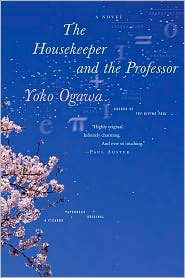
The Housekeeper and The Professor by Yoko Ogawa

The Housekeeper and The Professor by Yoko Ogawa
192 pages
Published February 2009 by Picador Books

Publisher's Summary:
He is a brilliant math Professor with a peculiar problem--ever since a traumatic head injury, he has lived with only eighty minutes of short-term memory.
She is an astute young Housekeeper, with a ten-year-old son, who is hired to care for him.
And every morning, as the Professor and the Housekeeper are introduced to each other anew, a strange and beautiful relationship blossoms between them. Though he cannot hold memories for long (his brain is like a tape that begins to erase itself every eighty minutes), the Professor’s mind is still alive with elegant equations from the past. And the numbers, in all of their articulate order, reveal a sheltering and poetic world to both the Housekeeper and her young son. The Professor is capable of discovering connections between the simplest of quantities--like the Housekeeper’s shoe size--and the universe at large, drawing their lives ever closer and more profoundly together, even as his memory slips away.

My thoughts:
I received this book from Picador so that I could participate in an online book discussion. Almost from the beginning the book starts delving into mathematics and far from being put off by this (I never really cared much for math), I found it fascinating. I kept thinking throughout the book that I might have enjoyed math much more if it had been presented to me by the Professor. The prose here is simple, the cast of characters small, the story charming. Stephen Snyder's translation from Ogawa's Japanese retains both the beauty and the Japanese flavor. I was pulled through this book in a day (okay, it is a relatively short book, but still it's an accomplishment for me). The relationship that developed between the housekeeper and the professor was so touching; the reader will so wish that they could be more to each other. The Washington Post called the book "strangely charming" and I would agree.

Care's Online Book Club (http://bkclubcare.wordpress.com/2009/06/09/review-the-housekeeper-and-the-professor/) says what's good about this book is: "The character development. The tender endearing respect between all the characters. The easy explanations of interesting* mathematical concepts. The layering and weaving together of appreciation for education and children, love of baseball, and how a work situation can foster a unique friendship." On this we agree and I think I can safely speak for both of us when I recommend you read 'The Housekeeper and The Professor." It remains one of my top five for the year.

Thursday, July 9, 2009

The Street of a Thousand Blossoms by Gail Tsukiyama

The Street of A Thousand Blossoms by Gail Tsukiyama
448 pages
Published August 2008 by St Martin's Press

In 1939 Japan, two orphans are being raised by their grandparents. Hiroshi shows early promise as a sumo wrestler. Kenji has discovered the art of making masks for the Noh theater.
But when Japan draws the U.S. into war, the boys' dreams must be put on hold. Meanwhile, the young daughters of a great sumo teacher are also suffering through the war. After the war, the lives of the girls and the young men become intertwined with the young men's lives when Hiroshi is chosen to begin training as a sumo. The story follows these young people for nearly thirty years as the young men pursue their dreams in very traditional fields as their country moves into the future. Along the way we also get to know their grandparents, Kenji's sensei, and the girls' father.

Although the novel is epic in time span, Tsukiyama tells the tale in small stories. Her prose is simple and she recreates a vivid portrait of Japan as it struggled to recover from World War II. The New York Times called the book tense, but I never really felt that Tsukiyama achieved a sense of tension; I saw pretty much everything coming before it happened. I learned a lot about sumo wrestling and Noh mask making but I felt like Tsukiyama gave a little too much attention to these things at times. None of the sumo matches felt any different from the others and I was never in doubt as to the outcome. Some of the peripheral characters got a lot of attention (Kenji's sensei, for example); this sometimes took away from the main stories. For all that was going on in the book, this was a slow read; and at over 400 pages, I really had to push myself to get through it. Once again, I felt like the book could have been shorter and not lost a thing.

Lisa, at Breaking the Fourth Wall, seemed to feel about the same way as I did on this one. Here's her review:
http://breakingfourth.blogspot.com/2009/03/book-review-street-of-thousand-blossoms.html.