Showing posts with label children's fiction. Show all posts

Thursday, February 20, 2025

The Wizard of Oz by L. Frank Baum

The Wizard of Oz
by L. Frank Baum
173 pages
Published 1900 

Summary: 
It is the first novel in the Oz series of books. A Kansas farm girl named Dorothy ends up in the magical Land of Oz after she and her pet dog Toto are swept away from their home by a cyclone. Upon her arrival in the magical world of Oz, she learns she cannot return home until she has destroyed the Wicked Witch of the West.

My Thoughts: 
I picked The Wizard of Oz as my book club's 2025 classic book because of all of the hype about Wicked, which is, of course, based on the book of the same name by Gregory Macguire and serves as something of a prequel to The Wizard of Oz. I used to read an abridged edition of the book to my daughter when she was growing up (it was one of her favorite books), but it's been a very long time since I read the full story (probably around the time I was 9, after having watched the movie on television one evening. Between the abridged version, the decades since I'd read the original, and the movie adaptation, I'd forgotten a lot about this book. 


Number one, they were silver slippers, not ruby. They never saw the Wicked Witch of the West until they were taken to her castle. Glinda didn't appear until the end of the book. And there was almost no buildup before the tornado - no farm hands, no Professor Marvel, and no Almira Gulch and her threats against Toto. But there were a lot more adventures on the way to the Emerald City, including a journey through a land entirely made of china, great ravines and rivers to cross, and new enemies and friends along the way. 
But I was delighted to find that much of the dialogue in the movie came straight from the book, particularly when the friends were with the Wizard. I found myself wishing that I'd found a copy of the full book to read to my daughter instead of the abridged edition. 

Something I hadn't realized when I'd read the book so very long ago was that, while it was written to appeal to children, it was heavily political. The silver slippers, for example, were a metaphor for the silver standard which was being replaced by the gold standard (the fiduciary backing metal); the yellow brick road symbolizes the dangerous path the gold standard placed the United States upon. The green of the Emerald City represented the color of paper money. The Emerald City itself represents Washington D.c. Each of the characters, from Dorothy to the Wicked Witches represents a class of people (or, in the case of the Cowardly Lion, one specific three-time presidential candidate from Nebraska, William Jennings Bryan). 

I learned all of this after having finished the book then wished I had time to reread it before my book club meeting, knowing what I know now. If you ever find yourself contemplating a reread of this classic, I highly recommend learning more before you go into it - it will give the book so much more depth. I did enjoy it without that knowledge, but I would have enjoyed it more had I learned more first. 


Thursday, September 12, 2019

Lit: Uniquely Portable Magic

In this week's episode of "Let's Clean Up Lisa's Bookish-Related Facebook Saves," I'm looking at books about children. I wasn't sure why I, who have only adult children, would have saved posts about books for little people. But as soon as I started looking at the lists, I remembered how much joy children's books have bought me over the years. And now I want start rereading the children's books that I've been saving.

Gretchen Rubin, who is a huge fan of children's literature, shared a list of her 81 favorite children's and young adult books. The list only includes one book by any given author so only James And The Giant Peach by Roald Dahl, The Fault In Our Stars by John Green, and The Lion, The Witch, and The Wardrobe by C. S. Lewis. Most of my favorites are on this list, as are many of my kids' favorites. There are also a lot of books on this list that I've never even heard of!

From Romper comes a list of 19 Obscure Children's Books Your Child Should Have On Their Shelf. Again, there are a couple of books here that I've never heard of but I'm pretty excited to see All Of A Kind Family, Pippi Longstockings In The South Seas, and Chitty, Chitty, Bang, Bang on this list.

Some of the same books that appeared on these lists also appear on The New York Public Library's 100 Great Children's Books|100 Years. If you're invited to a book shower or a children's birthday party, you can't go wrong with buying any of the books on this list. You've got to figure that this list includes books that have been popular with children at the library for decades. I've chosen to show you Crockett Johnson's Harold and the Purple Crayon which was one of my son's favorite books when he was little and which I credit for providing him early encouragement for his creative mind.

After looking at these lists, is there anything missing that you would include?

Wednesday, April 13, 2016

A Little Princess by Frances Hodgson Burnett

A Little Princess by Frances Hodgson Burnett
Illustrated by Tasha Tudor
Originally published in 1905
Source: our copy belongs to Miss H

Summary:
Set in 19th century London, a little girl goes from riches to rags and back again. Sara Crewe is delivered by her wealthy, doting father to a boarding school for young ladies in London. Raised in tropical India, she finds London a strange place. And Miss Minchin, the owner of the school, is cold and meanspirited. Sara, who is kindhearted and intelligent as well as fabulously wealthy, quickly becomes the reigning "princess" of the school. When her father suddenly dies penniless back in India, Miss Minchin forces her to work as a servant. Despite being treated cruelly, Sara retains her dignity and her kind ways, showing herself to be a true princess.


My Thoughts:
This isn't the first time I've talked about this book, it was one of my favorite books as a young girl and it will always hold a special place in my heart. In fact, when Miss H was born, it was one of the first books we gave her because she was, after all, our very own princess the minute she arrived. 

I read it to her when she was a little girl but then the movie came along and the details of the book got lost in the details of the movie adaptation that came out the same year she was born. It really is a wonderful movie but, as movies do, it left out some things that were important in the book while shifting the focus to other things. Seriously, if you have a little girl, watch it. But read the book, too. 

When I was making my list for the Classics Club Challenge in 2012, I included A Little Princess because I wanted to reacquaint myself with the details of the book I grew up loving. You know what? I still love it. I love the story, I love the writing, and I love Sara Crewe. Most of all, I love the lessons it teaches young girls - it's okay to be smart, attitude is everything, dreams make life better, be grateful for what you have, and, above all, always behave as if you are a princess. Not in an entitled, everyone-should-do-what-I-want way. For Sara, being a princess means being proud not haughty, being at all times civil, being polite not rude or malicious no matter what those around you do or say. Sara never let her circumstances drag her down to the level of those who would belittle or demean her and she never forgot that there were others who were worse off than she was. 

Wednesday, December 8, 2010

Alice's Adventures In Wonderland by Lewis Carroll

Alice's Adventures In Wonderland by Lewis Carroll
First published in 1865
Source: bought for my daughter who loves the Disney movie

When Alice follows a white rabbit with a pocket watch into a hole, she finds herself in Wonderland, a land where she frequently finds herself growing and shrinking and meets one of the strangest assortment of characters ever to grace the pages of literature, including the Cheshire Cat, a hookah-smoking caterpillar, The Mad Hatter and the Queen of Hearts.

Not long after she arrives in Wonderland, Alice begins to think that she may no longer be who she thinks she is, what with the changing sizes, her memory lapses, and all of the strange things she's seeing.  But she never really does lose herself, always retaining her common sense and feeling of fairness.

Of course the book is full of nonsense, which is much of what makes it so appealing to children.  But it's full of the kinds of humor that equally amusing for adults.  In one chapter, Alice and a group of animals have had to swim and are looking for something to dry themselves.  A mouse ("a person of some authority") began to tell the group the "dryest" thing he knows, which turns out to be a story of early English political history.  The Duchess is constantly trying to make a moral of everything.  Great long passages are plays on how the English language can be misunderstood and misused.
""Then you should say what you mean," the March Hare went on.
"I do," Alice hastily replied: "at least - at least I mean what I say - that's the same thing you know."
"Not the same thing a bit!" said the Hatter. "Why, you might just as well say that 'I see what I eat' is the same thing as 'I eat what I see!"
"You might just as well say," added the March Hare, "that 'I like what I get' is the same thing as 'I get what I like!""
Alice's Adventures In Wonderland was originally a story told by Charles Dodgson (a.k.a. Lewis Carroll) told to ten-year-old Alice Lidell and her sisters on a boat ride in 1862.  Alice asked Dodgson to write the story down which he finally did three years later, complete with his own drawings.  When the book was published, however, it included the drawing of John Tenniel.

I generally include what I didn't like or didn't think worked in a book when I do a review but I must admit that I can't think of a single thing I didn't enjoy in this story.  I was enchanted by Carroll's clever writing and amusing characters and absolutely adored Tenniel's drawings.  If you have not read this book, it can be had for free in several places on the internet.  But if you have children, I highly recommend picking up a copy to read to them; it will be a book they will want to read again and again.  No wonder my daughter loves this story so much!  I can't wait to read Through The Looking Glass And What Alice Found There, Carroll's follow up to Alice's Adventures in Wonderland.

Thursday, December 2, 2010

Pierre: A Cautionary Tale In Five Chapters And A Prologue and Where The Wild Things Are by Maurice Sendak

Pierre: A Cautionary Tale In Five Chapters And A Prologue by Maurice Sendak
Originally published in 1962
Source: we own it

"Pierre" is the story of young Pierre who refuses to do anything his parents tell  tell him to do and never says anything more than "I don't care."  It's just that attitude that gets him into trouble when he meets a lion.  As he always does, Sendak blends dark (Pierre is eaten by the lion) with light and his poetry with his delightful artwork, all combined to teach the reader a moral.

Where The Wild Things Are by Maurice Sendak
First Published in 1963
Source: a gift for my son when he was born

One night Max puts on his wolf suit a creates mischief of one kind and another, earning a trip to his room without supper.  While there Max forest grows in Max's room and a private boat comes by and takes Max away to where the wild things are.  Max soon tames the wild things and becomes their king but after a time he is forced to send them off to bed without their supper and decides he wants to be "where someone loved him best of all."

My favorite part of our copy of this book is the inscription our friend wrote in it when they gave it to my son:
"Always remember..., even when you are a "Wild Thing" you can always go back to be where someone loves you best of all."
It's a simply story with a wonderful lesson and I'm so happy that our friend made it a personal message, one all children need to know.

I re-read both of these books for the "You've Got Mail" Challenge.

Tuesday, November 30, 2010

The "Madeline" Books by Ludwig Bemelmans

Madeline, Madeline's Rescue, Madeline and the Bad Hat, Madeline and the Gypsies, and Madeline in America and Other Holiday Tales by Ludwig Bemelmans

The original "Madeline" was first published in 1939
Source: All five books purchased for my daughter

"In an old house in Paris that was covered with vines, lived twelve little girls in two straight lines."

So begins the book Madeline, the first in a series of books written first by Ludwig Bemelmans and more recently by his grandson John Bemelmans Mariano. The books are charming for their poetry, lovely drawings but most of all for the plucy little Madeline, "the smallest of all."  The girls are shepherded by Miss Clavel and enjoy great adventures throughout Paris but the biggest excitement of the book was Madeline's appendicitis attack.

Madeline's Rescue is the story of what happens when Madeline is rescued from the Seine River by a dog and won the Caldecott Medal in 1954.  In Madeline and the Bad Hat readers are introduced to Pepito, the son of the Spanish Ambassador who moves into the house next door to the girls.  Madeline and Pepito head off for great adventures in Madeline and the Gypsies.  "Madeline in America" is a collection of stories that include stories started by Bemelmans but finished by Marciano.  It also includes a lovely story about Christmas with Bemelmans written by his daughter.

I read the books as part of the "You've Got Mail" Challenge.  In that movie, Meg Ryan played a character that owned a children's book store.  All of the books/authors for the challenge were shown or mentioned in the movie.  It was a pleasure to revisit "Madeline;" I just may have to rewatch the movie, starring Frances McDormand as well!

Thursday, November 18, 2010

Two Childhood Favorites: Stuart Little and The Outsiders

"Stuart Little" by E. B. White
Originally published in 1945
Source: Bought this copy for my children

Stuart Little is the son of Mr. and Mrs. Frederick C. Little.  To say that he was a surprise at his birth would be an understatement;  he was not much bigger than a mouse...in fact, he looked very much like a mouse.  Although Stuart's size presents some problems and even some frights, the Littles love Stuart.  But when Stuart's friend, a bird names Margalo, flies away from the Little home, Stuart sets off on a grand adventure to find her. 

I read this book when I was young and read it again to my own children but I honestly did not remember that much about it, other than the basic premise.  This was White's first novel and the publisher's were concerned that children might not accept a story about a mouse-child or without a clear cut ending.  Clearly, they did.  White has created in Stuart a character that children can relate to - sure they aren't as small as a mouse but they are much smaller than all of the adults they are surrounded by.  I found Stuart Little to be simply charming.
"In the loveliest town of all, where the houses were white and high and the elm trees were green and higher than the houses, where the front yeards were wide and pleasant and the back yards were bushy and worth finding out about, wher ethe streets sloped down to the stream and the stream flowed quietly under the bridge, where the lawns ended in orchards and the orchards ended in fields and the fields ended in pastures and the pastures climbed the hill and disappeared over the top toward the wonderful wide sky, in this loveliest of all towns Stuart stopped to get a drink of sarsapilla."
Garth William's pen drawings in this book are lovely; I liked them so much better than his drawings in Charlotte's Web.  In this book, they really aided in telling the story.  If your children haven't read this one, please encourage them to do so.  It is so much better than the movie adaptation.


"The Outsiders" by S. E. Hinton
Originally published in 1967
Source: I bought this copy for my children

Life is tough for Ponyboy Curtis.  His parents died in a car accident several months earlier and his two older brothers are working hard to make sure the family can stay together.  But keeping Ponyboy, and themselves, out of trouble is no easy feat.  The Curtis boys are "greasers," a label that Ponyboy struggles with.  When the Socs, the rich kids from across town who are the greasers rivals, use the word, there's no doubt that it's intended as an insult.  Yet Ponyboy is proud of the people he calls friends and just fine with the style of their hair and they clothes they wear.  One night Ponyboy, his friend Johnny, the group's "pet," and Dallas (Dally), the meanest one in the group, sneak into the drive-in.  When they meet up with a couple of girls from the Socs it sets in motion a string of events that will forever change all of their lives.

S.E. Hinton started writing this book when she was only fifteen years old, something that is hard to believe except for the fact that it may account for the reason the book so captures the voice of her generation so well.  In The Outsiders Hinton brought to young people a voice that they had never had before.  The book is startlingly realistic and violent but also finds Ponyboy seeing the good in everyone.  Hinton does not make any "if we could just talk, everything would be fine" promises.  But she certainly tried to leave young people with the message that even though there are some barriers that might not be able to be crossed, trying to a least understand the other side might just make the barriers easier to live with.
"It seemed funny to me that the sunset she saw from her patio and the one I saw from the back steps was the same one.  Maybe the two different worlds we lived in weren't so different.  We saw the same sunset."
When you were all reading Judy Blume, I was reading S. E. Hinton.  With all of the talk about Blume I see on blogs, I sometimes have wondered if I made a mistake.  Perhaps I should have read some Blume.  But on re-reading The Outsiders I still think I made a great choice.

Wednesday, November 3, 2010

Charlotte's Web by E. B. White

Charlotte's Web by E.B. White
Originally published in 1952 by Harper & Row Publishers

Wilbur, the runt of the litter, is a pig saved and raised by a girl named Fern.  When Wilbur gets too big to live with Fern, he moves to her uncle's farm where he lives in a barn, surrounded by geese, sheep, a rat and a new friend, Charlotte, the spider. Although Fern saved Wilbur when he was first born, she's powerless to save him now that he's gotten bigger and it looks like he just might make a tasty ham for Christmas.  But his friendship with Charlotte saves him when the people wake up one morning to find, written in Charlotte's web, the words "Some Pig" above Wilbur's head.  People come from far and wide to see the amazing pig and, in the end, Charlotte's friendship saves Wilbur's life.

I read this when I was young, I read it to my children when they were young.  I've seen the movie dozens of times. So why did I read it again?  Because it works for a couple of the reading challenges I signed up for and it made for a fast read.  I didn't really expect to get anything new from the book after all of this time, just a bit of nostalgic happiness.

Yet as I read this book this time, I was amazed that I had never fully grasped the violence in this book.  How in the world did I not notice that when I was reading this to my kids?  White absolutely pulls no punches just because the book is for children.  It starts right off with Fern's father heading out the door with an ax to kill Wilbur.  Then there's the description of a spider ensnaring a fly.  And the part where a sheep describes to Wilbur how the farmer, Zuckerman, is going to kill him.  This is a beloved children's classic; what does that say about our need to sanitize books for our children these days?  The message I'm getting is that children are perfectly capable of understanding that the world can be a dangerous place, as long as the core message of the book is that everything will be alright when you are surrounded by people who care.

I was also surprised by a passage about the fair.  Given that this book was first published in the early 1950's, a time we tend now to think of as a kindler, gentler, safer time, I was surprise to find myself reading about parents being concerned about sending their children off at the fair without an adult.  I'll grant you that it would not even have crossed my mind to send a ten-year-old off unsupervised at a fair when my kids were growing up but in my mind, it would have seemed perfectly logical to have done so in 1952.

The burning question for me, after reading the book, is this: why does everyone think that Wilbur is so special?  Why in the world do they all find it so much easier to believe that a pig wrote those words in a spider's web than to imagine that a spider did?

Wednesday, August 4, 2010

Anne of Green Gable by Lucy Maud Montgomery

Anne of Green Gables by Lucy Maud Montgomery
Originally published in 1908
Source: I listened to the Librivox recording

Brother and sister Marilla and Matthew Cuthburt live and farm at Green Gables, in the village of Avonlea on the Prince Albert Island in Canada. When they decide to adopt a boy from an orphanage to help on the farm, they get instead Anne Shirley, a precious eleven year old girl. Marilla is more than ready to send her back immediately but Matthew is charmed and soon Anne finds herself a part of life on the farm. For her part, beyond being thrilled with the idea that she will finally have a home, Anne is overwhelmed immediately by a love of the natural setting of Green Gables. By the time Marilla gets a chance to find Anne another home, she has made the decision to keep Anne. A decision she will question again and again as Anne fumbles and stumbles her way through life. Because Anne is so prone to daydreaming, she is also prone to making careless mistakes. But she is also enthusiastic, loving and tries so hard to improve. The reader follows Anne through her life in Avonlea, her friendships (she is always looking for kindred spirits), and on through her days in high school where she excels.

My book club reads a "classic" every year and this year we choose "Anne of Green Gables." One of our members is a playwright who incorporated several classic girl's books into a play that some of us heard a reading of which prompted us to revisit our childhood. Of the five books incorporated into the play, this was the only one I had never read and I was eager to see what makes it so beloved. When I finished, I was still wondering.

I found the book excessively wordy, although Montgomery does a lovely job of describing nature. I quickly grew tired of Anne's daydreams and found much of the book repetitive. Further, I found it odd that Montgomery spent whole chapters discussing some situations then, as the book neared the end, condensed entire school years into a single chapter.

I did like the juxtaposition of Anne, who is all imagination, and Marilla, who is no nonsense and watching them gradually grow on each other. Although it often annoyed me how hard Marilla was on Anne even after she has warmed to her. But then I also felt sorry for Marilla when Anne would proclaim how fond she was of other people without ever really showing any fondness for Marilla.

The book is clearly of the time that it was written. On the other hand, young people today are every bit as concerned as Anne was about their appearance and having the right clothes. At one point, a couple gets married in a home because no one gets married in a church--and don't people still worry all of the time about what other people will think of them?

When I got to my book club meeting last month, I found that I wasn't the only one that was unimpressed with this book and when our playwright, who loves the book, arrived, we were quick to ask "why?" Her defense did make some of us reconsider the book. One of the things that still appeals to her about this book is that it does not preach, as do almost all other books written for children in this time period. True enough--it does not. And she loves the way Marilla allows Anne to make her mistakes and learn from them, a way of childrearing that was unheard of at the time but a way that most experts now recommend.

So, I'm left wondering...if I had read this book as a child, would I love it?

Tuesday, April 13, 2010

Eloise by Kay Thompson

Eloise by Kay Thompson, illustrated by Hilary Knight
61 pages
Published April 1969 by Simon and Schuster's Childrens
Source: my daughter

I feel a little bit like I cheated reading this for the read-a-thon but it counts for the You've Got Mail Challenge and I needed a quick read to sandwich in between other books during the read-a-thon.

Eloise is a six-year-old who lives in The Plaza hotel with Nanny; her dog that looks like a cat, Weenie, and her turtle, Skipperdee. To say that Eloise is a handful is an understatement. Eloise loves, loves, loves to ride the elevators and order room service. She simply cawn't, cawn't, cawn't go a day without adjusting the hotel's thermostats, or pulling out the fire houses, or opening all of the packages in the Package Room in search of one that might be for her. If she were you child, you'd be pulling your hair out. But since she's not, she's adorable.

Thompson captures the voice of a precocious six-year-old marvelously. Eloise skidders sticks along the wall, slomps in her skates and skibbles out of bed in the morning. As wonderful as the writing is, I can't imagine that Eloise would have been quite the success that it's been without Knight's drawings. We've got several of the Eloise books--they're on the shelf of books that I just have to keep in the hopes that someday I'll be able to snuggle up with a grand-daughter and Eloise.

Wednesday, March 10, 2010

James and the Giant Peach by Roald Dahl

James and the Giant Peach by Roald Dahl
119 pages
Copyright 1961 by Alfred A. Knopf
Source: Christmas gift 1969 from my aunt

Poor James was leading a perfectly fine life until one day his parents went to London where they were eaten by a rhinoceros who had escaped from the zoo. From then on he is sent to live in the middle of nowhere with his Aunt Spiker and Aunt Sponge--two exceedingly nasty spinsters who treat James as if he were their slave and don't allow him to leave their hill. Then one day a strange man approaches James at the fence with a bag full of mystery green things and tell him to eat them and they will make his life better. As James' luck would have it, he falls as he goes back up the hill, dropped the bag, and watching sadly as all of the green things disappear into the earth. All is not lost, however. Those little green creatures work their magic on an old peach tree that hasn't produced fruit in years. Soon there begins to grow a single peach that grows and grows until it is so enormous that the aunts are selling opportunities to see it. After the crowds leave, as James is being forced to clean up the mess the crowds have left, he discovers a hole in the peach and follows the tunnel that it is the opening to, only to discover a room in the center, filled with an assortment of insects and bugs that are now as big as he is, thanks to the same magic that grew the peach. One of them, the centipede, goes to work on chewing the peach loose from the tree and soon the group finds themselves bouncing down the hill, landing in the ocean and beginning a great adventure.

Only Roald Dahl can write a book where, in the second paragraph no less, he kills off both parents by having them eaten by a rhinoceros and still call it a children's book! All of his books feature some sort of horrible thing happening to the hero or heroine, all of them include some threat of danger and all of them include some kind of fantastical, magical thing. If they were written today, people would probably rail against them for being too violent for children. Fortunately, they were written years ago, when they could teach the lesson that even the smallest of us can survive and flourish despite the most terrible of odds. On re-reading this book, I'm convinced that Lemony Snicket, of A Series of Unfortunate Events, was heavily influenced by Dahl. I'm sure he wasn't the only one.

The book is also filled with wonderful poems and plenty to keep even an adult entertained. If you have young children, I recommend you read this one with them! I re-read this one as part of a couple of challenges and I found myself reading great passages of it to my 18-year-old who was equally amused.

Friday, March 5, 2010

Friday Favorite - March 5

The Trumpet of the Swan, by E. B. White, is the book that made Mini-me fall in love with books. It's not that he didn't like to read before then; he loved to have me crawl into bed with him and read as many books as I was willing to read. When he was in first grade, we bought a booked set of E. B. White books. I started with Charlotte's Web, then moved on to Stuart Little but put The Trumpet of the Swan off because it was the only one I hadn't read. Frankly, I didn't know anyone who had read it. But Mini-me was hooked almost from the start. When we were almost finished, he asked me not to read it one night. Confused, because he was enjoying it so much, I asked him why. "Because I don't want it to end," he told me. When we did finish it, he was so quiet and sad. "Can we start it again?" he asked. And that's when I knew I had a reader on my hands. Not just a kid that would read. But a kid that would love to read. A true mini-me!


Like the rest of his family, Louis is a trumpeter swan. But unlike his four brothers and sisters, Louis can't trumpet joyfully. In fact, he can't even make a sound. And since he can't trumpet his love, the beautiful swan Serena pays absolutely no attention to him.
Louis tries everything he can think of to win Serena's affection--he even goes to school to learn to read and write. But nothing seems to work. Then his father steals him a real brass trumpet. Is a musical instrument the key to winning Louis his love?

Friday, November 13, 2009

Friday Favorites - "A Little Princess"

Okay, I'm back to picking a book for my Friday Favorite that's been made into a movie. I cannot remember the first time I read FrancesHodgson Burnett's "A Little Princess" but I couldn't have been more than ten. I must have checked it out from the library because I didn't own it until my daughter was born. If I had ever owned it, I would have kept it, just as I did Louisa May Alcott's Little Women and Little Men; Heidi; and The Five Little Peppers And How They Grew. Even as a kid, I loved the classics!

Sara Crewe is delivered by her wealthy father to a new boarding school while he goes off to war. But when he dies, Sara finds herself penniless and at the mercy of the horrible Mrs. Minchin. Despite being made to become a maid and to live in the attic, Sara never losses her optimism and kindness. Even though Sara is no longer a "princess" in the school, she never stops being a real princess. She remains a favorite of most of the girls and attracts the attention of a mysterious benefactor. I love the lessons this book teaches: kindness is rewarded, it is better to be a good human being than rich, imagination is a wonderful thing and every little girl is somebody's princess.

The book was made into a movie in 1995. It's cast is largely unknown and the budget was tight but the movie was a beautiful realization of the book. My daughter and I love to rewatch this together every few months. I recommend it every bit as highly as I recommend the book!

Saturday, October 31, 2009

Friday Favorites - "The Little Old Lady Who Was Not Afraid of Anything"

I know, I know--it's not Friday. But I had to wait to post this until Halloween and now Halloween is minutes from over and I almost missed it. I don't even have little children to get into costumes and out into the neighborhood to use as an excuse for my lateness.


My pick this week is Linda Williams' The Little Old Lady Who Was Not Afraid Of Anything. My mom first found this book for my niece when she was very little. She loved it so much that a copy soon made it to my house. It is simply charming. At two years old, this was my son's favorite book. We made it interactive. The little old lady, out on a walk is confronted by a series of clothing items. Each makes a "sound" (although shake, shake is not really a sound). When we started reading the book, I did the "sounds" myself but soon my son was joining in the fun and I would let him read the sound words. By the time he was three, he could "read' this book himself. Although beloved by all three of my children, it was my oldest who truly loved this book. Tonight my fourteen-year-old and I read it together!

Beyond the fun factor, the book has a wonder message about being brave and facing fears. It teaches children that sometimes things aren't as scary as we might think they are. My copy is falling apart. But it will continue to be a part of Halloween for years to come.

Wednesday, September 16, 2009

Nostalgic For Children's Books


All this talk of books plus the start of fall is making me nostalgic. I'm missing the days when my kids used to crawl up in my lap to read. I'm missing the days when book order forms came home from the school and it was not uncommon for me to spend $50 on new books for the kids. It's been long enough now that I'm even missing the books that were read so often I didn't even need to look at the words any more. We liked to take our favorite books and use them for projects--right down to once mixing paint colors with our foot just like the mice in "Mouse Paint!" I always knew I could count on any book written or illustrated by Eric Carle, Ellen Stoll Walsh, Bill Martin Jr. and Lois Ehlert. One of the most beloved book in my house when my children were very little was "The Little Old Lady Who Was Not Afraid of Anything" by Linda Williams, illustrated by Megan Lloyd. Even as toddlers, my kids liked to act it out. With Halloween creeping up on us, I think it's time to bring this one back out for old time sake!


Todays post for BBAW is a meme about books. I think I pretty much covered these questions here a while back. Let's just say that I treat my books pretty carefully these days; must better than I used to when I was more prone to think of paperbacks as disposable.
To get the book cover pics for the recommendations, I went to the site for Scholastic Books and was excited to see that their bloggers are also participating in BBAW! Here are their responses to todays meme.

Friday, July 10, 2009

Friday Favorite

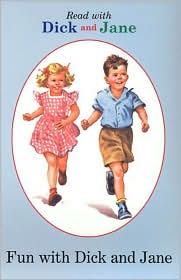
I'm really stepping back down memory lane this week with my Friday Favorite, actually favorites. I know I can't be the only person that has fond memories of the Dick and Jane series of books which taught children to read for over forty years. In fact, there are so many people that learned to read with Dick, Jane, their sister Sally, Father, Mother, and their dog Spot, that a number of publishers have republished some of the books.

In 1996, Harper Collins published "Growing up with Dick and Jane: Learning and Living the American Dream." Barnes & Noble's site says: "Here's your chance to step back into the innocent watercolor world of Dick and Jane, where night never comes, knees never scrape, parents never yell and the fun never stops. And side by side with the story of Dick and Jane is an entertaining and informative text that tracks important historical, social and educational events of the "Dick and Jane era." I love the way this book took me back to my childhood when life was almost as carefree as it always was for Dick and Jane.

Sunday, June 7, 2009

Sunday Salon - June 7


Yesterday I had the great pleasure of having lunch with my cousin, her friend, my cousin's daughter and my own daughter at the art museum. It was happenstance that we happened to be there when admission was free (yah!) but more importantly, when the museum was hosting an exhibit dedicated to the artwork from Golden Books, the books so many of us grew up on.

I had always thought of the artwork in these books as being of one type, but this exhibit proved that my memory was quite faulty. Among the illustrators shown were Richard Scarry and Hilary Knight (who provides the illustrations for the "Eloise" series of books). Many of the illustrations displayed are from books I still have in my possession and took me back to my earliest recollections of reading. Do you remember reading "Chicken Little," "The Little Red Hen," or "The Pokey Little Puppy?"

On Sunday 4/5 of my family headed off to headed off to enjoy lunch with my parents and usher at their community playhouse's production of "The Producers." They have very good talent in their city and the production was just wonderful. Sadly, like so many theaters, financially times are tough. The next time you're thinking of going out for the evening, why not forgo the movie multiplex and support one of your local theaters?