Showing posts with label young adult fiction. Show all posts

Wednesday, November 25, 2020

Before The Ever After by Jacqueline Woodson

Before The Ever After
by Jacqueline Woodson
Read by Guy Lockard
Published September 2020 by Nancy Paulsen Books
Source: audiobook checked out from my local library

Publisher's Summary:
For as long as ZJ can remember, his dad has been everyone's hero. As a charming, talented pro football star, he's as beloved to the neighborhood kids he plays with as he is to his millions of adoring sports fans. But lately life at ZJ's house is anything but charming. His dad is having trouble remembering things and seems to be angry all the time. ZJ's mom explains it's because of all the head injuries his dad sustained during his career. ZJ can understand that--but it doesn't make the sting any less real when his own father forgets his name. As ZJ contemplates his new reality, he has to figure out how to hold on tight to family traditions and recollections of the glory days, all the while wondering what their past amounts to if his father can't remember it. And most importantly, can those happy feelings ever be reclaimed when they are all so busy aching for the past?

My Thoughts:
I didn't even look at the summary before I requested this book from my library. I only needed to know that Woodson had written it to know that it would be a book worth reading. 

You will have noticed that I read very few young adult books. It's not that the young adult books I've read haven't been good; they have for the most part. But, for some reason, they almost always feel like books written by an adult trying to write as a young person (which, of course, they are). Woodson manages, though, to write in the voice of a young adult while also writing beautifully lyrical novels. 

Before The Ever After is no exception; in fact, it is written almost entirely in verse. In reviews of Woodson's books (including mine), you will invariably see the word "spare." She is a master of saying so much with so little. Here in just over 170 pages, she gives us a unique father-son story that begins with a family on top of the world to a family facing an unknown, frightening future. ZJ's identity is wrapped up in being the son of "Zachariah 44" Johnson, football star. So when his father can no longer play football, ZJ wonders who he will be. 

Woodson sets her story just at the time that chronic traumatic encephalopathy is being diagnosed in football players. This book is a tough reminder for people like me, who are huge football fans, that it is a dangerous game that takes a huge toll on the players. It's not that I wasn't aware that that it's a toll that is also suffered by those players' families; but reading about it from the point of view of a young son who is losing not only his father but also one of his best friends, has me, once again, seriously thinking about whether or not I can keep supporting the sport. It's hard to imagine being a twelve-year-old who is watching his father disappear along with so many people the family has considered friends. It's hard to read about it, even when it's told beautifully. 

Monday, November 5, 2018

The Hate U Give by Angie Thomas

The Hate U Give by Angie Thomas
Read by Bahni Turpin
Published February 2017 by HarperCollins Publishers
Source: my audiobook checked out from my local library

Publisher's Summary:
Sixteen-year-old Starr Carter moves between two worlds: the poor neighborhood where she lives and the fancy suburban prep school she attends. The uneasy balance between these worlds is shattered when Starr witnesses the fatal shooting of her childhood best friend Khalil at the hands of a police officer. Khalil was unarmed.

Soon afterward, his death is a national headline. Some are calling him a thug, maybe even a drug dealer and a gangbanger. Protesters are taking to the streets in Khalil’s name. Some cops and the local drug lord try to intimidate Starr and her family. What everyone wants to know is: what really went down that night? And the only person alive who can answer that is Starr.

But what Starr does—or does not—say could upend her community. It could also endanger her life.


My Thoughts:
I started listening to this book and then saw the movie before I was able to finish the book. That made it tough not to spend the last half of the book comparing it to the movie: "This isn't the way they did it in the movie," "This seems more realistic than this scene did in the movie," "Wait! This character wasn't even in the movie - but they did do a good job in the movie of working in the important parts of his story." Honestly, I think both the movie and the book suffered for my having seen the movie in the middle of listening to the book.

The book is not as emotionally manipulative as is the movie. Don't get me wrong, I really liked the movie and it did need to say in just two hours what the book got 464 pages to say. I appreciated the slower pace of the book, the chance to get to know the characters better and Turpin's narration, which really made me feel like Starr was telling me her story.

Thomas gives readers so much to think about in this book - race, privilege, code-switching, the ways in which people use situations for their own benefit, the way people can become radicalized. Importantly, while she has written a book for young people, this is a book that speaks to people of all ages, of all colors. And while the message is clear, Thomas doesn't let African-Americans off entirely,  calling out a culture where "snitching" is taboo.

Pop culture plays a big role in this book, especially Harry Potter and the music of Tupac Shakur, from whom the book takes its title. These references don't feel like merely a way to capture reader's attention; instead Thomas uses them in ways that advance the story. In one memorable scene, Thomas argues that the houses of Hogwarts are gangs:
“They have their own colours, their own hideouts, and they are always riding for each other, like gangs. Harry, Ron and Hermione never snitch on each other, just like gangbangers. Death Eaters even have matching tattoos. And look at Voldemort. They’re scared to say his name. Really, that “He Who Shall Not Be Named” stuff is like giving him a street name. That’s some gangbanging right there.”
I love that and I certainly came away from the book with a new appreciation of Shakur's music. And a new way of thinking about Hogwarts!

The book wasn't as visceral an experience for me as having the whole story told to me in two hours in a darkened theater was. But I just as much moved by the story and came away feeling like Thomas has told a story that can open people's eyes and make people think in a way that is universally appealing. I hope it works.

Thursday, November 18, 2010

Two Childhood Favorites: Stuart Little and The Outsiders

"Stuart Little" by E. B. White
Originally published in 1945
Source: Bought this copy for my children

Stuart Little is the son of Mr. and Mrs. Frederick C. Little.  To say that he was a surprise at his birth would be an understatement;  he was not much bigger than a mouse...in fact, he looked very much like a mouse.  Although Stuart's size presents some problems and even some frights, the Littles love Stuart.  But when Stuart's friend, a bird names Margalo, flies away from the Little home, Stuart sets off on a grand adventure to find her. 

I read this book when I was young and read it again to my own children but I honestly did not remember that much about it, other than the basic premise.  This was White's first novel and the publisher's were concerned that children might not accept a story about a mouse-child or without a clear cut ending.  Clearly, they did.  White has created in Stuart a character that children can relate to - sure they aren't as small as a mouse but they are much smaller than all of the adults they are surrounded by.  I found Stuart Little to be simply charming.
"In the loveliest town of all, where the houses were white and high and the elm trees were green and higher than the houses, where the front yeards were wide and pleasant and the back yards were bushy and worth finding out about, wher ethe streets sloped down to the stream and the stream flowed quietly under the bridge, where the lawns ended in orchards and the orchards ended in fields and the fields ended in pastures and the pastures climbed the hill and disappeared over the top toward the wonderful wide sky, in this loveliest of all towns Stuart stopped to get a drink of sarsapilla."
Garth William's pen drawings in this book are lovely; I liked them so much better than his drawings in Charlotte's Web.  In this book, they really aided in telling the story.  If your children haven't read this one, please encourage them to do so.  It is so much better than the movie adaptation.


"The Outsiders" by S. E. Hinton
Originally published in 1967
Source: I bought this copy for my children

Life is tough for Ponyboy Curtis.  His parents died in a car accident several months earlier and his two older brothers are working hard to make sure the family can stay together.  But keeping Ponyboy, and themselves, out of trouble is no easy feat.  The Curtis boys are "greasers," a label that Ponyboy struggles with.  When the Socs, the rich kids from across town who are the greasers rivals, use the word, there's no doubt that it's intended as an insult.  Yet Ponyboy is proud of the people he calls friends and just fine with the style of their hair and they clothes they wear.  One night Ponyboy, his friend Johnny, the group's "pet," and Dallas (Dally), the meanest one in the group, sneak into the drive-in.  When they meet up with a couple of girls from the Socs it sets in motion a string of events that will forever change all of their lives.

S.E. Hinton started writing this book when she was only fifteen years old, something that is hard to believe except for the fact that it may account for the reason the book so captures the voice of her generation so well.  In The Outsiders Hinton brought to young people a voice that they had never had before.  The book is startlingly realistic and violent but also finds Ponyboy seeing the good in everyone.  Hinton does not make any "if we could just talk, everything would be fine" promises.  But she certainly tried to leave young people with the message that even though there are some barriers that might not be able to be crossed, trying to a least understand the other side might just make the barriers easier to live with.
"It seemed funny to me that the sunset she saw from her patio and the one I saw from the back steps was the same one.  Maybe the two different worlds we lived in weren't so different.  We saw the same sunset."
When you were all reading Judy Blume, I was reading S. E. Hinton.  With all of the talk about Blume I see on blogs, I sometimes have wondered if I made a mistake.  Perhaps I should have read some Blume.  But on re-reading The Outsiders I still think I made a great choice.

Thursday, October 28, 2010

The Returners

The Returners by Gemma Malley
Published March 2010 by Bloomsbury USA
Source: the high school library

Teenager Will Hodges is a pretty miserable kid.  His mother is dead; he remembers seeing her dead in the water but can't remember anything about what happened.  His father has become radically political and heavily involved with a man whose political leanings are so nationalist that he seems he will stop at nothing to convict Will's old friend of murder just because he's not a native citizen.  His friends won't have anything to do with him, he's having terrible headaches and nightmares about concentration camps are waking him up almost nightly.  But most disturbing to Will are the people he keeps seeing who look familiar to him until he gets closer; then he realizes he doesn't know them but most certainly seem to know him.

More and more these people, these "freaks," start showing up...at school, on the street and even in Will's yard.  Then one day Will decides that it's time to confront one of these people and is surprised to find that they have been waiting for him to recognize them and they know him from another time in history.  They are the Returners and Will, they say, is one of them. Now Will has to a decision to make: will he follow what they say is his destiny or will he choose to break the cycle and do what he knows is the right thing. 

Although the first 150 pages of the book are a little slow moving, the story really picks up once Will meets the Returns and discovers what they know about his past and what they say is his destiny.  Then all of the build up starts to come together as Will is has to decide if there is really such a thing as free will or if all of us are pre-destined to follow a certain path.  I don't want to give away too much of the story; it will have to suffice to say that being a Returner is not a pleasant destiny and yet they all seem perfectly willing to stay on the path they have been following for thousands of years.

The book is marketed as being for 12-year-olds and up but I think someone that young would not really get the messages this book delivers.  My daughter read it in sophomore English and I think that 15- to 16-year-olds would be able to have a terrific discussion of the themes in this story.

Saturday, January 16, 2010

The Adoration of Jenna Fox by Mary E. Pearson

The Adoration of Jenna Fox by Mary E. Pearson
272 pages
Published April 2008 by Henry Holt & Co.
Source: my daughter checked it out from the school library

**review contains possible spoilers**

Jenna, 17, has just awoken from the coma that she has been in for more than a year following a terrible accident. She has no memory of the mother and grandmother that she is living with or the father who made his fortune in biotechnology and who spends most of his time across the country. Fortunately, Jenna was a treasured child and much of her life has been preserved on video discs; there's a disc for every year of her life. But Jenna has no recollection of any of the events on the discs and has no connection to the girl in videos with the same name.

Gradually memories begin to return. Most of them are very detailed memories of very small parts of her life. But there are also memories of friends that are no longer in her life. And the memories begin to create more questions than they do answers. For one thing, why can she remember whole passages from Thoreau but not remember what her old room looked like? And why can she remember being in her mother's womb? Jenna's also trying to figure out why her grandmother does seem to like her (something she's sure wasn't the case before the accident), why her parents won't allow her to return to school and why her room and clothes seem so impersonal. The answers will come from everyone and everything around her.

Set in the not too distant future, California has experienced the "big one" and much of that state has fallen into the ocean, leaving what's left badly damaged. Planting of non-native species of plants has resulted in the extinction of many native species of trees, shrubs and flowers. Overuse of antibiotics as resulted in super viruses that cannot be contained by any medication. A world-wide virus has killed millions of people. Because of this, an ethics board has been set up that is in charge of governing medical technology and to set up a point system for all lifesaving technology. The reader is asked again and again to question the choices that mankind has made.

This is the first true YA novel that I have read since I was regularly reading YA novels in my youth. It did take me a while to adjust to that level of storytelling. But this is definitely not a book that talks down to young people or that would strictly appeal to young people. It deals with the very grownup issues of ethics and what constitutes a "soul." It asks the question, how far would you go to save someone you love?

This book does contain some plotting issues that bothered me. For one thing, why does Jenna enroll in school under her own name if her family is so well known and she's supposed to be in hiding? Also, there's a neighborhood boy who is also a schoolmate of Jenna's that poses a threat which is never resolved. But the pacing and writing are so well done, that I was able to overlook these things. Midway through the book, Pearson reveals the big truth about Jenna. What, I thought, is she doing? Why would I want to keep reading now that I know this? The answer is because Pearson is not done with the reader yet. Knowing the "what" does not reveal the"why" and only serves to make Jenna's situation appear all the more perilous.

I highly recommend this book for anyone high-school aged or older.

Tuesday, June 16, 2009

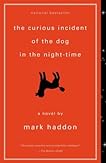
The Curious Incident of the Dog in the Night-time by Mark Haddon


The Curous Incident of the Dog in the Night-time by Mark Haddon
226 pages
Published May 2004 by Vintage

Late one night, 15-yr-old Christopher Boone discovers, on a late night walk, that his neighbor's poodle, Wellington, has been impaled with a garden fork. This sets Christopher, who is a first accused of killing the dog, off on a detective mission to find the real killer. The complication for Christopher is that he is autistic...and that his father has forbidden him from looking into the matter. But Christopher, who always follows the rules...literally, continues his search for the truth. But the truth he finds is a much bigger surprise and leads Christopher to embark on a journey that would seem impossible for a person with his limitations.

This book is entirely written from Christopher's point of view which makes it quite unique. Christopher is very honest about his quirks (he does not like the color yellow or being touched) and open about his hopes (he is a mathematics genius). When Christopher sets off on his journey, the story does get a little long; but seeing how he is able to navigate his way around is quite interesting. The relationship between Christopher and his father is very touching; his father even goes out of his way to prepare meals for Christopher that meet his very stringent color requirements. There are some big issues for Christopher to deal with in this book and Haddon gets him through through them very believably. This story is told without pity or condescension.