Showing posts with label magical realism. Show all posts

Thursday, June 5, 2025

Black Woods, Blue Sky by Eowyn Ivey

Black Woods, Blue Sky
by Eowyn Ivey
11 hours, 34 minutes
Read by Rebecca Lowman
Published February 2025 by Random House Publishing Group

Publisher's Summary: 
Birdie’s keeping it together; of course she is. So she’s a little hungover, sometimes, and she has to bring her daughter, Emaleen, to her job waiting tables at an Alaskan roadside lodge, but she’s getting by as a single mother in a tough town. Still, Birdie can remember happier times from her youth, when she was free in the wilds of nature.

Arthur Neilsen, a soft-spoken and scarred recluse who appears in town only at the change of seasons, brings Emaleen back to safety when she gets lost in the woods. Most people avoid him, but to Birdie, he represents everything she’s ever longed for. She finds herself falling for Arthur and the land he knows so well. 

Against the warnings of those who care about them, Birdie and Emaleen move to his isolated cabin in the mountains, on the far side of the Wolverine River.

It’s just the three of them in the vast black woods, far from roads, telephones, electricity, and outside contact, but Birdie believes she has come prepared. At first, it’s idyllic and she can picture a happily ever after: Together they catch salmon, pick berries, and climb mountains so tall it’s as if they could touch the bright blue sky. But soon Birdie discovers that Arthur is something much more mysterious and dangerous than she could have ever imagined, and that like the Alaska wilderness, a fairy tale can be as dark as it is beautiful.

My Thoughts: 
In 2021, I read Eowyn Ivey's The Snow Child and was enchanted by it. I use the word "enchanted" because the book employed magical realism, something I generally struggle with, but which I loved in that book. Here again, Ivey uses magical realism to tell a story and, once again, I quickly accepted it as a necessity to tell a story that would have been less impactful without it. 

This time, it took a bit more willingness to suspend disbelief and I did have a harder time connecting to Birdie than I did the characters in The Snow Child. Life's been hard for Birdie; her mother walked out on her when she was a child and she's raising a child on her own; but it was hard for me to buy in to the idea that she was a good mother. Taking off to live with a man she hardly knew, in a remote place she had never been to seemed the height of irresponsibility to me even though I knew that she saw it as a fresh start and a chance to show Emaleen the life she had known as a child. 

The thing is, Arthur has a secret and is not at all who Birdie thinks he is. She misses all of the signs and ignores all of the warnings. Even when Birdie and Emaleen are flown to Arthur's cabin by his adopted father and Birdie sees how he lives, no warning bells seem to go off. Even so, for a while after the two arrive, things begin to go better. Arthur clearly cares about both of them and Birdie finds herself in love with him. He tries his hardest to be what they need. But, ultimately, it's not in his nature and Birdie's inability to accept that will cost them all. 

I appreciated this one for having an utterly unique storyline, I did come to care very much about Emaleen...and Arthur, for that matter, and Rebecca Lowman's reading is excellent. So, even though I didn't fall in love with this book, I did enjoy it and it made for a nice break from my more conventional reads. 


Tuesday, April 29, 2025

The Life Impossible by Matt Haig

The Life Impossible
by Matt Haig
336 pages
Published September 2024 by Penguin Publishing Group 

Publisher's Summary: 
“What looks like magic is simply a part of life we don’t understand yet…”

When retired math teacher Grace Winters is left a run-down house on a Mediterranean island by a long-lost friend, curiosity gets the better of her. She arrives in Ibiza with a one-way ticket, no guidebook and no plan.

Among the rugged hills and golden beaches of the island, Grace searches for answers about her friend’s life, and how it ended. What she uncovers is stranger than she could have dreamed. But to dive into this impossible truth, Grace must first come to terms with her past.

Filled with wonder and wild adventure, this is a story of hope and the life-changing power of a new beginning.

My Thoughts: 
"A beautiful novel full of life-affirming wonder and imagination and, at its adventurous heart, a wry and tender love-letter to the best of being human.” —Benedict Cumberbatch

I don't usually put much credence into quotes about books from other authors. Publishers tend to pick authors for quotes who are prone to like the book and writers are likely to want to praise a book, in no small part because they'd like the same done for them. But Benedict Cumberbatch? I doubt he's hoping for a great review of his next film from Haig. 

Still not the reason I picked up this one. I picked this one because my book club read Haig's The Midnight Library and we all really liked it. Why not read his next novel as a club as well? Now I'm honestly question that decision. While The Midnight Library absolutely had a fantasy element, it worked for me as a device between chapters. But in this one the fantasy element is front and center and it's supernatural. I'm not sure how that's going to go over with my book club. I know I struggled with it throughout the book. 
"Once upon a time there was an old woman who lived the most boring life in the universe. 

That woman rarely left her bungalow, except to see the doctor, help at the charity shop, or visit the cemetery. She didn't garden any more. The grass was overgrown, and the flowerbeds were full of weeds. She ordered her weekly shopping. She lived in the Midlands. Lincoln, Lincolnshire. The same orange-bricked market town that she had stayed in - apart from a stint t Hull University centuries ago - all her adult life. 

You know the place."
Grace is a lonely woman, living with grief over the long-ago loss of her son and more recently her husband when she receives the notice that a long-ago acquaintance has left her a home. Grace once did a kindness for Christina, something that seems insignificant to Grace but changed Christina's life. Grace arrives in Ibiza only to discover that what she's inherited is a small, run-down house set far off from the city and has been left a list of things to do in her time on the island. Almost immediately warned to avoid Alberto Rios; but Grace, wanting to know what happened to Christina, soon realizes that Alberto is the only one who can help her find out. So to check something off of her list and because Alberto tells her he will show her what happened to Christina, Grace goes scuba diving with Alberto late one night. What happens leave Grace able to read minds, to have a far reaching knowledge, and the ability to move objects.  Now she must decide what to do with those "gifts" and if she can truly know what happened to Christina and stop the people who were trying to hurt her. 

All of which sounds like a crazy adventure novel. Which it is...kind of. But it is far more about how Grace, who has been battling anhedonia for years and living with the guilt of her son's death, find pleasure in life again and learns to forgive herself. And that is very much the kind of book I enjoy. Strangely, one of the things I really enjoyed about this book was all of the references to mathematics (Grace had been a math teacher) - Haig really uses math to explain how the magical elements in this book just might not be that implausible, but also to explain life. I liked that - I may have to rethink my opinion about math...and maybe magical realism. 

Monday, July 1, 2024

The Cemetery of Untold Stories by Julia Alvarez

The Cemetery of Untold Stories
by Julia Alvarez
256 pages
Published Algonquin Books of Chapel Hill
Source: my copy courtesy of the publisher, through Netgalley, in exchange for an honest review

Publisher's Summary: 
Alma Cruz, the celebrated writer at the heart of The Cemetery of Untold Stories, doesn’t want to end up like her friend, a novelist who fought so long and hard to finish a book that it threatened her sanity. So when Alma inherits a small plot of land in the Dominican Republic, her homeland, she has the beautiful idea of turning it into a place to bury her untold stories—literally. She creates a graveyard for the manuscript drafts and the characters whose lives she tried and failed to bring to life and who still haunt her. 

 Alma wants her characters to rest in peace. But they have other ideas and soon begin to defy their author: they talk back to her and talk to one another behind her back, rewriting and revising themselves. Filomena, a local woman hired as the groundskeeper, becomes a sympathetic listener to the secret tales unspooled by Alma's characters. Among them, Bienvenida, dictator Rafael Trujillo's abandoned wife who was erased from the official history, and Manuel Cruz, a doctor who fought in the Dominican underground and escaped to the United States.
 
The Cemetery of Untold Stories asks: Whose stories get to be told, and whose buried? Finally, Alma finds the meaning she and her characters yearn for in the everlasting vitality of stories. Julia Alvarez reminds us that the stories of our lives are never truly finished, even at the end.

My Thoughts: 
A little more than five years ago, my husband and I went to hear Julia Alvarez speak. At that time, I had a couple of her books on my to-be-read list, but hadn't actually read anything she'd written. I was so impressed with her that I knew I needed to rectify that. This is now my third of her books and I've several things to be true of her books: 
  • The themes of family (especially sisters), the immigrant experience, home, and storytelling will appear. 
  • The writing will be beautiful. 
  • The book will make me really think and I'm bound to learn from it. 
  • It's possible that I may feel like I'm in over my head. 
This book was no exception. I'll admit to wondering, in the beginning, if this book might be more cerebral than what I was up to when I began reading. But I also knew that I wanted to see how it would play out so I continued reading and Alvarez began pulling me in, even when it became apparent that magical elements were going to be involved (and you all know how tricky that it for me!). 

For a bit I felt pulled about, from one person's story to another's, from Alma's story to Filomena's story. Gradually they became one and the need for that background for each of them became apparent as the stories told by those buried characters begin to emerge. 

Manuel Cruz is Alma's father, a man who long ago spoke of a of mysterious place, a place his daughters mocked him about. Then one day he stopped speaking of it and, as he slipped into dementia, he stopped telling his girls anything about his past. 

Bienvenida is based on the real wife of Rafael Trujillo. Her she is a woman who gets swept up in the make-believe world Trujillo creates in wooing her and remains blind to the person he really is until she is forced to leave the country so that he can marry a new woman who can give him children. 

Filomena is a woman who grew up in the slums, whose mother abandoned her as a child and whose father was abusive. She and her sister, Perla, get tricked into coming into the city and working as maids for a wealthy family. When Perla becomes pregnant by the family's son, they are forced to marry. When he lands in trouble for going against Trujillo, the young family is sent to New York City and Filomena is deprived of the sister she's become estranged from and her beloved nephew. 

As Filomena listens to the stories in the cemetery, we begin to see how Alma's father's, Bienvenida's, and, eventually, Filomena's mother's stories are intertwined. 

As the book moved between the stories told by the characters in the cemetery and the real lives of Alma and Filomena, I never found myself confused or trying to race through one story to get to the next. For me, everything was laid out and unfolded perfectly. I grew to care deeply about these characters, even those who were more deeply flawed. In just 256 pages, Alvarez took me from doubting this book to wishing it were longer, not because it didn't feel complete; but because I wanted to hear more of the stories. 


Thursday, July 14, 2022

The Particular Sadness of Lemon Cake by Aimee Bender

The Particular Sadness of Lemon Cake
by Aimee Bender
Read by Aimee Bender
8 hours, 53 minutes
Published June 2010 by Doubleday

Publisher's Summary:
On the eve of her ninth birthday, unassuming Rose Edelstein, a girl at the periphery of schoolyard games and her distracted parents' attention, bites into her mother's homemade lemon-chocolate cake and discovers she has a magical gift: she can taste her mother's emotions in the cake. She discovers this gift to her horror, for her mother - her cheerful, good-with-crafts, can-do mother-tastes of despair and desperation. Suddenly, and for the rest of her life, food becomes a peril and a threat to Rose.

The curse her gift has bestowed is the secret knowledge all families keep hidden-her mother's life outside the home, her father's detachment, her brother's clash with the world. Yet as Rose grows up she learns to harness her gift and becomes aware that there are secrets even her taste buds cannot discern.

My Thoughts:
This book has been on my TBR for probably almost since it was published in 2010. At the time it was all over Goodreads so on to the TBR it went. To be honest, I had no recollection what it was about when I found that my library had it on audiobook. To be honest, since 2010, I've developed a much better idea of the kind of books I like and the kinds that don't work for me. Books with things like a magical gift of tasting emotion in food would likely have steered me away from this book had I read the summary before I started listening to the book. 

You know how sometimes I tell you that I'm happy I didn't read the summary of a book and get scared off by it or how I'm happy that I pushed myself to read something that's outside of what I normally pick up? I'm sorry to say that this was not one of those times. It's an interesting premise. I just wish it would have gone in a different direction, been more about how Rose was able to use her gift. Instead it's much more about how she learns to stifle it and also much more about Rose's brother, Joseph, the golden child who descends into the unknown. It's an unknown only Rose is first aware of and it will, eventually, tie into Rose's own gift. That felt like it's own story to me. 

But let's go back to 2010, when this book was published and Goodreads was all aflutter about it. They weren't alone. Jane Ciabattari, writing for NPR, was impressed with what Bender crafted, as was Susan Salter Reynold, writing for the L. A. Times. So maybe I should have read that summary, passed on the book, and spare you my opinion of this one. Clearly it wasn't for me (at least not at this time) but it certainly has worked for so many others. Perhaps you'd be one of them. 

Tuesday, March 30, 2021

Magic Lessons by Alice Hoffman

Magic Lessons
by Alice Hoffman
Published 
Source: checked out from my local library

Publisher's Summary:

Where does the story of the Owens bloodline begin? With Maria Owens, in the 1600s, when she’s abandoned in a snowy field in rural England as a baby. Under the care of Hannah Owens, Maria learns about the “Nameless Arts.” Hannah recognizes that Maria has a gift and she teaches the girl all she knows. It is here that she learns her first important lesson: Always love someone who will love you back. 

When Maria is abandoned by the man who has declared his love for her, she follows him to Salem, Massachusetts. Here she invokes the curse that will haunt her family. And it’s here that she learns the rules of magic and the lesson that she will carry with her for the rest of her life. Love is the only thing that matters.

My Thoughts:
The movie adaptation of Alice Hoffman's Practical Magic was released in 1998 and it's become one of those movies that I will watch any time I come across it playing on t.v. I have yet to pick up that book; why I don't know. But when Hoffman released the prequel, The Rules of Magic, I was quick to grab that up (my review here) and I was charmed. So, of course, it stood to reason that it was a given that I would read this book, which is a prequel to a prequel. If you've never read any of the books, you might as well start with this one and work your way from 1664 to the 1990's, rather than as they books were written. 

When I wrote my review of The Rules of Magic, I noted that even though the book was about witches and curses it felt much more like a book about families than about magic. This book feels more centered around magic, largely because it is set just after the witch hunts in Europe and during the witch hunts in the Americas. Still, at its heart, this is also a book family and even more about love. And while there is straight up magic in the story, much of what is considered by others in the book would be what we now consider homeopathic medicine - using what Mother Nature has given us to heal ourselves. 

As with The Rules of Magic, this book can drag on too long in places and frequently felt repetitive (yes, yes, I get it Ms. Hoffman, familiars have to pick their people). And having read these book in reverse, I was struck by how the ending of this book didn't jive with an impression I got about the way the Owens women were perceived in the community in the later books. 

Still, Hoffman pulled me into the story from the beginning, with Maria's life being upturned, to Curacao, where Maria first meets James Hathorn who will turn out not to be the man he appeared to be, to Salem then New York and back to Salem. We learn to listen to our inner voices (even if it takes Maria a good long while to do that), that revenge never bring happiness, that there are some bonds that can never be broken, and that you should always love someone who will love you back. 

Monday, October 9, 2017

The Rules of Magic by Alice Hoffman

The Rules of Magic by Alice Hoffman
Published October 2017 by Simon and Schuster
Source: my copy courtesy of the publisher, through Netgalley, in exchange for an honest review

Publisher's Summary:
Find your magic.

For the Owens family, love is a curse that began in 1620, when Maria Owens was charged with witchery for loving the wrong man.

Hundreds of years later, in New York City at the cusp of the sixties, when the whole world is about to change, Susanna Owens knows that her three children are dangerously unique. Difficult Franny, with skin as pale as milk and blood red hair, shy and beautiful Jet, who can read other people’s thoughts, and charismatic Vincent, who began looking for trouble on the day he could walk.

From the start Susanna sets down rules for her children: No walking in the moonlight, no red shoes, no wearing black, no cats, no crows, no candles, no books about magic. And most importantly, never, ever, fall in love. But when her children visit their Aunt Isabelle, in the small Massachusetts town where the Owens family has been blamed for everything that has ever gone wrong, they uncover family secrets and begin to understand the truth of who they are. Back in New York City each begins a risky journey as they try to escape the family curse.

The Owens children cannot escape love even if they try, just as they cannot escape the pains of the human heart. The two beautiful sisters will grow up to be the revered, and sometimes feared, aunts in Practical Magic, while Vincent, their beloved brother, will leave an unexpected legacy.

My Thoughts:
So, I know I just said, in another review, that I don't like supernatural elements in books. Literally just said it. Even after I had started reading this book. As it turns out, I may be wrong, at least when the supernatural is done by someone who knows how to do it as well as Alice Hoffman. For some reason, even though the entire book is about witches, and curses, and mind reading, it never felt like the magic was the center of the book. Instead, this is really a book about family, love, redemption, and being true to yourself and I do love a book with those themes.

I've never read Hoffman's Practical Magic (this is actually a prequel to that earlier book), but I love the movie adaptation, starring Sandra Bullock, Nicole, Kidman, and Stockard Channing and Dianne Wiest (the later two play Franny and Jet Owens, the sisters in this book). I adore that movie for the very reasons that I enjoyed this book. It's not a given that a movie adaptation of a book will fairly represent the book on which it was based (ok, it's often not even close); but, on the assumption that this one did, I had a feeling I would enjoy a book based on the aunts younger lives. Hoffman did not disappoint because, at it's heart, the magic in this book is the characters, who adored, each in their own way.

Even though the rules the Owens children grow up with are a little unusual, they are still rules made by parents and not understood by the children. Even though the Owens children have unique magical gifts and can often read each others minds, don't most siblings grow up each with their own unique gifts and an ability to read each other where others might not be able to do so? They don't appreciate their parents until they are gone, they long to be accepted, they long to be loved but are afraid of love - aren't these all things that are universal?

Hoffman charmed me with her blend of humor, sadness, grief, love, spirit, and family bond. Perhaps that was the greatest magic of the book. It's not perfect (it can drag on too long in some places and occasionally feel repetitive) but it was the perfect book for me at just the right time.


Monday, March 22, 2010

The Girl Who Chased The Moon by Sarah Addison Allen

The Girl Who Chased The Moon by Sarah Addison Allen
288 pages
Published by Random House
Source: the publisher and Pump Up Your Book

Emily Benedict has come to Mullaby, North Carolina, following her mother's death, to live with a grandfather she has never met, in a town her mother has never told her anything about. But Emily quickly learns that her mother growing up was not the same woman Emily knew. In fact, she seems to have been the town pariah--a spoiled little rich girl who went out of her way to torment others. Her grandfather is a giant, there are strange lights that skip across the yard at night, and the wallpaper in her mother's old bedroom changes patterns. When Emily meets young Win Coffey and Julia Winterson, a woman who was one of the victims of her mother's nastiness, she begins to learn more and more about the Mullaby lights and why the people of Mullaby hate her mother so much. Grandpa Vance isn't much of a talker, but Emily gets him to start telling her exactly what happened so many years ago. Maybe she will be able to fit in; maybe she and Win will overcome his family's strong objections to their growing friendship.

Julia, meanwhile, is wrestling with her own demons. She's come back to Mullaby for a couple of years to wrap up her father's estate but she's also trying to avoid her former stepmother Beverly and Sawyer Alexander, a man with whom she had a one night stand almost 20 years ago in high school. Her hatred of Sawyer has kept her going for all of these years. But when he finally does reappear in her life, her high school feelings for him come flooding back and he's doing his best to overcome her defenses. I most enjoyed Julia's part of the story and watching her overcome and come to terms with her past.

The book relays on the action to move it along and I think I would have liked that more without the magic that is such a big part of the story. If you're a fan of Allen's, though, you're looking for that in a book and you won't be disappointed. I felt that a lot of the characters were stereotypes but readers who've posted reviews on Barnes & Noble's site don't agree with me.

I found some descriptive phrases a little jarring. At one point Allen writes that a "smell was intense and delicious, like being in an oven." A smell is like being in an oven? But overall, this was an quick, enjoyable read that didn't require much thought and which I knew, early on, could be counted on to end happily.

Wednesday, August 5, 2009

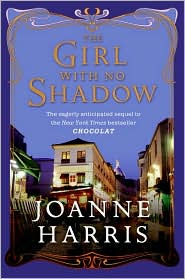
The Girl With No Shadow by Joanne Harris

The Girl With No Shadow By Joanne Harris
464 pages
Published April 2008 Harper Collins Publishing


This is the sequel to Harris' Chocolat which was made into a movie starring Johnny Depp and Juliette Binoche. It picks up the tale of Vianne and Anouk Rocherseveral years after they have moved on from the village of Lansquenet. They are now settled in to Paris, along with Rosette, the daughter Vianne was pregnant with at the end of Chocolat. Because of some previous misfortune, Vianne has given up on the magic she had previously used so effectively. Through a series of events, Vianne has opened a chocolaterie and is involved with the landlord of the shop's building. Business is not good, however, until Zozie comes into their lives. Zozie adds a brightness to their lives and soon has Anouk deeply under her influence. A delightful cast of characters begins to frequent the shop. But Zozie is not what she seems to be. Roux, the father of Rosette, makes an appearance again in this book.

Harris is brilliant at interweaving story lines and creating unique and charming periphery characters.
The reader begins to get to the truth of Zozie long before it is revealed to Vianne and Harris builds the tension as Zozie begins to wreak havoc and Vianne realizes that hiding is no longer possible. The story is told from the perspective of Anouk, Vianne, and Zozie, a tool that really helped move the story along. I felt that Harris had made some minor changes from the original story to appease readers that may have only seen the movie and not read Chocolat. I also felt that Vianne's current beau was something of a stereotype. Overall, I found the book well-written and a satisfying read.