Showing posts with label fantasy. Show all posts

Thursday, December 18, 2025

Mini-reviews: Death of A Smuggler, Book of Gothel, Searching for Sylvie Lee, The Wife Upstairs

It's time to get caught up on reviews, but there are so many to do now that I'm just going to have to do mini-reviews in groups. We'll start with four and see if I can get these all caught up by the end of the year!

Death of a Smuggler by M. C. Beaton and R. W. Green
6 hours, 34 minutes
Read by David Monteath
Published February 2025 by Grand Central Publishing

Publisher's Summary: 
All Hamish Macbeth wants is a quiet life in his peaceful home in the Highland village of Lochdubh. But when his newly-assigned constable arrives, he presents Hamish with a surprise and a secret. Getting to the bottom of the secret becomes the least of Hamish's problems when he meets a family who have a score to settle with a sinister man who has mysteriously gone missing. Discovering a murdered woman's body puts further pressure on Hamish, especially when it becomes clear that the murdered woman and the missing man are linked...

My Thoughts: 
Maybe I've just read/listened to enough of the Hamish MacBeth books that they've just lost their charm. Maybe it's the fact that it's a new writer. Maybe this one just wasn't as good. I'm not sure and it's been more than two months since I read it. It felt more convoluted than previous books and lacking the charm that I'd originally liked in these books. Or maybe I'm feeling like Lochdubh is a really dangerous place to be and I no longer understand why anyone would live there. 

Book of Gothic: Memoir of a Witch by Mary McMyne
13 hours, 30 minutes
Read by Vanessa Johansson
Published September 2023 by Orbit

Publisher's Summary: 
Haelewise has always lived under the shadow of her mother, Hedda-a woman who will do anything to keep her daughter protected. For with her strange black eyes and even stranger fainting spells, Haelewise is shunned by her village, and her only solace lies in the stories her mother tells of child-stealing witches, of princes in wolf-skins, of an ancient tower cloaked in mist, where women will find shelter if they are brave enough to seek it.

Then, Hedda dies, and Haelewise is left unmoored. With nothing left for her in her village, she sets out to find the legendary tower her mother used to speak of-a place called Gothel, where Haelewise meets a wise woman willing to take her under her wing.

But Haelewise is not the only woman to seek refuge at Gothel. It's also a haven for a girl named Rika, who carries with her a secret the Church strives to keep hidden. A secret that reveals a dark world of ancient spells and murderous nobles behind the world Haelewise has always known...


My Thoughts: 
I haven't read a good fairy tale retelling in a long time; and while this one had witch in the title and you all know how I feel about magic and witches in my books, I figured it was worth a shot. 

The reader was good, there were some really interesting ideas in this one that kept my attention. But I also felt like there was just too much going on, that the ending was a bit disappointing, and there wasn't enough of a tie to Rapunzel to really make it a back story for that fairy tale. If you're a fan of witches and fantasy, with a touch of feminism thrown in, you might enjoy this one more than I did. 

Searching For Sylvie Lee by Jean Kwok
12 hours, 9 minutes
Read by Angela Lin, Samantha Quad, Caroline McLaughlin
Published December 2020 by HarperCollins

Publisher's Summary: 

It begins with a mystery. Sylvie, the beautiful, brilliant, successful older daughter of the Lee family, flies to the Netherlands for one final visit with her dying grandmother-and then vanishes.

Amy, the sheltered baby of the Lee family, is too young to remember a time when her parents were newly immigrated and too poor to keep Sylvie. Seven years older, Sylvie was raised by a distant relative in a faraway, foreign place, and didn't rejoin her family in America until age nine. Timid and shy, Amy has always looked up to her sister, the fierce and fearless protector who showered her with unconditional love.

But what happened to Sylvie? Amy and her parents are distraught and desperate for answers. Sylvie has always looked out for them. Now, it's Amy's turn to help. Terrified yet determined, Amy retraces her sister's movements, flying to the last place Sylvie was seen. But instead of simple answers, she discovers something much more valuable: the truth. Sylvie, the golden girl, kept painful secrets . . . secrets that will reveal more about Amy's complicated family-and herself-than she ever could have imagined.

A deeply moving story of family, secrets, identity, and longing, Searching for Sylvie Lee is both a gripping page-turner and a sensitive portrait of an immigrant family. It is a profound exploration of the many ways culture and language can divide us and the impossibility of ever truly knowing someone-especially those we love.

My Thoughts: 
This one was a Read With Jenna pick but I didn't pick it because of that. I picked it because it was an audiobook that was available when I needed something and it gave me some diversity in my reading. Bush Hager calls this a "true beach read." I've gotta say that I think of beach reads as something lighter, but perhaps for her it had to do with it being a book she just couldn't put down. I didn't have that same reaction. 

I did feel like I learned a lot about other cultures and there were certainly plenty of a-ha moments in this one that I didn't see coming. I can certainly see why it would be a good choice for a book club - there is a lot to discuss here: migrants, different cultures, sibling relationships, family relationships, mysteries to be solved. But it's a book that starts sad and just stays that way. Perhaps my feelings about this one had more to do with me than the book. 

The Wife Upstairs by Rachel Hawkins
8 hours, 57 minutes
Read by Emily Shaffer, Kirby Heyborne, Lauren Fortgang
Published November 2021 by St. Martin's Publishing Group

Publisher's Summary: 
Meet Jane. Newly arrived to Birmingham, Alabama, Jane is a broke dog-walker in Thornfield Estates--a gated community full of McMansions, shiny SUVs, and bored housewives. The kind of place where no one will notice if Jane lifts the discarded tchotchkes and jewelry off the side tables of her well-heeled clients. Where no one will think to ask if Jane is her real name.

But her luck changes when she meets Eddie Rochester. Recently widowed, Eddie is Thornfield Estates' most mysterious resident. His wife, Bea, drowned in a boating accident with her best friend, their bodies lost to the deep. Jane can't help but see an opportunity in Eddie--not only is he rich, brooding, and handsome, he could also offer her the kind of protection she's always yearned for.

Yet as Jane and Eddie fall for each other, Jane is increasingly haunted by the legend of Bea, an ambitious beauty with a rags-to-riches origin story, who launched a wildly successful southern lifestyle brand. How can she, plain Jane, ever measure up? And can she win Eddie's heart before her past--or his--catches up to her?

With delicious suspense, incisive wit, and a fresh, feminist sensibility, The Wife Upstairs flips the script on a timeless tale of forbidden romance, ill-advised attraction, and a wife who just won't stay buried. In this vivid reimagining of one of literature's most twisted love triangles, which Mrs. Rochester will get her happy ending?

My Thoughts: 
This one was another case of my interest being piqued by a book that claimed to be a retelling of a story, a classic I've read several times. I'm not opposed to the idea that maybe Jane isn't the innocent that she was in Bronte version. Or that we're going to get a whole new image of Rochester and Bertha (the literal wife upstairs). But the names of the characters, the fact that Rochester is keeping his wife locked upstairs, and that a fire will end it all is as far as Hawkins gets to working from Charlotte Bronte's novel, which was disappointing. The disappointment didn't end there - the reason Bertha is locked away is preposterous, the big secret Jane was keeping that caused her no end of trouble turned out to be a big yawn, and not a one of the characters developed beyond what they were when the novel began. 

Thursday, June 5, 2025

Black Woods, Blue Sky by Eowyn Ivey

Black Woods, Blue Sky
by Eowyn Ivey
11 hours, 34 minutes
Read by Rebecca Lowman
Published February 2025 by Random House Publishing Group

Publisher's Summary: 
Birdie’s keeping it together; of course she is. So she’s a little hungover, sometimes, and she has to bring her daughter, Emaleen, to her job waiting tables at an Alaskan roadside lodge, but she’s getting by as a single mother in a tough town. Still, Birdie can remember happier times from her youth, when she was free in the wilds of nature.

Arthur Neilsen, a soft-spoken and scarred recluse who appears in town only at the change of seasons, brings Emaleen back to safety when she gets lost in the woods. Most people avoid him, but to Birdie, he represents everything she’s ever longed for. She finds herself falling for Arthur and the land he knows so well. 

Against the warnings of those who care about them, Birdie and Emaleen move to his isolated cabin in the mountains, on the far side of the Wolverine River.

It’s just the three of them in the vast black woods, far from roads, telephones, electricity, and outside contact, but Birdie believes she has come prepared. At first, it’s idyllic and she can picture a happily ever after: Together they catch salmon, pick berries, and climb mountains so tall it’s as if they could touch the bright blue sky. But soon Birdie discovers that Arthur is something much more mysterious and dangerous than she could have ever imagined, and that like the Alaska wilderness, a fairy tale can be as dark as it is beautiful.

My Thoughts: 
In 2021, I read Eowyn Ivey's The Snow Child and was enchanted by it. I use the word "enchanted" because the book employed magical realism, something I generally struggle with, but which I loved in that book. Here again, Ivey uses magical realism to tell a story and, once again, I quickly accepted it as a necessity to tell a story that would have been less impactful without it. 

This time, it took a bit more willingness to suspend disbelief and I did have a harder time connecting to Birdie than I did the characters in The Snow Child. Life's been hard for Birdie; her mother walked out on her when she was a child and she's raising a child on her own; but it was hard for me to buy in to the idea that she was a good mother. Taking off to live with a man she hardly knew, in a remote place she had never been to seemed the height of irresponsibility to me even though I knew that she saw it as a fresh start and a chance to show Emaleen the life she had known as a child. 

The thing is, Arthur has a secret and is not at all who Birdie thinks he is. She misses all of the signs and ignores all of the warnings. Even when Birdie and Emaleen are flown to Arthur's cabin by his adopted father and Birdie sees how he lives, no warning bells seem to go off. Even so, for a while after the two arrive, things begin to go better. Arthur clearly cares about both of them and Birdie finds herself in love with him. He tries his hardest to be what they need. But, ultimately, it's not in his nature and Birdie's inability to accept that will cost them all. 

I appreciated this one for having an utterly unique storyline, I did come to care very much about Emaleen...and Arthur, for that matter, and Rebecca Lowman's reading is excellent. So, even though I didn't fall in love with this book, I did enjoy it and it made for a nice break from my more conventional reads. 


Tuesday, April 29, 2025

The Life Impossible by Matt Haig

The Life Impossible
by Matt Haig
336 pages
Published September 2024 by Penguin Publishing Group 

Publisher's Summary: 
“What looks like magic is simply a part of life we don’t understand yet…”

When retired math teacher Grace Winters is left a run-down house on a Mediterranean island by a long-lost friend, curiosity gets the better of her. She arrives in Ibiza with a one-way ticket, no guidebook and no plan.

Among the rugged hills and golden beaches of the island, Grace searches for answers about her friend’s life, and how it ended. What she uncovers is stranger than she could have dreamed. But to dive into this impossible truth, Grace must first come to terms with her past.

Filled with wonder and wild adventure, this is a story of hope and the life-changing power of a new beginning.

My Thoughts: 
"A beautiful novel full of life-affirming wonder and imagination and, at its adventurous heart, a wry and tender love-letter to the best of being human.” —Benedict Cumberbatch

I don't usually put much credence into quotes about books from other authors. Publishers tend to pick authors for quotes who are prone to like the book and writers are likely to want to praise a book, in no small part because they'd like the same done for them. But Benedict Cumberbatch? I doubt he's hoping for a great review of his next film from Haig. 

Still not the reason I picked up this one. I picked this one because my book club read Haig's The Midnight Library and we all really liked it. Why not read his next novel as a club as well? Now I'm honestly question that decision. While The Midnight Library absolutely had a fantasy element, it worked for me as a device between chapters. But in this one the fantasy element is front and center and it's supernatural. I'm not sure how that's going to go over with my book club. I know I struggled with it throughout the book. 
"Once upon a time there was an old woman who lived the most boring life in the universe. 

That woman rarely left her bungalow, except to see the doctor, help at the charity shop, or visit the cemetery. She didn't garden any more. The grass was overgrown, and the flowerbeds were full of weeds. She ordered her weekly shopping. She lived in the Midlands. Lincoln, Lincolnshire. The same orange-bricked market town that she had stayed in - apart from a stint t Hull University centuries ago - all her adult life. 

You know the place."
Grace is a lonely woman, living with grief over the long-ago loss of her son and more recently her husband when she receives the notice that a long-ago acquaintance has left her a home. Grace once did a kindness for Christina, something that seems insignificant to Grace but changed Christina's life. Grace arrives in Ibiza only to discover that what she's inherited is a small, run-down house set far off from the city and has been left a list of things to do in her time on the island. Almost immediately warned to avoid Alberto Rios; but Grace, wanting to know what happened to Christina, soon realizes that Alberto is the only one who can help her find out. So to check something off of her list and because Alberto tells her he will show her what happened to Christina, Grace goes scuba diving with Alberto late one night. What happens leave Grace able to read minds, to have a far reaching knowledge, and the ability to move objects.  Now she must decide what to do with those "gifts" and if she can truly know what happened to Christina and stop the people who were trying to hurt her. 

All of which sounds like a crazy adventure novel. Which it is...kind of. But it is far more about how Grace, who has been battling anhedonia for years and living with the guilt of her son's death, find pleasure in life again and learns to forgive herself. And that is very much the kind of book I enjoy. Strangely, one of the things I really enjoyed about this book was all of the references to mathematics (Grace had been a math teacher) - Haig really uses math to explain how the magical elements in this book just might not be that implausible, but also to explain life. I liked that - I may have to rethink my opinion about math...and maybe magical realism. 

Tuesday, January 14, 2025

The Antidote by Karen Russell

The Antidote
by Karen Russell
432 pages
Published March 2025 by Knopf Doubleday Publishing Group
Source: my copy courtesy of the publisher, through Netgalley, in exchange for an honest review

Publisher's Summary: 
The Antidote opens on Black Sunday, as a historic dust storm ravages the fictional town of Uz, Nebraska. But Uz is already collapsing—not just under the weight of the Great Depression and the dust bowl drought but beneath its own violent histories. The Antidote follows a "Prairie Witch,” whose body serves as a bank vault for peoples’ memories and secrets; a Polish wheat farmer who learns how quickly a hoarded blessing can become a curse; his orphan niece, a basketball star and witch’s apprentice in furious flight from her grief; a voluble scarecrow; and a New Deal photographer whose time-traveling camera threatens to reveal both the town’s secrets and its fate.

Russell's novel is above all a reckoning with a nation’s forgetting—enacting the settler amnesia and willful omissions passed down from generation to generation, and unearthing not only horrors but shimmering possibilities. The Antidote echoes with urgent warnings for our own climate emergency, challenging readers with a vision of what might have been—and what still could be.

My Thoughts: 
The Antidote was a great book to finish off 2024. It defies classification: it is both historical fiction and fantasy. It is political commentary, sweeping saga, intimate personal stories. It is devastating and hopeful, tense but not without humor. It's set in one of the most notable times of this country's history but addresses concerns that span the centuries. And it's set in a fictional small town in Nebraska, but it's packed with real places, the real history of the state, and real photographs taken by those sent to record that time.
"Black Sunday began as a gash in the western sky, growing wider and wider and spilling down dirt instead of blood. Sometimes I imagine the glee of those journalists in the New York City papers - typing up the story of our worst day in their fancy language. Adjusting the margins and pushing our tragedy into a skinny column, just like old Marvin at the funeral home shoving a tall corpse into a tight suit."
"Imagine every ghost rising up to hurl their cemetery earth at the living. That was the sound we heard last Sunday afternoon. At 3:00 p.m the sun was murdered in cold blood, in full view of every woman and child. The sun sank into black cloud. Buried alive, at a shocking altitude, but the duster to end all dusters."
We get the story primarily from The Prairie Witch, Asphodel Oletsky, Harp Oletsky, and Cleo Allfrey whose names will change as chapter headings as the books progresses. But we also get chapters from the points of view of a cat and a scarecrow, chapters that are The Antidote's history, and one of Harp's "deposits." In less skilled hands, all of this shifting could be confusing; but Russell skillfully blends all of these points of view at the same time she is moving the story forward while giving us the backstory of the land and the people. The characters are fully realized, their travails their own but their concerns and hopes universal. While the full story is slow to develop, it's never drags and it's well worth the time spent when everything comes to a conclusion with a second cataclysmic (and real) event. 
"The Republican River became a four-mile-wide whitewater monster, thrashing its long tail from eastern Colorado to Oxford, Nebraska. Twenty-four inches of rain fell in twenty-four house! Bridges split and splintered apart. Hundreds of miles of road got washed out. The river poured forward with enough force to carry cars and rooftops. Walls floated away. Friends became cadavers in outfits we recognized, floating beside tractors and drowned cattle. Bodies were seen riding on the crest through the middle of towns, their shy faces staring underwater even as we screamed their names."
At a time when I was really struggling to focus on any book, this one grabbed me and kept me reading. The concepts, the history, the characters, the writing, the pacing, the creativity all worked to make this book that will stay with me a long time. As much as it is set in the past, it is filled with lessons to be learned, not the least of which are to see how history is repeating itself and how human nature remains unchanged. Russell leaves us with hope - we see that there is an opportunity to learn from the past and to change our future. If only we will listen. 

One final note, if you read this book, make sure you read the Land Lost Acknowledgment and the Author's Note at the end. 


Thursday, October 10, 2024

Vampires In the Lemon and Other Stories Grove by Karen Russell

Vampires In The Lemon Grove and Other Stories 
by Karen Russell
Read by Arthur Morey, Joy Osmanski, Kaleo Griffith, Mark Bramhall, Michael Bybee, Romy Rosemont, and Robbie Daymond
9 hours, 15 minutes
Published February 2013 by Alfred A. Knopf

Publisher's Summary: 
In the collection's marvelous title story, two aging vampires in a sun-drenched Italian lemon grove find their hundred-year marriage tested when one of them develops a fear of flying. In "The Seagull Army Descends on Strong Beach, 1979", a dejected teenager discovers that the universe is communicating with him through talismanic objects left in a seagull's nest. "Proving Up" and "The Graveless Doll of Eric Mutis" - stories of children left to fend for themselves in dire predicaments - find Russell veering into more sinister territory, and ultimately crossing the line into full-scale horror. In "The New Veterans", a massage therapist working with a tattooed war veteran discovers she has the power to heal by manipulating the images on his body. In all, these wondrous new pieces display a young writer of superlative originality and invention coming into the full range and scale of her powers.

My Thoughts: 
Book two for Readers Imbibing Peril (R.I.P.). Yea, me; although, I must admit that this was a complete coincidence. This is one of those books that I've been wondering about for a long time (a decade, actually), but it was getting an advanced copy of Russell's latest work (The Antidote) and having a break in the audiobooks I'd requested from the library, that finally had me picking this one up. 

Maureen Corrigan (NPR) had this to say about the first story in this collection: "The title story kicks off this collection by doing the near impossible: making me care about vampires, a breed more overexposed these days than Labrador retrievers." I agree, despite my major skepticism when the story began. Poor Clyde is a vampire who can no longer transform into a bat and fly; instead he spends his days and nights sitting at a table at the back of a lemon grove, where no one except one young worker, seems to be aware of what he is. He lives for the arrival of his wife, who descends nightly from a cave on high, along with thousands of other bats. It was his wife who made him understand that they could survive without blood and the two of them discovered that lemons work as a kind of analgesic for their kind. But has their marriage reached its end? And will the reality of that cause Clyde to do the unthinkable? I liked this story much more and it set the bar high. 

Like all collections of short stories (at least in my experience), not all stories are equal. I must admit that I gave up on "The New Veterans," which felt to me like it was dragging. But both "Proving Up" and "The Graveless Doll of Eric Mutis" impressed me with their originality and twists. In "Proving Up," Russell has set her story in Nebraska (something she has repeated in The Antidote), which always makes a story more interesting to me. Each of these stories is a work of fantasy, a genre that you know I often struggle with, but here the fantasy element almost never overwhelmed the story. I mean, even a vampire just felt like a sad old man to me! 

Perhaps my favorite thing about this collection was the fact that each of the stories was read by a different reader and each felt absolutely perfectly suited to the story they read. 

I more eager than ever to get back to The Antidote and Russell's Swamplandia, which I own...somewhere (is it in print? is it on my Nook?). 

Tuesday, October 1, 2024

The Once and Future Witches by Alix E. Harrow

The Once and Future Witches
by Alix E. Harrow
528 pages / 16 hours, 3 minutes
Read by Gabra Zackman
Published October 2020 by Orbit

Publisher's Summary: 
In 1893, there's no such thing as witches. There used to be, in the wild, dark days before the burnings began, but now witching is nothing but tidy charms and nursery rhymes. If the modern woman wants any measure of power, she must find it at the ballot box.

But when the Eastwood sisters―James Juniper, Agnes Amaranth, and Beatrice Belladonna―join the suffragists of New Salem, they begin to pursue the forgotten words and ways that might turn the women's movement into the witch's movement. Stalked by shadows and sickness, hunted by forces who will not suffer a witch to vote―and perhaps not even to live―the sisters will need to delve into the oldest magics, draw new alliances, and heal the bond between them if they want to survive.

There's no such thing as witches. But there will be.


My Thoughts: 
The Once and Future Witches is not my usual reading fare. But my dad, in a little sleight of hand, aided and abetted by the same people he was tricking, got my sister and I to each send the other a copy. The reason for that? Well, in my family, I've been known as the Wicked Witch of the West and my sister as the Wicked Witch of the East for going on twenty years. Plus, this is a book about sisters and feminism. When my dad heard about this one, he thought it was the perfect book for the two of us to read. 

This was meant to be a read/listen combination once I discovered that it was readily available on audio from my library. But some extra time in the car and a home project that gave me plenty of time to listen caused me to end up listening to the whole book. It's a good thing I found it on audio because I'm not sure when I would have gotten to such a long book in print, but it's the perfect time of year to be reading this one.  

What I Liked About This Book: 
  • I'm always happy to read a book about sisters and how life may cause them to grow apart, but the bond will never be broken. In this book, that's true even into eternity. 
  • Equally, I love a book filled with strong women and this book has a lot of them. Juniper comes in hot (and mad) and remains a force to be reckoned with. Agnes has the kind of anger within her that leaves little doubt that her strength can be counted on, even when she tries to avoid it. But it's Bella, the quiet librarian, who surprises everyone with her strength and her unwillingness to stop trying when it appears all is lost.
  • Harrow is an equal opportunity writer when it comes to passing out the ways of witchcraft, pulling in Native American and African American witch ways (for the most part ways that we would recognize as homeopathic and natural remedies). She even allows men the opportunity to use witchcraft. I would have liked to have seen more of these other witches. 
  • I appreciated that Harrow included gay characters. It felt a little bit like they might have been included as a tool to expand the reader base but it wasn't over done. 
  • Gabra Zackman's reading of the book. She did an excellent job of voicing the different characters. 
What Didn't Work For Me: 
  • I was really excited to read a book about suffragettes and was looking forward to how that might work with the witchcraft. Unfortunately, the suffragettes were pushed to the side with the emphasis on wanting to bring back witching ways rather than advancing the rights of women. To be fair, the suffragette leaders in this book were the very kinds of rich, white women that themselves pushed out black women in reality and an agenda aligned with their religion. Still, if you're going to write a book with an alternate reality, you could do a lot to blend the two. 
  • It's a little thing, but I wish Harrow would have landed on the way each of the sister was going to be known. Sometimes James Juniper was just that, other times she was Juniper, and still other times Juni. Agnes was nearly always Agnes, but often Agnes Amaranth. Beatrice's change made more sense; in the beginning of the book, she was almost exclusively Beatrice until she claimed her power and then she became Belle. Except when she was Beatrice Belladonna. 
  • This is a really long book that I felt could easily have been cut down 100 pages as it often felt like it was repetitive and somethings were just too over the top and could have been left out. 
  • The last 20-25 minutes or so of the audiobook. It just felt like the story could have been finished up in the final big "scene" with a short epilogue. 
The Once and Future Witches was named one of NPR's best books of 2020. Their reviewer absolutely loved this book. Clearly it was a book that was right up her alley. It is not, as you know if you've been around for any period of time, up my alley. Sometimes those books surprise me, sometimes they do not. And sometime, like with this one, I find enough to like about the book to enjoy the story; but not enough to make me want to rush out and pick up another book about witchcraft. 

This counts as my kickoff to Reader's Imbibing in Peril (R.I.P.) XIX with Peril of the Listen. 

Thursday, November 17, 2022

Mini-Review: Midnight Library by Matt Haig

 Yeah, I could have written full reviews for the books I've reviewed this week and gotten another week of reviews; but, if I put this off longer, I'll forget the books, let alone what I want to say about them. So here's another mini-review of a book I've read, and really enjoyed, recently. 

Midnight Library
by Matt Haig
304 pages
Published September 2020 by Penguin Publishing Group
Source: my public library

Publisher's Summary: 
Somewhere out beyond the edge of the universe there is a library that contains an infinite number of books, each one the story of another reality. One tells the story of your life as it is, along with another book for the other life you could have lived if you had made a different choice at any point in your life. While we all wonder how our lives might have been, what if you had the chance to go to the library and see for yourself? Would any of these other lives truly be better? 

In The Midnight Library, Matt Haig's enchanting blockbuster novel, Nora Seed finds herself faced with this decision. Faced with the possibility of changing her life for a new one, following a different career, undoing old breakups, realizing her dreams of becoming a glaciologist; she must search within herself as she travels through the Midnight Library to decide what is truly fulfilling in life, and what makes it worth living in the first place.

My Thoughts: 
Recommended by a friend at work (thanks, Ann!), this is a book that really makes you think about the what ifs of your life, and there are so very many more what ifs than you ever considered. If you had a chance to see every single possible version of the life you might have led, which would you choose? Nora discovers that getting what you thought you wanted out of life isn't necessarily what you would have chosen had you known how it would have ended. 

I wasn't a fan of the ending of this one. I wish it had ended about six pages earlier, left the reader wondering. But there were some really great things in this book. 
"Nora had always had a problem accepting herself. From as far back as she could remember, she'd had the sense that she wasn't enough. Her parents, who both had their own insecurities had encouraged that idea. 

She imagined, now, what it would be like to accept herself complete. Every mistake she had ever made. Every mark on her body. Every dream she hadn't reached or pain she had felt. Every lost or longing she had surpassed. 

She imagined accepting it all. The way she accepted nature. The way she accepted a glacier or a puffin or the breach of a whale. 

She imagined seeing herself as just another brilliant freak of nature. Just another sentient animal, trying their best. 

And in doing so, she imagined what was like to be free." 

Wednesday, August 10, 2022

The Scent Keepr by Erica Bauermeister

The Scent Keeper
by Erica Bauermeister
Published May 2019 by St Martin's Publishing Group
Read by Gabra Zackman
9 hrs, 34 mins

Publisher's Summary: 
Emmeline lives an enchanted childhood on a remote island with her father, who teaches her about the natural world through her senses. What he won’t explain are the mysterious scents stored in the drawers that line the walls of their cabin, or the origin of the machine that creates them. As Emmeline grows, however, so too does her curiosity, until one day the unforeseen happens, and Emmeline is vaulted out into the real world—a place of love, betrayal, ambition, and revenge. To understand her past, Emmeline must unlock the clues to her identity, a quest that challenges the limits of her heart and imagination.

Publisher's Summary: 
This is my fourth Erica Bauermeister book - I missed it's publication but I've been looking forward to enjoying more of her work ever since I finished The Lost Art of Mixing in 2014 (preceded by two of her books in 2011). 

I was so looking forward to what has become Bauermeister's forte - casts of characters brought together to lean on each other to overcome adversity, with each character having their own chapters to develop their stories. I didn't even look at the summary when I requested this book from the library (again!). That preconceived expectation I had going into this book almost certainly colored my opinion of the book, much to this book's detriment. I didn't get my cast of characters in The Scent Keeper or all of their back stories. 

There is also what I would best call a sense of magical realism or fantasy to this book. As you know, magical realism and/or fantasy are elements in books that I struggle with. Sometimes they work for me. Because they do, I wouldn't have dismissed this book out of hand had I read in the summary that Emmeline's father had a machine that could capture scents, which he stored in bottles. Most often, though those elements don't work for me in a book. Unfortunately, this was one of those books. 

Kirkus Reviews calls this book an "artfully crafted coming-of-age story." Lately I've been finding myself agreeing with Kirkus more and more but I'm afraid I have to disagree with them on this one. Even given the element of fantasy in the first part of this book, Emmeline's time on the island with her father, that was my favorite part of the book (although Zackman's reading of Emmeline's father's voice didn't work for me at all). Bauermeister's writing in this really shown, with her sublime descriptions of the nature surrounding Emmeline. Once Emmeline leaves the island Bauermeister seems to lean more on stereotypes and tropes than I've seen before in her work. 

I can't help but wonder what I might have made for this book had I known ahead of time what the book was about. Or had I read the book in print, rather than in audiobook form. Might I have seen Bauermeister's characters as the individuals she no doubt meant them to be? Might I have been more willing to accept the fantasy elements - the machine, Emmeline's ability to "read" people by their scents and the scents they leave behind? Perhaps. For now, I will just look forward to what Bauermeister is working on now. 


Friday, December 31, 2021

Four Mini-Reviews

Remember how I told you that, even thought my reading was way down, where I was really failing was in getting the reviews written? So in order to start the new year off with a clean slate, I'm going to have a second post on this last day of the year and do mini-reviews of the last four books I finished in 2021. 

Beautiful World, Where Are You by Sally Rooney
Read by Aoife McMahon 
Published September 2021 by Farrar, Straus and Giroux
11 Hours

Publisher's Summary:
Alice, a novelist, meets Felix, who works in a warehouse, and asks him if he’d like to travel to Rome with her. In Dublin, her best friend, Eileen, is getting over a break-up and slips back into flirting with Simon, a man she has known since childhood. Alice, Felix, Eileen, and Simon are still young—but life is catching up with them. They desire each other, they delude each other, they get together, they break apart. They have sex, they worry about sex, they worry about their friendships and the world they live in. Are they standing in the last lighted room before the darkness, bearing witness to something? Will they find a way to believe in a beautiful world?

My Thoughts:
I've been meaning to get to one of Rooney's books for a long time so when this one started getting buzz, I decided it was as good a place to start as any. And it won the Good Reads Choice Award for Fiction for 2021, an award chosen by people like myself. 

I gave up on it 70% in. I never give up on a book when I'm more than half way through it but I couldn't stand any more of any of these characters or the weird way that Rooney paced her story. There were long emails between Alice and Eileen where one or the other of them opined about the state of the world and then we were treated to long passages of the minutiae of their lives. And sex. Lots of sex. It might be a good book - it wasn't for me at this time. And while Aoife McMahon did a terrific job, maybe I would have enjoyed it more in print. I'll never find out because there are too many other books I'd rather pick up. 

Bewilderment by Richard Powers
Read by Edoardo Bellerini
Published September 2021 by W. W. Norton Company 
8 Hours

Publisher's Summary:
The astrobiologist Theo Byrne searches for life throughout the cosmos while singlehandedly raising his unusual nine-year-old son, Robin, following the death of his wife. Robin is funny, loving, and filled with plans. He thinks and feels deeply and can spend hours painting elaborate pictures of the endangered animals he loves. He is also about to be expelled from third grade for smashing his friend in the face. 

 What can a father do, when the only solution offered to his troubled son is to put him on psychoactive drugs? What can he say when his boy comes to him wanting an explanation for a world that is clearly in love with its own destruction? With its soaring descriptions of the natural world, its tantalizing visions of life beyond and its account of a father and son's ferocious love, Bewilderment marks Richard Powers's most intimate and moving novel. At its heart lies the question: How can we tell our children the truth about this beautiful, imperiled planet?

My Thoughts:
This one is written by a Pulitzer Prize winner, a prize awarded not by readers like me. And I read and found enough in Powers' The Overstory to be intrigued to see how he would incorporate science into a story about interesting people this time. 

Like The Overstory, Kirkus Reviews and I agree about this one. While it can veer into planetary fantasy frequently, those pieces also serve to give readers insight into the relationship between father and son. And it's a marvelous relationship between a man who is deeply grieving the wife he adored and his challenging son who is equally lost without the person who understood him best. 

Powers makes his opinion of the previous administration, about climate change and what humans are doing to our planet, and his thoughts about our eagerness to medicate over finding better solutions clear. And yet this one did not feel quite a preachy. Maybe because I agree with him. Maybe because I cared so much about Theo and Robin. 

The Sweetness of Water by Nathan Harris
Read by William DeMeritt
Published June 2021 by Hachette Book Group
12 Hours

Publisher's Summary: 
In the waning days of the Civil War, brothers Prentiss and Landry—freed by the Emancipation Proclamation—seek refuge on the homestead of George Walker and his wife, Isabelle. The Walkers, wracked by the loss of their only son to the war, hire the brothers to work their farm, hoping through an unexpected friendship to stanch their grief. Prentiss and Landry, meanwhile, plan to save money for the journey north and a chance to reunite with their mother, who was sold away when they were boys.

Parallel to their story runs a forbidden romance between two Confederate soldiers. The young men, recently returned from the war to the town of Old Ox, hold their trysts in the woods. But when their secret is discovered, the resulting chaos, including a murder, unleashes convulsive repercussions on the entire community. In the aftermath of so much turmoil, it is Isabelle who emerges as an unlikely leader, proffering a healing vision for the land and for the newly free citizens of Old Ox.

With candor and sympathy, debut novelist Nathan Harris creates an unforgettable cast of characters, depicting Georgia in the violent crucible of Reconstruction. Equal parts beauty and terror, as gripping as it is moving, The Sweetness of Water is an epic whose grandeur locates humanity and love amid the most harrowing circumstances.

My Thoughts:
Yep, 100% agree with the publisher on this one. These characters are unforgettable and Harris does a wonderful job of balancing the terror and beauty of this time, this place, and these people. While very bad things do happen, though, Harris balances that with hope and it made all the difference for me. I'm not sure why this one didn't get more press and acclaim. 

For the second time in one post, I have to admit to agreeing with Kirkus Reviews who found this book just as moving as I did. 

The Invisible Life of Addie LaRue by V. E. Schwab
Read by Julia Whalen
Published October 2020 by Tom Dougherty Associates

Publisher's Summary: 
France, 1714: in a moment of desperation, a young woman makes a Faustian bargain to live forever and is cursed to be forgotten by everyone she meets. Thus begins the extraordinary life of Addie LaRue, and a dazzling adventure that will play out across centuries and continents, across history and art, as a young woman learns how far she will go to leave her mark on the world. But everything changes when, after nearly 300 years, Addie stumbles across a young man in a hidden bookstore and he remembers her name.

My Thoughts: 
If you look at this one on Goodreads, you'll find that you'll see a lot of one- and two-star reviews and then a lot of five-star reviews, not much in between. Here's the thing - I get both of those reactions. It's too long and probably Schwab spends too much time in the present and not enough time following Addie through the 300 years of her life. We learn that she spent time working as a spy during WWII but we know nothing her experiences doing that. We know that she traveled over time but never to a country where the population was anything other than predominately white. And we have to buy into the idea that she could fall for the the devil to whom she has promised her soul and who appears to her in a form she conceived (the ultimate bad boy). 

This one was, perhaps, the right book at the right time for me because I was willing for forgive Schwab most of that (except maybe perhaps the length). How hard would it be to survive if no one ever remembered you - you couldn't hold a job, couldn't rent an apartment. It's impossible to survive while never bending the rules yet, when she finally does meet the man who does remember her, how to justify all she's done? And how will their relationship survive? I found myself more than willing to suspend disbelief and go along for the ride. Julia Whelan's reading, as always, only served to enhance the experience. 

And that's a wrap for 2021 folks. No year-end statistics. Just an updated list at the top of this page of my favorite books of the year. 

Thursday, December 9, 2021

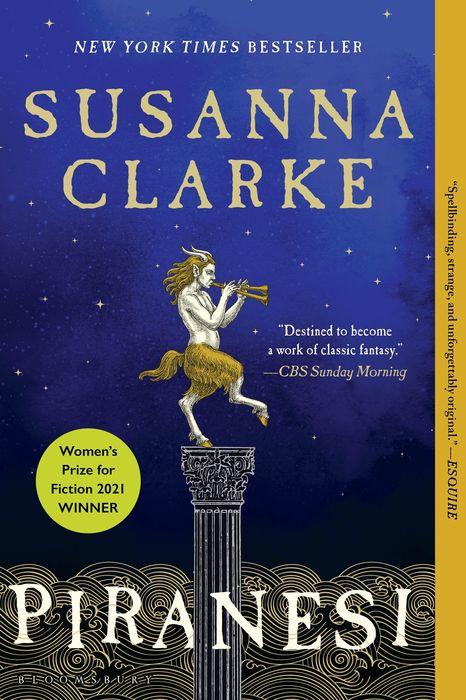
Piranesi by Susanna Clarke

Piranesi by Susanna Clarke
Published September 2020 by Bloomsbury USA
Pages 272

Publisher's Summary: 
Piranesi’s house is no ordinary building: its rooms are infinite, its corridors endless, its walls are lined with thousands upon thousands of statues, each one different from all the others. Within the labyrinth of halls an ocean is imprisoned; waves thunder up staircases, rooms are flooded in an instant. But Piranesi is not afraid; he understands the tides as he understands the pattern of the labyrinth itself. He lives to explore the house. 

There is one other person in the house—a man called The Other, who visits Piranesi twice a week and asks for help with research into A Great and Secret Knowledge. But as Piranesi explores, evidence emerges of another person, and a terrible truth begins to unravel, revealing a world beyond the one Piranesi has always known.

My Thoughts: 
I've been reading...sort of...but I haven't been able to make myself sit down and right a book review for a few weeks. Even when I've enjoyed a book as much as I enjoyed Piranesi. Clarke's first book was the door stopper Jonathan Strange and Mr. Norrell, which I have never picked up for two reasons: 1) it's nearly 900 pages long and 2) the word "magic" appears in the book description. If you've been around long, you know that magic, magical realism, fantasy are book ideas that I tend to veer away from. But Piranesi won the Women's Prize for Fiction in 2020 so, without even reading the description, I requested it from the library. 

And, once again, it's been proven that sometimes a book that leaves reality behind can be just what I need. 

The entire book is told through Piranesi's journals, the journals of a person who lives almost entirely along in a labyrinth of halls and vestibules so expansive that he can walk for hours to reach a hall he has meticulously mapped over his time there. He has managed to figure out how to sustain himself using what the tides bring to him and the few gifts that The Other brings. Piranesi seems content with his life exploring and caring for the 13 human skeletons he has come across in his explorations. But the more he explores, the more he talks to The Other, the more questions he begins to have. And when another human appears in the halls, everything Piranesi has believed in begins to unravel. Who can he trust? Where did the stories in his earliest journals come from? 

Clarke has managed, in under 300 pages, to create a story that Kirkus Reviews calls "weird and haunting and excellent." It is every bit of that and more. While there's nothing here that we can relate to as being a part of our everyday lives, everyone of us can relate to the wonder, the fear, the sadness that Piranesi experiences. And who wouldn't like the idea of a world you could retreat to when the real world becomes too much, a world where magic still exists? This book took me away from the real world and I needed that right now. 

Tuesday, March 30, 2021

Magic Lessons by Alice Hoffman

Magic Lessons
by Alice Hoffman
Published 
Source: checked out from my local library

Publisher's Summary:

Where does the story of the Owens bloodline begin? With Maria Owens, in the 1600s, when she’s abandoned in a snowy field in rural England as a baby. Under the care of Hannah Owens, Maria learns about the “Nameless Arts.” Hannah recognizes that Maria has a gift and she teaches the girl all she knows. It is here that she learns her first important lesson: Always love someone who will love you back. 

When Maria is abandoned by the man who has declared his love for her, she follows him to Salem, Massachusetts. Here she invokes the curse that will haunt her family. And it’s here that she learns the rules of magic and the lesson that she will carry with her for the rest of her life. Love is the only thing that matters.

My Thoughts:
The movie adaptation of Alice Hoffman's Practical Magic was released in 1998 and it's become one of those movies that I will watch any time I come across it playing on t.v. I have yet to pick up that book; why I don't know. But when Hoffman released the prequel, The Rules of Magic, I was quick to grab that up (my review here) and I was charmed. So, of course, it stood to reason that it was a given that I would read this book, which is a prequel to a prequel. If you've never read any of the books, you might as well start with this one and work your way from 1664 to the 1990's, rather than as they books were written. 

When I wrote my review of The Rules of Magic, I noted that even though the book was about witches and curses it felt much more like a book about families than about magic. This book feels more centered around magic, largely because it is set just after the witch hunts in Europe and during the witch hunts in the Americas. Still, at its heart, this is also a book family and even more about love. And while there is straight up magic in the story, much of what is considered by others in the book would be what we now consider homeopathic medicine - using what Mother Nature has given us to heal ourselves. 

As with The Rules of Magic, this book can drag on too long in places and frequently felt repetitive (yes, yes, I get it Ms. Hoffman, familiars have to pick their people). And having read these book in reverse, I was struck by how the ending of this book didn't jive with an impression I got about the way the Owens women were perceived in the community in the later books. 

Still, Hoffman pulled me into the story from the beginning, with Maria's life being upturned, to Curacao, where Maria first meets James Hathorn who will turn out not to be the man he appeared to be, to Salem then New York and back to Salem. We learn to listen to our inner voices (even if it takes Maria a good long while to do that), that revenge never bring happiness, that there are some bonds that can never be broken, and that you should always love someone who will love you back. 

Wednesday, February 5, 2020

The Starless Sea by Erin Morgenstern

The Starless Sea by Erin Morgenstern
Published November 2019 by Knopf Doubleday Publishing Group
Source: checked out from my local library

Publisher’s Summary:
Zachary Ezra Rawlins is a graduate student in Vermont when he discovers a mysterious book hidden in the stacks. As he turns the pages, entranced by tales of lovelorn prisoners, key collectors, and nameless acolytes, he reads something strange: a story from his own childhood. Bewildered by this inexplicable book and desperate to make sense of how his own life came to be recorded, Zachary uncovers a series of clues—a bee, a key, and a sword—that lead him to a masquerade party in New York, to a secret club, and through a doorway to an ancient library hidden far below the surface of the earth. What Zachary finds in this curious place is more than just a buried home for books and their guardians—it is a place of lost cities and seas, lovers who pass notes under doors and across time, and of stories whispered by the dead. Zachary learns of those who have sacrificed much to protect this realm, relinquishing their sight and their tongues to preserve this archive, and also of those who are intent on its destruction. Together with Mirabel, a fierce, pink-haired protector of the place, and Dorian, a handsome, barefoot man with shifting alliances, Zachary travels the twisting tunnels, darkened stairwells, crowded ballrooms, and sweetly soaked shores of this magical world, discovering his purpose—in both the mysterious book and in his own life.

My Thoughts:
I adored Morgenstern’s debut novel, The Night Circus. I fell so deeply into it when I read it that it often took several minutes for me to readjust to reality when it was time to set the book aside. To say that I was eager to get my hands on her latest work would be an understatement. A nice fat work of fantasy seemed like the perfect way to forget that it was winter outside. I had such high hopes for this book.

And now I have such complicated feelings about it.

It’s a book about stories. It’s a book chock full of stories woven throughout the novel. Even better, most of the stories within the novel read like fairy tales or myths and you know how much I love fairy tales. We’ve read several different chapters of stories before we ever come to Zachary; in fact, we read the story from Zachary’s childhood before he does, before we even know it’s Zachary.
Alright, I thought, these stories are all going to tie together in some way as we go along and I’m all in for that. And like any good mystery, surely we’ll eventually learn what all of those symbols mean – the bee, the key, and the sword (to say nothing of the feather, the owl, the crowns, the hearts and the cats).
“A boy at the beginning of a story has no way of knowing that the story has begun.”
Morgenstern’s writing is gorgeous and she can paint a scene in your head like nobody else can. The rooms and tunnels and beaches of the Starless Sea and its Harbors came alive for me and I loved the way Morgenstern played with using different materials, sizes, and times. She’s got a sea made of paper confetti , stories written on ribbons and body parts, an entire scene set inside a dollhouse, and sea of honey. Morgenstern’s imagination has run away with her and she has clearly relished in showing off all of the worlds she can create. Which is, unfortunately, one of the ways this book fell flat for me.

The New York Times reviewer said it better than I can:
"Morgenstern’s attempt to mingle a dozen or so narratives into an intertwined myth is strangely devoid of tension for a book in which a nameless woman’s tongue is cut out on Page 10. We flit from story to story like bees — bees, keys, swords, crowns and hearts dance a heady symbolic gavotte throughout — never knowing where we might land, or who will turn out to really be who, or if the pirate is a real pirate or a metaphor, or whether any of it has a point. As a story about stories, Morgenstern’s latest contains the seeds of its own destruction: It abandons people in favor of theme."

Things got so complicated I could hardly keep up with where we were. More importantly, in a book where there are very few characters, it was really important to make me care about the characters. But I never really got attached to any of them. Which was a disappointment, considering that in the beginning, I was really into Zachary and his friend Kat and their relationship. But then Kat disappeared and I was never drawn fully into the characters again.

And all of those things that I expected to come together as the book went on? They didn't, not entirely. That might work for some readers. It was frustrating for me. Especially since where Morgenstern did bring things together, it really wow'd me. I wanted more of that. And all of those symbols? Again, some of them become clear. Others you'll have to figure out for yourself. Maybe all of that was the point. Maybe Morgenstern wanted to make her readers think. But I was too busy trying to figure out what was going on to think too deeply about what meant what.

If this book were 100 pages shorter, 100 pages less convoluted, I think it would have worked better for me. If there had been more interaction between the characters that explained their feelings for each other better, it might have worked better for me. If there had been less world building and more plot, it might have worked better for me. As is, I admire Morgenstern's writing, her incredible imagination, and the world she created. But I came away feeling I didn't get what I expected from the person who gave me The Night Circus.


Wednesday, June 14, 2017

The Changeling by Victor LaValle

The Changeling by Victor LaValle
Published June 2017 by Random House Publishing
Source: my copy courtesy of the publisher through Netgalley, in exchange for an honest review

Publisher's Summary:
When Apollo Kagwa’s father disappeared, all he left his son were strange recurring dreams and a box of books stamped with the word IMPROBABILIA. Now Apollo is a father himself—and as he and his wife, Emma, are settling into their new lives as parents, exhaustion and anxiety start to take their toll. Apollo’s old dreams return and Emma begins acting odd. Irritable and disconnected from their new baby boy, at first Emma seems to be exhibiting signs of postpartum depression, but it quickly becomes clear that her troubles go even deeper. Before Apollo can do anything to help, Emma commits a horrific act—beyond any parent’s comprehension—and vanishes, seemingly into thin air.

Thus begins Apollo’s odyssey through a world he only thought he understood, to find a wife and child who are nothing like he’d imagined. His quest, which begins when he meets a mysterious stranger who claims to have information about Emma’s whereabouts, takes him to a forgotten island, a graveyard full of secrets, a forest where immigrant legends still live, and finally back to a place he thought he had lost forever.

My Thoughts:
Book two, this week, of the books I judged by their covers. Book two, this week, of the books I judged by their covers whose covers turned out to be right. Well, this one was also pitched to me as a dark fairy tale and I've been feeling like it was time to get back into fairy tales.

That reading rut I've been in for months? This might just be the book that pulls me out. It's not my usual read, very deep into the fantasy realm, but it's also the first book that I've literally been unable to put down in months. Maybe because I needed something that completely took me away from reality. Maybe because sometimes going outside of your comfort zone is exactly what it takes to remind you how great reading can be.

The Changeling is gruesome, and scary, and twisty. It builds slowly, feeling like a perfect ordinary, if somewhat sad story. Then suddenly, the book takes off and LaValle takes readers on a macabre adventure that sucked me in and made me forget where I was and how long I'd been reading.

LaValle included copious references to fairy tales and literature that, of course, appealed to me, including making his lead characters a librarian and a buyer/seller of books. The man clearly knows his way around the book world and the history of stories.

Paul Beatty (author of The Sellout) compared The Changeling to the work of the Coen brothers. The Fargo kind of Coen brothers movie seems more than an apt comparison with an ordinary setting, a lot of unexpected twists and tension, and a whole lot of blood. That gory factor generally turns me off in a book or a movie. But the Coen brothers have a way to do it that I can handle. Victor LaValle seems to have that same touch. Maybe because it feels appropriate where it's used, but also because the stories have so much more to recommend them.

I've never heard of LaValle before. A review on Vulture.com called LaValle a "prolific horror master." Now, I'm not a big fan of horror, not in my movies and not in my books. I don't want to read a book that makes me even more afraid of the bad things that really could happen to me. But if his particular brand of horror combines characters I care about in great story lines and I can don't feel like I won't be able to walk into my own house alone after dark, I might just have to give his work another try.

Thursday, December 30, 2010

Jane Bites Back by Michael Thomas Ford & Pride & Prejudice by Marvel Comics

When I waved the white flag on challenges a couple of weeks ago, I had completely lost track of the fact that the Everything Austen Challenge also ended on December 31.  I may be willing to give up on some challenges but not on this one!  So I've immersed myself this week in racing to complete five more things for the challenge, having already read and reviewed Northanger Abbey.

Jane Bites Back by Michael Thomas Ford
Published December 2009 by Random House Publishing Group
Source: I won this book as part of the prize pack for last years' "Everything Austen Challenge"

What if Jane Austen really was dead?  Or, more precisely, what if she were undead?  In Jane Bites Back, 41-year-old Jane Austen traveled for a tryst with Lord Byron only to have him seduce her...and the turn her into a vampire.  She returned home only to fake her own illness and death.  Over 200 years later, she's living in a small town, operating a bookstore, fending off a possible suitor and just about to give up on having her last manuscript published.  Things are complicated enough but they get even more complicated when a publisher buys her book, Lord Byron returns to try to woo her away (and by "woo" I mean threaten to harm those she cares about if she doesn't come with him), and a particularly vocal Charlotte Bronte fan, who is also a well-known blogger, starts causing trouble. 

This book did pose some interesting ideas as Jane contemplated her modern day life as opposed to her known life and what it might be like to actually outlive everyone and everything you ever knew.  But seriously, this book is almost three hundred pages long and in the end almost nothing is tied up.  Byron seems to have become a changed vampire, Jane has decided to take a chance on love but there is still the matter of another vampire, Jane still hasn't told her lover the truth about herself and Byron is prepping to train her more secrets of the vampire world.  Ford appears to have written this book solely to set himself up with the means to write a sequel.

Pride and Prejudice (set of 5 comic books)
Published April 2009 by Marvel Comics
Source: more loot from the Everything Austen prize pack

Exactly what it says it is--the graphic version of my all-time favorite book.  Kudos to Marvel comics for a job well done chopping the book down to the amount of dialogue and narrative that can be squeezed into this format without losing the essence of the book.  This book took me right back to the comic versions of other classic books I read growing up and I have to admit that enjoyed them.  Except for the faces.  Really, I often found them to be more than a little creepy, hard to distinguish the different young female characters and the faces were a bit too modern. Oh, and the ads for other comics and video games were distracting and seemed entirely out of place.  If I'm reading any kind of a version of Pride & Prejudice, am I really likely to be the kind of person who will be interested in picking up the game "Red Faction: Guerilla," rated M for mature audiences?

Sex and the Austen Girl
An internet series written by Laura Viera Rigler (Rude Awakenings of a Jane Austen Addict and Confessions of a Jane Austen Addict) seen on Babelgum.com

It has been my intention since I first heard of this series to keep up with it as the new episodes came out.  And then I completely forgot about it.  So I watched all 23 (as of now) episodes in one evening.  Which means that I watched the beginning 23 times.  Boy, was I sick of that by the end.  The series consists of two characters, "Jane Mansfield" and "Courtney Stone" having a conversation about different aspects of life.  "Jane" has been dropped from Regency England into modern day Los Angeles and "Courtney" has been dropped from L.A. into Jane Austen's England.  These ladies find a lot they agree on (indoor plumbing is vastly superior to chamber pots) and some things they don't (Jane is appalled that women shave and wax off all of their body hair).  Twenty-three episodes in a row got to be a little much.  But taken individually, these are a lot of fun and make you think about the things we take for granted and things that might be better done the good old-fashioned way.

Thursday, October 28, 2010

The Returners

The Returners by Gemma Malley
Published March 2010 by Bloomsbury USA
Source: the high school library

Teenager Will Hodges is a pretty miserable kid.  His mother is dead; he remembers seeing her dead in the water but can't remember anything about what happened.  His father has become radically political and heavily involved with a man whose political leanings are so nationalist that he seems he will stop at nothing to convict Will's old friend of murder just because he's not a native citizen.  His friends won't have anything to do with him, he's having terrible headaches and nightmares about concentration camps are waking him up almost nightly.  But most disturbing to Will are the people he keeps seeing who look familiar to him until he gets closer; then he realizes he doesn't know them but most certainly seem to know him.

More and more these people, these "freaks," start showing up...at school, on the street and even in Will's yard.  Then one day Will decides that it's time to confront one of these people and is surprised to find that they have been waiting for him to recognize them and they know him from another time in history.  They are the Returners and Will, they say, is one of them. Now Will has to a decision to make: will he follow what they say is his destiny or will he choose to break the cycle and do what he knows is the right thing. 

Although the first 150 pages of the book are a little slow moving, the story really picks up once Will meets the Returns and discovers what they know about his past and what they say is his destiny.  Then all of the build up starts to come together as Will is has to decide if there is really such a thing as free will or if all of us are pre-destined to follow a certain path.  I don't want to give away too much of the story; it will have to suffice to say that being a Returner is not a pleasant destiny and yet they all seem perfectly willing to stay on the path they have been following for thousands of years.

The book is marketed as being for 12-year-olds and up but I think someone that young would not really get the messages this book delivers.  My daughter read it in sophomore English and I think that 15- to 16-year-olds would be able to have a terrific discussion of the themes in this story.