Showing posts with label prize winner. Show all posts

Tuesday, October 8, 2024

Trust by Hernan Diaz

Trust
by Hernan Diaz
10 hours, 21 minutes
Read by: Edoardo Ballerini, Jonathon Davis, Mozhan Marno, Orlagh Cassidy
Published May 2022 by Penguin Publishing Group

Publisher's Summary: 
Even through the roar and effervescence of the 1920s, everyone in New York has heard of Benjamin and Helen Rask. He is a legendary Wall Street tycoon; she is the daughter of eccentric aristocrats. Together, they have risen to the very top of a world of seemingly endless wealth-all as a decade of excess and speculation draws to an end. But at what cost have they acquired their immense fortune? This is the mystery at the center of Bonds, a successful 1937 novel that all of New York seems to have read. Yet there are other versions of this tale of privilege and deceit.

Hernan Diaz's TRUST elegantly puts these competing narratives into conversation with one another-and in tension with the perspective of one woman bent on disentangling fact from fiction. The result is a novel that spans over a century and becomes more exhilarating with each new revelation.

At once an immersive story and a brilliant literary puzzle, 
TRUST engages the reader in a quest for the truth while confronting the deceptions that often live at the heart of personal relationships, the reality-warping force of capital, and the ease with which power can manipulate facts.

My Thoughts:
Here is my recommendation to you: read the summary; read reviews of this book; decide whether or not it interests you and, if it does, add it to your list of books to read. Then don't pick it up to read for several months, until you've forgotten that summary and those reviews and only pick it up because it's on your list so you know it interested you at that time. 

To be honest, it's what I do so much of the time and it almost always works in my favor. It worked for me here. I had no idea when the book began that I was reading a book within a book. I was fascinated by Benjamin and Helen and their relationship. And then utterly startled when suddenly I was reading (well, listening to) notes written by Andrew Bevel, the man upon whom Benjamin Rask was based by the writer Harold Vanner in his book. 

Next we jump to Ida Partenza, a woman living with her out there father who had to run from Italy because of his political beliefs, who is hired by Bevel to write that memoir we just read the notes for. Ida's task is made all the more difficult by Bevel's insistence on clearing his wife's name while also refusing to include any real details of her life, much to Partenza's amazement. Neither book will yield a true picture of the real Mildred Bevel, a woman Andrew didn't seem to know well himself. Ida grows more and more curious and, ultimately, finds Mildred's diaries. And that's where readers go next, into the pages of those diaries to get to know the real Mildred Bevel. At least that's what we believe. In the end, though, we're trusting her to know that truth. But at this point, one wonders if the truth is still out there to be found. 

This book won the Pulitzer Prize for fiction and it's easy to see why. This is such an interesting and unique way to tell a story. Even more an interesting and unique way to remind readers that the truth is not easy to know. And within that unique structure is so much more. In Trust, Diaz has written: 

"...a glorious novel about empires and erasures, husbands and wives, staggering fortunes and unspeakable misery..." - Oprah Daily

"A remarkably accessible treatise on the power of fiction." - The Boston Globe

"A rip-roaring, razor-sharp dissection of capitalism, class, greed, and the meaning of money itself." - Vogue

If you're looking for a book that will challenge you, make you think, teach you something (lordy, did I learn a lot about the stock market, in particular in the early decades of the last century), that's exceedingly well written, I highly recommend Trust. Is it a book I loved? Not really. But it is one I greatly admire. 
Thursday, December 9, 2021

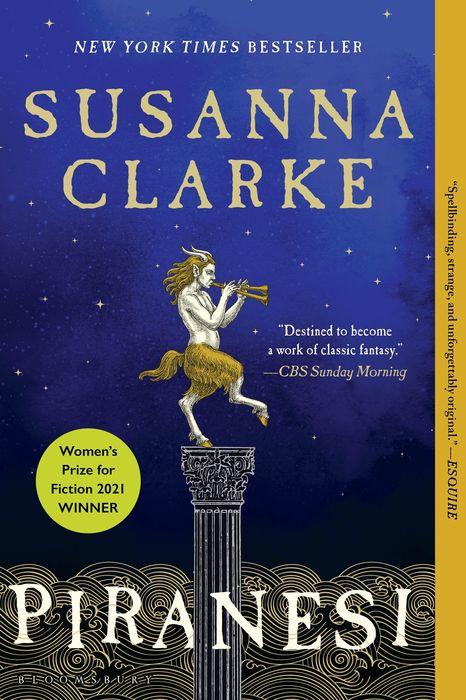
Piranesi by Susanna Clarke

Piranesi by Susanna Clarke
Published September 2020 by Bloomsbury USA
Pages 272

Publisher's Summary: 
Piranesi’s house is no ordinary building: its rooms are infinite, its corridors endless, its walls are lined with thousands upon thousands of statues, each one different from all the others. Within the labyrinth of halls an ocean is imprisoned; waves thunder up staircases, rooms are flooded in an instant. But Piranesi is not afraid; he understands the tides as he understands the pattern of the labyrinth itself. He lives to explore the house. 

There is one other person in the house—a man called The Other, who visits Piranesi twice a week and asks for help with research into A Great and Secret Knowledge. But as Piranesi explores, evidence emerges of another person, and a terrible truth begins to unravel, revealing a world beyond the one Piranesi has always known.

My Thoughts: 
I've been reading...sort of...but I haven't been able to make myself sit down and right a book review for a few weeks. Even when I've enjoyed a book as much as I enjoyed Piranesi. Clarke's first book was the door stopper Jonathan Strange and Mr. Norrell, which I have never picked up for two reasons: 1) it's nearly 900 pages long and 2) the word "magic" appears in the book description. If you've been around long, you know that magic, magical realism, fantasy are book ideas that I tend to veer away from. But Piranesi won the Women's Prize for Fiction in 2020 so, without even reading the description, I requested it from the library. 

And, once again, it's been proven that sometimes a book that leaves reality behind can be just what I need. 

The entire book is told through Piranesi's journals, the journals of a person who lives almost entirely along in a labyrinth of halls and vestibules so expansive that he can walk for hours to reach a hall he has meticulously mapped over his time there. He has managed to figure out how to sustain himself using what the tides bring to him and the few gifts that The Other brings. Piranesi seems content with his life exploring and caring for the 13 human skeletons he has come across in his explorations. But the more he explores, the more he talks to The Other, the more questions he begins to have. And when another human appears in the halls, everything Piranesi has believed in begins to unravel. Who can he trust? Where did the stories in his earliest journals come from? 

Clarke has managed, in under 300 pages, to create a story that Kirkus Reviews calls "weird and haunting and excellent." It is every bit of that and more. While there's nothing here that we can relate to as being a part of our everyday lives, everyone of us can relate to the wonder, the fear, the sadness that Piranesi experiences. And who wouldn't like the idea of a world you could retreat to when the real world becomes too much, a world where magic still exists? This book took me away from the real world and I needed that right now. 

Monday, August 13, 2018

Less by Andrew Sean Greer

Less by Andrew Sean Greer
Published May 2018 by Little, Brown, and Company
Source: bought for my Nook

Publisher's Summary:
Who says you can't run away from your problems? You are a failed novelist about to turn fifty. A wedding invitation arrives in the mail: your boyfriend of the past nine years is engaged to someone else. You can't say yes--it would be too awkward--and you can't say no--it would look like defeat. On your desk are a series of invitations to half-baked literary events around the world.

QUESTION: How do you arrange to skip town?

ANSWER: You accept them all.

What would possibly go wrong? Arthur Less will almost fall in love in Paris, almost fall to his death in Berlin, barely escape to a Moroccan ski chalet from a Saharan sandstorm, accidentally book himself as the (only) writer-in-residence at a Christian Retreat Center in Southern India, and encounter, on a desert island in the Arabian Sea, the last person on Earth he wants to face. Somewhere in there: he will turn fifty. Through it all, there is his first love. And there is his last.

Because, despite all these mishaps, missteps, misunderstandings and mistakes, Less is, above all, a love story.

My Thoughts:
I've started this review three times. What remains of two of those opening paragraphs can now be found at the end of this review. They included points I wanted to make but they didn't say enough about this book. This book that won the Pulitzer Prize despite being a book that includes humor that made me laugh out loud. How often do serious prizes award books like that? How did that happen? Well, it probably happened because Less is really so much more.

This is a travelogue, the story of a man reaching middle age and feeling that he hasn't accomplished anything, a tale of friendship, the story of one man's life. Less is, above all, a love story. It is filled with pain and sadness, it is self-deprecating and funny, it is filled with yearning for the past without hope for the future.

Poor Arthur. He is a man who feels broken in so many ways! He travels the world with a glass half empty view on life and finds, time and again, that life is full of surprises, some of them amazingly wonderful. As Arthur travels, Greer moves the book back and forth in time, effortlessly, so that we learn just how Arthur became the man whose most prized possession was a medium blue suit, lined in fuchsia - "There is no Arthur Less without the suit."

Greer is a master at painting a picture, using the mundane to make the scene come alive:
"It was the year the cicadas returned: less had not been alive when they buried themselves in the earth. But now they returned: tens of thousands of them, horrifying but harmless, drunk driving through the air so they bumped into heads and ears, encrusting telephone poles and parked cars with the delicate, amber-hued, almost Egyptian discarded shells. Girls worse them as earrings. Boys (Tom Sawyer descendants) trapped the live ones in paper bags and released them at study hour. At night, the creatures hummed in huge choruses, the sound pulsing around the neighborhood And school would not end until June. If ever."
"...the endless series of shops, as if made from one continuous concrete barrier, painted at intervals with different signs advertising chickens and medicine, coffins and telephones, pet fish and cigarettes, hot tea and "homely" food, Communism, mattresses, handicrafts and dumbbells and gold by the ounce; the low, flat temples appearing at regular intervals like the colorful, elaborately frosted, but basically inedible sheet cakes displayed at Less's childhood bakery; the women sitting roadside with baskets of shimmering silver fish, terrifying manta rays, and squid, with their cartoon eyes; the countless men standing at tea shops, variety stores, pharmacies, watching Less as he goes by; the driver dodging bicycles, motorcycles, lorries (but few cars), moving frenetically in and out of traffic, bringing Less back to the time at Disney World when his mother led him and his sister to a whimsical ride based on The Wind In The Willows  - a ride that turned out to be a buckle-whitening rattletrap wellspring of trauma."
When we talk about reading more diversely, my brain always goes to the idea that I need to read more books by people of color. Which, of course, I do. What I tend to forget, in that conversation, are all of the books about people whose lives are nothing like mine, even though their skin color may be the same - inner city youths, back country "hill billies," and gay people. It's a shortcoming I'm going to work to remedy in the future. Because everyday I'm reminded that it's incumbent upon us to learn more about each other if we have any hope of understanding each other and coming together. And Greer taught me so much in this book.

I knew in 2009, after I read Greer's The Story of A Marriage, that I would read more books by Greer but for some reason I just haven't gotten around to it, even though I have two others on my Nook. It may be hard now to go back to those. Because Less won the freaking Pulitzer Prize for literature. I mean, how can those other books live up to that?! I suppose they may not. But, given my track record with Greer, I imagine they will still be well worth reading.

Oh, yes, I almost forgot this little gem that reminded me so much of watching baseball when my brother was playing and when my sons were:
"Nothing has happened in right field all season, which is why he was put there: a kind of athletic Canada."
It's a funny line but one that always reminds me how sad it was to watch those boys (including my younger son) who were stuck out in right field. They are so often the boys who have no interest in the sport, but whose parents so badly want them to be part of the team. Like Arthur's father, we parents often need to do a better job and finding the things that bring our children joy, instead of trying to make them fit into our expectations.

Thursday, April 12, 2018

Middlesex by Jeffrey Eugenides

Middlesex by Jeffrey Eugenides
Published September 2002 by Knopf Canada
Read by Kristoffer Tabori
Source: my audiobook purchased at my local library book sale; I also have a physical copy, the origins of which I don't recall

Publisher's Summary:
In the spring of 1974, Calliope Stephanides finds herself drawn to a classmate at her girls' school in Grosse Point, Michigan. That passion -- along with her failure to develop -- leads Callie to suspect that she is not like other girls. The explanation for this is a rare genetic mutation -- and a guilty secret -- that have followed Callie's grandparents from the crumbling Ottoman Empire to Prohibition-era Detroit and beyond, outlasting the glory days of the Motor City, the race riots of 1967, and the family's second migration, into the foreign country known as suburbia. Thanks to the gene, Callie is part girl, part boy. And even though the gene's epic travels have ended, her own odyssey has only begun.


My Thoughts:
"I was born twice: first, as a baby girl...in January of 1960; and then again, as a teenage boy...in August of 1974."


Once upon a time, I suppose I had some inkling what this book was about. Then I forgot. I just knew that it was a book that people raved about. So I bought it. Twice. Then, shortly after I bought the audiobook, I read somewhere that it was the first popular book with a hermaphrodite as its main character; and, I'm ashamed to say, I moved it to the bottom of the pile. And then I listened to podcasts instead of popping in the first disc. I could not imagine 500 pages about a hermaphrodite that wasn't just sensationalized. Stupid, stupid, stupid.

If you've been reading my Sunday posts, or follow me on Instagram, Snapchat, or Litsy, you've been hearing me rave about this book for the past few weeks, "One of the best readings of a book I've ever listened to; Kristoffer Tabori is amazing,""just blown away by Eugenides writing. Why did I wait so long?!" When the end-of-the-year post goes up with my favorites for the year, it's going to be pretty tough to top this one as my favorite audiobook of the year.

But just how did I overcome my qualms about a book featuring an hermaphrodite? I'm not going to lie; some parts of the book made me a little uncomfortable. But, then I've been working the past couple of years to read more books that make me uncomfortable so I appreciate the ways that Eugenides made me learn about human sexuality. In the end, what he seems to be saying about all of that is that it is who we are inside that makes us who we are, not what we are on the outside.

But this book is about so much more than gender identity. It's a coming of age story that's also about war, passion, immigration and the immigrant experience, the rise and fall of a city, racial tensions, religion, nature versus nurture, societies, the American Dream, gender roles, and, most of all, it's about family. The characters in this book will stay with me for a long time: Lefty and Desdemona who escaped the great fire of Smyrna and pursued the American Dream while never leaving their Greek customs entirely behind; Jimmy Zizmo, who was married to their cousin and took them under his wing but who also exposed them to the seamier side of America; Milton, who worked hard to leave behind his Greek roots and become a big man with his Cadillacs and unusual house in the tony suburb of Gross Pointe; the aunts, uncles, and family friends who made up the Sunday dinner crowd. They all made Callie/Cal who she/he was as much by who they were as by genetics.

Does Eugenides sometimes get a little verbose? Oh, yeah, sometimes to the point of ridiculousness. But I'm willing to forgive all of that for the empathy, sadness, humor, and insight that he has imbued his story with. As I said when I was getting near the end, I'm going to miss this book.

Wednesday, September 28, 2011

The Tiger's Wife by Tea Obreht

The Tiger's Wife by Tea Obreht
338 pages
Published March 2011 by George Weidenfeld & Nicholson
Source: bought it

In an unnamed Balkan country, Natalia and her best friend Zora, young doctors, are heading to an orphanage when Natalia learns of the mysterious death of her beloved grandfather. The mystery isn't so much that he died (Natalia has known for some time that he had cancer) but why he died where he died. As Natalia tries to make sense of what her grandfather was doing, she turns to the stories he told her as she was growing up when they made their weekly trips to visit the tigers at the zoo, stories of the deathless man. With mysteries surrounding her (who are the people digging in the vineyard behind the home she and Zora are staying in?), Natalia begins to piece together the greatest story of her grandfather's life, the story of the tiger's wife.
"Everything necessary to understand my grandfather lies between two stories: the story of the tiger's wife, and the story of the deathless man. These stories run like secret rivers through all the other stories of his life...One, which I learned after his death, is the story of how my grandfather became a man; the other, which he told to me, is of how he became a child again."
Obreht picked me right up out of my family room and dropped me into that unknown Balkans country; I could envision myself in the car as Natalia drove along the coast in search of the town where her grandfather died, I felt a bit of panic imagining myself in the isolated valley where Natalia's grandfather grew up. I was particularly enchanted by the stories of the deathless man and the tiger's wife and eagerly read on to learn more about these characters and how they tied in to Natalia's grandfather. I was equally interested in the story of Natalia, a girl who grew up living in a country first on the cusp of war, then at war but in a way that doesn't directly affect her and then, finally, when war came to her city. Through all of this, Obreht contemplates death at all ages.
"But children die how they have been living - in hope. They don't know what's happening so they expect nothing, they don't ask you to hold their hand - but you end up needing them to hold yours. With children, you're on your own."
The story introduces a tremendous number of characters, giving the readers the back story for many of them. This gives the reader a well-rounded vision of the characters but it can become confusing. I can't imagine reading this book over a long period of time without taking notes to keep track of everything.

The Tiger's Wife was the Omaha Bookworms' September selection. Usually we try to read the Pulitzer Prize winner, but after one of our members read (and hated) Jennifer Egan's A Visit From The Goon Squad, we opted to go with the Orange Prize winner instead. We usually try to time our reads so that those who use the library have plenty of advance time to secure a copy and those who buy the books can get it in paperback. Unfortunately, we made our decision too late to get library copies for some people and the book which is only available in hardcover until November which meant that most of our members either didn't get to the book at all or had only managed to get to part of it by the time we met. Those of us who had read the book enjoyed talking about it but it's pretty hard to talk about a book when so many people are still planning to finish it!

Wednesday, May 18, 2011

Brooklyn by Colm Toibin

Brooklyn by Colm Toibin
262 pages
Published March 2010 Simon & Schuster Adult
Source: bought this one to read with the Omaha Bookworms

In Enniscorthy, Ireland in post World War II, jobs are tough to come by so when Eilis Lacey is offered a part-time job at a local shop she can't turn down the opportunity despite the fact that neither her mother nor her sister approve of the owner. Not long afterward, Eilis' beloved sister, Rose, tells Eilis and her mother that she has invited a Father Flood to tea. Father Flood is originally from Enniscorthy but is currently living in the U.S. His purpose in coming to tea is to invite Eilis to come to Brooklyn; he will sponsor her and has already lined up a job and housing. As she sits there listening to the good father, Eilis realizes that both her mother and sister are being unusually quiet and it comes to her that it's really already been decided that she will be going to America.

After a horrible journey across rough seas, Eilis arrives in America to begin her new life and soon settles into a routine that is, well, routine and a little boring. Despite living in Brooklyn in a very exciting time, Eilis lives a very insular life. She goes to work, she goes to night school, she spends what little free time she has almost exclusively at the boarding house. And in all of those places, Eilis makes almost no effort to befriend anyone. She can't seem to find the place where she fits in and the things that happen around her seem to affect her very little. Perhaps the only thing that she is at all aware of is all of the discrimination rampant in the ethnically diverse borough.

Finally Eilis meets a nice Italian boy and discovers first love and finally becomes more a part of America. Then a terrible tragedy takes her back to Ireland. Once there, Eilis begins to feel the draw of a real home, unsure whether she will ever return to America.

I read this book with the Omaha Bookworms for our May selection after it was recommended by one of our members (Mari of Bookworm With A View). Mari loved it, in no small part because it evoked memories of stories she had heard from her grandparents who were Irish immigrants who settled in Brooklyn at about the same time. Only half of the ladies had actually finished the book so it was hard to talk too much about the book but even those who had only gotten part way through the book were really enjoying it.

Time moves at quite a pace in Brooklyn; Toibin bypasses long periods of time between episode and vignettes. Toibin compares his writing style to Ernest Hemingway with good cause; he knows how to tell a story with just what is necessary to tell the story perfectly. Nothing showy or lush about Brooklyn. All of the emotion is just under the surface and yet it is palpable and the characters are believable and realistic. This book was twice short-listed for the Mann Booker Prize and now I know why.

Wednesday, December 1, 2010

Angela's Ashes by Frank McCourt

Angela's Ashes by Frank McCourt
368 pages
Published 1996
Source: I own it

Malachy McCourt had barely arrived in America before he met Angela Sheehan.  Soon she was pregnant and the two were "convinced" that they should marry by Angela's cousins.  Cousins who ever after told her what a terrible man her husband was.  They were right; Malachy McCourt was an alcoholic who was never able to keep a job for more than three weeks and frequently drank his entire pay for a week before he went home.  This was the life that Frank was born into.  Within a couple of years he was joined by brothers Malachy, Oliver, and Eugene and sister Margaret, the apple of her father's eye.  For Margaret, their father stopped drinking and had she lived who knows how the McCourt family's life might have changed.  But she didn't; Malachy started drinking more than ever and Angela sank into a deep depression.  Eventually her cousins convinced the family to return to Ireland, where things went from very bad to much, much worse.
"When I look back on my childhood I wonder how I survived at all.  It was, of course, a miserable childhood: the happy childhood is hardly worth your while.  Worse than the ordinary miserable childhood is the miserable Irish childhood, and worse yet is the miserable Irish Catholic childhood."
A miserable childhood it was.  There were more children born and more children died.  McCourt's father continued his drinking ways, forcing the family to rely for years almost exclusively on the assistance of various agencies (in his defense, it played hugely against him that he was from the North living in Limerick). There was rarely much more to eat than bread and often not enough coal to boil water for tea.  Frank suffered from typhoid fever and the worst case of conjunctivitis that I've ever heard of.  During his three month confinement with the typhoid, he spent most of his time alone in a ward of the hospital where there were no other patients and his mother was not even allowed to visit.  His life at home was so bad, that when he was finally able to return home he found himself longing for the quiet, the warmth and the cleanliness of the hospital.
"I think my father is like the Holy Trinity with three people in him, the one in the morning with the paper, the one at night with the stories and the prayers, and then the one who does the bad thing and comes home with the smell of whiskey and wants us to die for Ireland."

With the second World War going on, many of the Irish father's went to London and began sending home money to the other families on the lane,  When Malachy goes to London, the McCourts finally think their luck has changed.  But not one dime ever arrives from England.  Not only that, but with Malachy gone, the family was no longer eligible for the assistance they had relied on for years.  Now the family become more and more reliant on a family that didn't want to help and a church that kept turning its back on them.
"This is my mother, begging.  This is worse than the dole, the St. Vincent de Paul Society, the Dispensary.  It's the worst kind of shame, almost as bad as begging on the streets where the tinkers hold up their scabby children, Give us a penny for the poor child, mister, the poor child is hungry, missus."
I cannot imagine how any of the McCourt children survived this life.  Yet survive Frank and three of his brothers did.  Frank decided at fourteen to quit school, despite a passion for learning, to become a telegram boy, a job that not only helped his family survive but also allowed him to begin saving money for his eventual escape back to  America. 

Oh Frank McCourt, how I love this book!  I read it the year it won the Pulitzer and it earned a hard to earn spot on my permanent bookshelf.  Which means that, theoretically, I will someday re-read a book.  But I have a hard time ever making myself do that.  How could a book that's sitting on that shelf ever live up to my memory of it?  This one did.

This time I was struck by the fact that McCourt frequently repeated things.  Where I might have thought on the first read that this was done to effectively emphasize his points, this time I did find it excessive.  Still that was the only fault I found with the book.  McCourt spares no one in this book, finding fault with both of his parents, his larger family, the government, and the Catholic church.  But while the book can frequently feel angry, it is more often filled with humor and compassion.  McCourt brings his story to life: the malodor of the outhouse that's shared by the block but right next to the McCourt's house, the sting of the fleas, the misery of living in a house where for six months of the year, the family was forced to live on the second floor due to the flooding on the first floor.  McCourt is a master of the English language and writing in dialect.  I actually responded to my husband one night while reading this with an Irish accent.  Back on the shelf this book will go.  Someday I know I will read it again.

Friday, November 20, 2009

Olive Kitteridge by Elizabeth Strout

Olive Kitteridge by Elizabeth Strout
304 pages
Published September 2008 by Random House
Source: purchased

In this Pulitzer-prize winning novel (actually it's a collection of short stories), Strout explores the life of Olive Kitteridge, a retired middle school math teacher who is the kind of person that people avoid in her small town of Crosby. Olive was not a perfect neighbor, not a perfect wife and certainly not a perfect mother. She is abrasive, outspoken, and not in the least able to communicate well with anyone in her life. Her husband, Henry, was the town pharmacist until a big chain moved into town and Henry was beloved by everyone. Her son, Christopher, does everything he can to avoid his mother after he's an adult. But somehow, in some way, Strout is able to convince us that Olive is someone we should call about.

As a mother, Olive admits that she made mistakes but she says that she loved her son and believes that she raised him in a way so that he always knew that. She has had her own issues growing up that make the reader understand why she is the way she is, so you can understand why she might have been a cold mother. But Christopher remembers things differently. As readers, we are not given a full picture of the past so that we never reach a point where we can judge either party.

In some of the stories, Olive is something of a ship passing in the night; the reader almost misses her presence in the story. In others, she is a peripheral player. It was in those stories that I felt like Strout gave us glimpses of Olive that made her a more bearable person, such as the story where she sits in a car with a suicidal young man and just talks to him until he begins to doubt his choice. And when Olive takes her revenge on her brand new daughter-in-law, readers may just think that it was the most brilliant and realistic piece of revenge they've ever read and justifiable.

Throughout the book, Strout deals with issues of love, marriage and infidelity in all of it's guises as she writes about the people in the town of Crosby that cross paths with Olive. There are cases of unfulfilled extramarital love, a case of infidelity discovered in a seemingly happy marriage of decades, and a case of infidelity in a marriage where one person has given up on the physical relationship. Strout never passes judgement; she puts these situations out for the reader to consider.

My book club read this for our November selection and everyone liked this book. There is a lot here to discuss and I do recommend it for book clubs.

Friday, August 28, 2009

Gilead by Marilyn Robinson

Gilead by Marilynne Robinson
256 pages
Published November 2004 by Farrar, Straus and Giroux

Reverend John Ames is 77-years-old and in ill health in 1956 when he begins writing a letter to his young son, hoping to tell his son, through the letter, all of the things he would have told him if he'd lived longer. In the letter, Ames writes about the two generations of Ames preachers before him, he talks about the death of his first wife and daughter, life in a small town, life in the Midwest and religion. While writing the letter, he is confronted with one of the biggest crises of his life when his namesake, and son of his best friend, returns home. In trying to come to an understanding of the younger man's previous actions and to find forgiveness in his heart, Ames must also face questions of his own self worth.

I am not a good reader when it comes to books that should be read slowly. If I love a book (and I loved this book), I want to devour it. Robinson will not let the reader plow through Gilead. It is simply too beautiful; there is simply too much to be absorbed. The writing is spare and thoughtful. The book has a quietness.
"I was struck by the way the light felt that afternoon. I have paid a good deal of attention to light, but no one could begin to do it justice. There was the feeling of a weight of light--pressing the damp out of the grass and pressing the smell of sour old sap out of the boards on the porch floor and burdening even the trees a little as a late snow would do. It was the kind of light that rests on your shoulders the way a cat lies on your lap."
Ames spends a great deal of time contemplating faith but the book never reads as "preachy." Robinson raises questions but does not attempt to leave the reader with easy explanations or answers.

The Washington Post says: "one feels touched with grace just to read it." The New York Times called it "demanding, grave and lucid."

I had started reading this book when Amy, of My Friend Amy, asked for bloggers to review the fifty books that Newsweek had declared "Books of Our Time." Each of us was to decide if we felt the book we had read was a book of our time. Gilead is not only a book of our time, but I felt that it really is a book for the ages. To see reviews of all of the books, check them out here.

Friday, June 19, 2009

Friday Favorite

With the recent success of "Run," I'm thinking again of my favorite Ann Patchett book, "Bel Canto."


Goodreads.com gives this synopsis: "In an unnamed South American country, a world-renowned soprano sings at a birthday party in honor of a visiting Japanese industrial titan. His hosts hope that Mr. Hosokawa can be persuaded to build a factory in their Third World backwater. Alas, in the opening sequence, just as the accompanist kisses the soprano, a ragtag band of 18 terrorists enters the vice-presidential mansion through the air conditioning ducts. Their quarry is the president, who has unfortunately stayed home to watch a favorite soap opera. And thus, from the beginning, things go awry.

Among the hostages are not only Hosokawa and Roxane Coss, the American soprano, but an assortment of Russian, Italian, and French diplomatic types. Reuben Iglesias, the diminutive and gracious vice president, quickly gets sideways of the kidnappers, who have no interest in him whatsoever. Meanwhile, a Swiss Red Cross negotiator named Joachim Messner is roped into service while vacationing. He comes and goes, wrangling over terms and demands, and the days stretch into weeks, the weeks into months. "

Dawn, at www.sheistoofondofbooks.com, had this to say about "Bel Canto: " Patchett gives us a novel which explores the human condition in a vacuum. With Roxane Coss’ music being the only common language, the hostages and terrorists alike stretch their perceived limits, and we readers join the hostages in a sort of “Stockholm syndrome.” This is a highly recommended hard-to-put-down novel."

There are a lot of characters in this book, but Patchett makes sure none of them gets lost. Each character is fully developed. The kidnappers in this book are real people with a real cause, not stereotypes. The writing is beautiful and compassionate and captures the humanity of both the captives and the captors. In a list of my top ten books, this one makes the grade.

Sunday, June 7, 2009

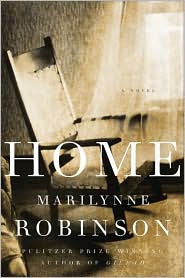
Home by Marilynne Robinson


Home by Marilynne Robinson
336 pages
Published Sept 2008 by Farrar, Straus, and Giroux

Orange Prize winner for 2009

Synopsis:
Glory Boughton, aged thirty-eight, has returned to Gilead to care for her dying father. Soon her brother, Jack—the prodigal son of the family, gone for twenty years—comes home too, looking for refuge and trying to make peace with a past littered with tormenting trouble and pain.
Jack is a bad boy from childhood, an alcoholic who cannot hold a job, he is perpetually at odds with his surroundings and with his traditionalist father, though he remains Boughton’s most beloved child. Brilliant, lovable, and wayward, Jack forges an intense bond with Glory and engages painfully with Ames, his godfather and namesake.
My review:

Pulitzer-prize winning Robinson writes beautiful, languid stories that cannot be rushed through. Jack is a marvelously complex character--a one moment you want to hold him in your arms and comfort him and in the next you want to slap him upside the head and tell him to get his stuff together. His relationship with his father, a retired Presbyterian minister, is complicated--by his father's failing health, his father's unwavering beliefs, and Jack's desire to live up to his father's love without being able to embrace his father's faith.
The story is as much about Glory, who is also struggling with her own demons. Having Jack around helps Glory not only deal with their father, but helps her deal with her ghosts--a broken engagement, the death of a niece and own complicated history with Jack.
There is a "surprise" at the end of the book, which did not come as a surprise to me but explains a great deal about Jack's present pain. And there are no neat and tidy endings in the book--Robinson does not write happily-ever-after stories.