Showing posts with label science fiction. Show all posts

Tuesday, December 30, 2025

Mini-Reviews: Between the Devil and the Deep Blue Sea; Go Gentle; Wild, Dark Shore; Broken Country; Between Two Kingdoms

 All caught up now and ready for the new year! 

Between the Devil and the Deep Blue Sea by Jessica Guerrieri
282 pages
Published May 2025 by Harper Muse

Publisher's Summary: 
Leah O'Connor is torn between her current existence and the allure of a phantom life that can no longer be hers.

Swept off her feet by the gentle charm of Lucas O'Connor, Leah's unexpected pregnancy changes the course of her carefree and nomadic existence. Over a decade and three children later, Leah is unraveling. She resents the world in which her artistic aspirations have been sidelined by the overwhelming demands of motherhood, and the ever-present rift between herself and her mother-in-law, Christine, is best dulled by increasingly fuller glasses of wine.

Christine represents a model of selfless motherhood that Leah can neither achieve nor accept. To heighten the strain, Lucas's business venture, a trendy restaurant that honors his mother, has taken all his attention, which places the domestic demands squarely on Leah's shoulders. Seeking an ally in her sweet sister-in-law Amy, Leah shares a secret that, if made known to the wider family, could disrupt the curated ecosystems that keep the O'Connors connected.

As Leah dances with the devil while descending further into darkness, her behavior becomes more erratic and further alienates her from both Lucas and the wider family. Leah's drinking threatens the welfare of her family, prompting Amy to turn to Christine for support. A duel for loyalty ensues. When the inevitable waves come crashing down, it's the O'Connor women who give Leah a lifeline: the truth of what they've all endured. But Leah alone must uncover the villain of her own story, learn how to ask for help, and decide if the family she has rejected will be her salvation or ultimate undoing.

My Thoughts: 
Despite the fact that this one was only 282 pages, I still felt like it could have been edited down and I did feel like there were options for the O'Connors that would have allowed Leah to continue with her artwork while also allowing Lucas to pursue his dream of recreating his parents' former restaurant that would have avoided the conflict that fueled much of Leah's active addiction.

Still, this one felt like a good depiction of addiction, told from a couple of viewpoints and a good examination of what happens when a woman has children she wasn't planning on having. In this case, Leah very much loves her children, but she never stops feeling like she lost a part of herself when she had them. The publisher's summary seems to insinuate that Leah is the villain of her own story; that's untrue. The only villain here is addiction. 

Go Gentle by Maria Semple
384 pages
Published April 2026 by Penguin Publishing Group

Publisher's Summary: 
Adora Hazzard has it all figured out. A Stoic philosopher and divorcĂ©e, she lives a contented life on New York City’s Upper West Side. Having discovered that the secret to happiness is to desire only what you have, she’s applied this insight to blissful effect: relishing her teenage daughter, the freedom of being solo, and her job as a moral tutor for the twin boys of an old-money family. She’s even assembled a "coven"—like-minded women who live on the same floor in the legendary Ansonia—and is making active efforts to grow its membership. Adora’s carefully curated life is humming along brilliantly until a chance meeting with a handsome stranger.

Soon, her ordered world is upended by black-market art deals, secret rendezvous, and international intrigue . . . and her past—which she has worked so hard to bury—lands like a bomb in her present. Inflamed by unquenchable desire, Adora finds herself a woman wanting more: and she’ll risk everything to get it.

My Thoughts: 
I first encountered Semple's writing in 2010 and might never have picked up another of her books. But then came Where'd You Go Bernadette and the promise that I'd seen in that first book came to fruition in Bernadette. Going into this book, I wondered which version of Semple I'd get and was pleasantly surprised to find that, once again, I felt like Semple more than lived up to my expectations. 

There are some jarring jumps, which some readers may struggle with. There are also a number of things that will be tough for some readers. But once again, Semple's written satire that works on many levels and this is an intelligent read. Adora is a great character and it's nice to read a book about a middle-aged woman that allows her to be a full-fledged person. It's not a book for everyone but it is a book that I'll be recommending to a lot of my reader friends. Jump on board for the ride! 

Wild, Dark Shore by Charlotte McConaghy
320 pages
Published March 2025 by Flatiron Press
A Reese's Book Club pick 

Publisher's Summary: 
A family on a remote island. A mysterious woman washed ashore. A rising storm on the horizon.

Dominic Salt and his three children are caretakers of Shearwater, a tiny island not far from Antarctica. Home to the world’s largest seed bank, Shearwater was once full of researchers, but with sea levels rising, the Salts are now its final inhabitants. Until, during the worst storm the island has ever seen, a woman mysteriously washes ashore.

Isolation has taken its toll on the Salts, but as they nurse the woman, Rowan, back to strength, it begins to feel like she might just be what they need. Rowan, long accustomed to protecting herself, starts imagining a future where she could belong to someone again. 

But Rowan isn’t telling the whole truth about why she set out for Shearwater. And when she discovers sabotaged radios and a freshly dug grave, she realizes Dominic is keeping his own secrets. As the storms on Shearwater gather force, they all must decide if they can trust each other enough to protect the precious seeds in their care before it’s too late—and if they can finally put the tragedies of the past behind them to create something new, together.


My Thoughts: 
One of my favorite books of 2025, which those of you who have been around a while will find surprising when I tell you there's an element of science fiction to this one. Climate change is having a devastating impact on the planet with drought resulting in fires and dying crops and rising sea levels devouring islands and the borders of continents. 

The Salts have to get off the island soon, before it's entirely devoured. Their job is to finish collecting seeds from the seed bank to bring back to the continent before the seed bank is flooded. But members of the family are all dealing with grief following the loss of their wife/mother and they're also harboring a secret they hope will never be discovered. When Rowan is found washed up after a boat wreck, she's also harboring a secret. Despite that, the family and Rowan begin to form an alliance that might just be what it takes to get them all off of the island before it's too late...as long as those secrets stay hidden. This would make an excellent book club selection. 

Broken Country by Clare Leslie Hall 
320 pages 
Published March 2025 by Simon and Schuster
A Reese's Book Club pick

Publisher's Summary
“The farmer is dead. He is dead, and all anyone wants to know is who killed him.”

Beth and her gentle, kind husband Frank are happily married, but their relationship relies on the past staying buried. But when Beth’s brother-in-law shoots a dog going after their sheep, Beth doesn’t realize that the gunshot will alter the course of their lives. For the dog belonged to none other than Gabriel Wolfe, the man Beth loved as a teenager—the man who broke her heart years ago. Gabriel has returned to the village with his young son Leo, a boy who reminds Beth very much of her own son, who died in a tragic accident.

As Beth is pulled back into Gabriel’s life, tensions around the village rise and dangerous secrets and jealousies from the past resurface, this time with deadly consequences. Beth is forced to make a choice between the woman she once was, and the woman she has become.

My Thoughts: 
Another of my favorite books of 2025, one I recommend to everyone. Hall's writing is marvelous and if I could have, I might have read this on in one sitting. 

There's a mystery to that death of the farmer, one that is slowly revealed as Hall moves readers from the past (Beth's and Gabriel's youthful love story) to Beth's and Frank's life together to glimpses into the trial of the accused murder of the farmer. These are well-written characters placed in a story line that allows each character room to explore why they are who they are. This one has everything I love in a novel - terrific writing and characters, a lovely setting both physically and in time, an emotional impact that stayed with me long after I'd finished the book. 

Between Two Kingdoms: A Memoir of a Life Interrupted by Suleika Jaouad
Read by Suleika Jaouad
13 hours, 2 minutes
Published February 2021 by Random House Publishing Group 

Publisher's Summary: 
In the summer after graduating from college, Suleika Jaouad was preparing, as they say in commencement speeches, to enter “the real world.” She had fallen in love and moved to Paris to pursue her dream of becoming a war correspondent. The real world she found, however, would take her into a very different kind of conflict zone.

It started with an itch-first on her feet, then up her legs, like a thousand invisible mosquito bites. Next came the exhaustion, and the six-hour naps that only deepened her fatigue. Then a trip to the doctor and, a few weeks shy of her twenty-third birthday, a diagnosis: leukemia, with a 35 percent chance of survival. Just like that, the life she had imagined for herself had gone up in flames. By the time Jaouad flew home to New York, she had lost her job, her apartment, and her independence. She would spend much of the next four years in a hospital bed, fighting for her life and chronicling the saga in a column for The New York Times.

When Jaouad finally walked out of the cancer ward-after countless rounds of chemo, a clinical trial, and a bone marrow transplant-she was, according to the doctors, cured. But as she would soon learn, a cure is not where the work of healing ends; it's where it begins. She had spent the past 1,500 days in desperate pursuit of one goal-to survive. And now that she'd done so, she realized that she had no idea how to live.

How would she reenter the world and live again? How could she reclaim what had been lost? Jaouad embarked-with her new best friend, Oscar, a scruffy terrier mutt-on a 100-day, 15,000-mile road trip across the country. She set out to meet some of the strangers who had written to her during her years in the hospital: a teenage girl in Florida also recovering from cancer; a teacher in California grieving the death of her son; a death-row inmate in Texas who'd spent his own years confined to a room. What she learned on this trip is that the divide between sick and well is porous, that the vast majority of us will travel back and forth between these realms throughout our lives. 

My Thoughts: 
I was familiar with Jaouad as the wife of musical virtuoso Jon Batiste, and familiar with her recent battle with leukemia through Batiste's movie American Symphony. But I knew nothing about how her battle had begun, how she had beaten leukemia previously, or how she and Batiste had come together. 

Jaouad writes in detail about how her symptoms first appeared, how she battled to keep moving forward with her personal life before she was finally diagnosed, the man she nearly married who stayed with her through much of her battle until it just became too much for him, and the treatments she endured as she fought the cancer. It brings home that fact that battling cancer requires a team far beyond the professionals in the medical buildings and how hard it is for patients to deal with that. It makes it clear how important finding a community that understands is, and how much someone has to want to live to be willing to go through what it takes to come out on the other end. Even though my family members have battled (and some lost that battle to) cancer, I learned so much from this book about what it takes out of a person and their loved ones and about cancers themselves. Jaouad was fortunate to be a skilled enough writer to find work that allowed her to work as much as she could and even to travel the country in search of other stories as she felt able. We are fortunate to have all of those stories. 

Thursday, February 6, 2025

Beautyland by Marie-Helene Bertino

Beautyland
 by Marie-Helene Bertino
Read by Andy Arndt
8 hours, 56 minutes
Published January 2024 by Farrar, Straus, Giroux

Publisher's Summary: 
At the moment when Voyager 1 is launched into space carrying its famous golden record, a baby of unusual perception is born to a single mother in Philadelphia. Adina Giorno is tiny and jaundiced, but she reaches for warmth and light. As a child, she recognizes that she is different: She possesses knowledge of a faraway planet. The arrival of a fax machine enables her to contact her extraterrestrial relatives, beings who have sent her to report on the oddities of Earthlings. 

For years, as she moves through the world and makes a life for herself among humans, she dispatches transmissions on the terrors and surprising joys of their existence. Then, at a precarious moment, a beloved friend urges Adina to share her messages with the world. Is there a chance she is not alone?

Marie-Helene Bertino’s Beautyland is a novel of startling originality about the fragility and resilience of life on our Earth and in our universe. It is a remarkable evocation of the feeling of being in exile at home, and it introduces a gentle, unforgettable alien for our times.

My Thoughts: 
One of the best parts of being part of a family of readers is that they make another great source of book recommendations. In this case, Beautyland was recommended to me by Mini-me. As much as I like to think of myself as reading somewhat diversely, Mini-me puts me to shame. They read everything manga, sci-fi, fantasy, nonfiction, literary fiction. Beautyland is billed as science fiction, what with Adina being an alien communicating with her home planet. But this book can't be so narrowly defined; it reads much more like literary fiction to me. 

Adina "activates" when she is four-years-old, at the moment her head hits the concrete after she is pushed by the father she won't see again until she is an adult. That night she "wakes up" in a classroom with otherworldly teachers who tell her that her mission is to find out if Earth is a planet where others from her planet can survive when their dying planet is no longer viable. When her mother brings home a fax machine from a neighbor's trash and puts it in Adina's room, Adina discovers that if she sends a fax, she will get a reply she believes is coming from her handlers. She begins regularly sending them her impressions of our planet, the humans who inhabit it, and her own life. 
"I require speech lessons and corrective lenses and most likely teeth braces. I am an expensive extra­terrestrial."

‘‘The ego of the human male is by far the most dangerous aspect of human society.’’ 

 ‘‘Death’s biggest surprise is that it does not end the conversation.’’ 

Her observations are often spot on, often touching, and frequently amusing. Often equally amusing are the responses she receives.  

Adina is young, but wise enough never to mention the nightly lessons she will have in the coming years or that fact that she is from another planet that can't be seen. Still others can plainly see that Adina is unusual. It's that very fact that makes her a character that will stay with me for a very long time. While almost all reviewers refer to this as a work of science-fiction, I'm still unsure. Was Adina an alien being or a woman whose brain was rewired by trauma that left her with a unique life experience and take on the world around her? Beautyland works either way, and maybe the fact that I was left wondering made it all that much more impressive. 


Tuesday, July 16, 2024

The Morningside by Tea Obreht

The Morningside
by Tea Obreht
304 pages
Published March 2024 by Random House Publishing House
Source: my copy courtesy of the publisher, through Netgalley, in exchange for an honest review

Publisher's Summary:
There’s the world you can see. And then there’s the one you can’t. Welcome to the Morningside.

After being expelled from their ancestral home in a not-so-distant future, Silvia and her mother finally settle at the Morningside, a crumbling luxury tower in a place called Island City where Silvia’s aunt Ena serves as the superintendent. Silvia feels unmoored in her new life because her mother has been so diligently secretive about their family’s past, and because the once-vibrant city where she lives is now half-underwater. Silvia knows almost nothing about the place where she was born and spent her early years, nor does she fully understand why she and her mother had to leave. But in Ena there is an opening: a person willing to give the young girl glimpses into the folktales of her demolished homeland, a place of natural beauty and communal spirit that is lacking in Silvia’s lonely and impoverished reality.

Enchanted by Ena’s stories, Silvia begins seeing the world with magical possibilities and becomes obsessed with the mysterious older woman who lives in the penthouse of the Morningside. Bezi Duras is an enigma to everyone in the building: She has her own elevator entrance and leaves only to go out at night and walk her three massive hounds, often not returning until the early morning. Silvia’s mission to unravel the truth about this woman’s life, and her own haunted past, may end up costing her everything.

My Thoughts: 
This is the third book by Obreht I've read (and reviewed) and, as much as I enjoyed the other two, this was by far my favorite of her books. With each book, Obreht explores new territory and new time periods. Inland was set in the American West's past; The Tiger's Wife was set in the Balkans in more or less present day. The Morningside takes us to an unknown land, some time in the future. 

Climate change has wrecked havoc on the planet, wars have taken a further toll. We never know exactly where on Earth Silvia and her mother have finally settled (it might be New York City); it's not particularly relevant, other than to that they have traveled a great distance from a land called Back Home. Which isn't to say that the setting doesn't play an important role in the story - it's, in fact, crucial for Obreht to give readers a full impression of the landscape and the way that rising waters have impacted Island City. Much of what we learn of Island City is in stories told to The Dispatcher, a renegade radio program that allows listeners to tell stories of the city as they knew it and the city as it is now. 

Silvia's mother has told her very little about why they are constantly moving or anything about their family, other than that Silvia has an aunt, Ena. When the Repopulation Program enables them to move to Island City and live in the Morningside, where Ena is superintendent, Ena opens a door to the past and the mystical. Because of Ena's stories (particularly that the three dogs Bezi takes for a walk every evening are actually men), Silvia comes to believe that Bezi Duras might actually be a Vila, a nature spirit capable of vengeful acts when angered. 

Because Silvia can't be enrolled in school, she has a lot of time on her hands. Some of it is spent helping her mother. A great deal of it is spent exploring and trying to determine the truth about Bezi. Along the way, she is helped by Lewis May, a man who used to the be superintendent of the building and makes an arrangement with Silvia whereby she is given a key to the elevator to Bezi's penthouse floor. Even after their deal is completed, May remains a constant in Silvia's life. 

One day a new family moves into The Morningside, one with a mysterious father who isn't much seen but will come to play a big part in Silvia's future, and a daughter who becomes Silvia's only friend and the driving force behind moving Silvia along in learning the truth about Bezi. 

I wouldn't want to be a bookseller or a librarian trying to figure out where to shelve The Morningside; it is equal parts science-fiction (cli-fi, as some are calling it), fairy tale, and dystopian novel. It has an element of magic that I surprisingly loved and some wonderfully unique characters and situations. I wasn't always sure what to make of it. But I loved that I had no idea where the story was going. Even the ending, which ties things up more neatly than I often like, isn't nearly a happily-ever-after and comes with something extra that makes me rethink things right up to the end of the book. Utterly original and one of my favorites of the year. 


Tuesday, February 6, 2024

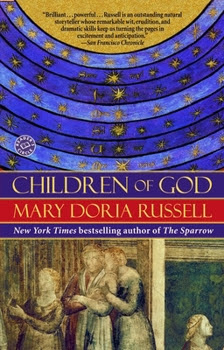
Children of God by Mary Doria Russell

Children of God
by Mary Doria Russell
Read by Anna Fields
17 hours, 57 minutes
Published 1998 by Villard

Publisher's Summary: 
The only member of the original mission to the planet Rakhat to return to Earth, Father Emilio Sandoz has barely begun to recover from his ordeal when the Society of Jesus calls upon him for help in preparing for another mission to Alpha Centauri. Despite his objections and fear, he cannot escape his past or the future. 

Old friends, new discoveries and difficult questions await Emilio as he struggles for inner peace and understanding in a moral universe whose boundaries now extend beyond the solar system and whose future lies with children born in a faraway place.

My Thoughts: 
Children of God is Mary Doria Russell's sequel to 1996's The Sparrow, which I read in 2014 (my review here). I loved that book, it was a standout in a year of great reads. It broke my heart and I have never forgotten it. I had either never realized there was a sequel or forgotten all about it until a co-worker mentioned it a while back. I was eager to get back to find out what happened to Emilio Sandoz, who hasn't left my mind in 10 years. 

What didn't work for me: 
  • Like The SparrowChildren of God moves back and forth in time. For some reason, this time around that didn't really work for me. I felt like too much was revealed too soon. 
  • Russell asks us to forgive characters in this one that we had grown to (let's be honest here) hate in The Sparrow. As a person, I understand that people are complicated and grow and change over time. As a reader, I often struggle with that. I had a hard time forgiving Supaari (the character who sold Emilio in The Sparrow) regardless of what we learn about him in this one and never could stop hating Hlavin Kitheri. 
  • A lot of time was spent developing a relationship between Emilio and a woman on earth that he plans to marry, before he is kidnapped and returned to Rakhat. It was what helped Emilio heal but then Russell turns around and does a terrible thing to him again. Later, we're apparently meant to believe that it was God's plan that he return to Rakhat. Not a fan of a plan that causes so much pain.
  • The Sparrow was very much centered around a few central characters, a family of sorts, Children of God is a much broader novel. There are a lot of characters in this one and, when listening especially, it's difficult to keep track of them and equally difficult to care about them.  
  • Sorry, but I really didn't "get" the ending. And it felt a little bit like the whole book led to a point of "trust in God." 
What I liked: 
  • Emilio Sandoz. He's perhaps an almost too good character, but he is not without depth of character. He struggles with forgiveness, faith, trust, and an ability to open himself back up again. 
  • Although there are a lot of characters in this one and we don't necessarily get as in depth a look into them as we would with a smaller "cast," we do get to see the complexity of many of the characters. 
  • Russell really explores how our intentions, even when meant for the best, can also go terribly awry or be misinterpreted. 
  • Russell explores the universality of conflict, how important communication and compromise are, how vital forgiveness is. Even if I did have a problem with forgiveness of particular characters, I understand that, in order to find peace, forgiveness is essential. 
  • As a person who struggles with faith and long ago gave up on organized religion, I appreciate that Russell puts organized religion, its methods, and intentions under a microscope. 
Would I recommend it? I've got such mixed feelings. I'm not sure The Sparrow needed a sequel. I'm not sure I gained anything by there being one, other than that Emilio finally found some peace. 

Thursday, June 16, 2022

Kindred by Octavia Butler

Kindred
by Octavia Butler
Read by Kim Staunton
10 hours 55 minutes
Published 1979

Publisher's Summary:
Having just celebrated her 26th birthday in 1976 California, Dana, an African-American woman, is suddenly and inexplicably wrenched through time into antebellum Maryland. After saving a drowning white boy there, she finds herself staring into the barrel of a shotgun and is transported back to the present just in time to save her life. During numerous such time-defying episodes with the same young man, she realizes the challenge she's been given: to protect this young slaveholder until he can father her own great-grandmother. 

My Thoughts: 
Kindred has been on my list of book that I really should read sooner rather than later for at least a decade. Clearly that list isn't doing what it's supposed to do. When one of my book club members suggested we read this one this summer, I decided time travel was as good a link to summer travel as any other kind. 

But Kindred is most decidedly not the light summer read I would usually pick for the summer. It's definitely going to be a tough read for my book club members, including some things we usually try to avoid in books. But it's an important book for a number of reasons. 

First of all there's this (from the Barnes and Noble website): "Octavia E. Butler (1947-2006) was considered one of the best science fiction writers of her generation. The Patternist series (including her first novel, Patternmaster) established her among the science fiction elite. But it was Kindred, a story of a black woman who travels back in time to the antebellum South that brought her mainstream success. For years the only African-American woman writing science fiction books, like Parable of the Sower, Butler encouraged others to follow in her path." Butler was the first science fiction writer to earn a MacArthur fellowship and the first black woman to win both Hugo and Nebula awards. It's always a great idea to read the books that broke new ground and led the way for so many others. 

Then, of course, there's the issue of slavery, decades before the Civil War. Even as we're reading about horrible beatings of slaves, especially run away slaves, rape of the female slaves by the masters, and the selling off of children and husbands, Butler continually emphasizes that the Weylins were much less severe than other slave owners. Again and again, Dana is thrown through time, forced to save the life of a white man who seems determined, more and more through the years, to kill himself and it's up to her to save him to save herself. 

Along the way Dana must learn how to balance the person she is in the present day with the person she must be in the antebellum South. When she inadvertently transports her white husband back with her once, they are forced to live the lie that he is her master and she his property. She becomes desperate to get him back to the present time, fearful that life in the South in the early 19th century will change the man she loves permanently. Through the years, and the abuse she endures, Dana begins to worry that she, too, will be changed in ways that will mark her for the rest of her life. The characters in this book are not caricatures; they are individuals, each with their own strengths and weaknesses, each with their own ways to survive. 

Kindred will certainly not be my last book by Butler. Although, I'm sorry to say, it may be the last I listen to as I felt the reading lacked the gravitas the book deserves. 


Thursday, March 17, 2022

Never Let Me Go by Kazuo Ishiguro

Never Let Me Go
by Kazuo Ishiguro
9 hours 40 minutes
Read by Roslayn Lander
Published 2005 by Random House

Publisher's Summary: 

As children, Kathy, Ruth, and Tommy were students at Hailsham, an exclusive boarding school secluded in the English countryside. It was a place of mercurial cliques and mysterious rules where teachers were constantly reminding their charges of how special they were. 

Now, years later, Kathy is a young woman. Ruth and Tommy have reentered her life. And for the first time she is beginning to look back at their shared past and understand just what it is that makes them special—and how that gift will shape the rest of their time together.

My Thoughts: 
I loved the movie adaptation of Ishiguro's The Remains of the Day and was so happy to discover that the book was everything the movie was and more. For years I've been meaning to pick up more of his work, this one in particular, expecting much the same. I've been thinking about this book for a couple of weeks now and I'm still not sure if I got much of the same or nothing of the sort. 

Both books are an exploration of morals and a longing for the past. Both are quiet, character driven and explore personal relationships. Both are beautifully written; both explore the relationship between its main character and an institution. Both Kathi H., here, and Stevens, in Remains of the Day are carers of a sort. But whereas, The Remains of the Day is a work of historical fiction, Never Let Me Go is a work of a dystopian world. They could not have felt any more different to me. 

In Never Let Me Go we learn early on that Kathi is a "carer" for "donors," some of whom are her former classmates. Slowly Kathi takes us back to life at Hailsham, which seems like a perfectly ordinary boarding school with something of an emphasis on the arts. There are sports, cliques, teenagers becoming couples. But it doesn't take long to figure out that this is not, in fact, an ordinary boarding school. These children never seem to leave the premises. There are no visits from parents, there are no funds from home or new clothes to show off. It becomes clear that these children are being raised for a purpose.
"I can see we were just at that age when we knew a few things about ourselves -- about who we were, how we were different from our guardians, from the people outside -- but hadn't yet understood what any of it meant."

Eventually, as they transition from school to their real purpose in life, we learn what that purpose is. Which doesn't entirely come as a surprise but the truth of their existence is even uglier. As he did in The Remains of the Day, Ishiguro keeps the ugly parts of life mostly in the background. But here they are harder to hide...and harder to read. 

One reviewer said that the book has hope. I didn't see that; I felt overwhelmed by the bleakness of Kathi's life and future. This is not a book readers can relate to and these are not characters readers can relate to but every reader can feel the sadness of a life lived for the singular purpose these characters live for. Perhaps at a different time in my life I might have enjoyed such a desolate book more, might have appreciated it for its lessons about mankind. I won't give up on Ishiguro; his writing continues to impress but this was not for me - not now anyway. 


Tuesday, February 15, 2022

Cloud Cuckoo Land by Anthony Doerr

Cloud Cuckoo Land
by Anthony Doerr
Read by Marin Ireland and Simon Jones
14 hours 52 minutes
Published September 2021 by Scribner

Publisher's Summary: 
Thirteen-year-old Anna, an orphan, lives inside the formidable walls of Constantinople in a house of women who make their living embroidering the robes of priests. Restless, insatiably curious, Anna learns to read, and in this ancient city, famous for its libraries, she finds a book, the story of Aethon, who longs to be turned into a bird so that he can fly to a utopian paradise in the sky. This she reads to her ailing sister as the walls of the only place she has known are bombarded in the great siege of Constantinople. Outside the walls is Omeir, a village boy, miles from home, conscripted with his beloved oxen into the invading army. His path and Anna’s will cross.

Five hundred years later, in a library in Idaho, octogenarian Zeno, who learned Greek as a prisoner of war, rehearses five children in a play adaptation of Aethon’s story, preserved against all odds through centuries. Tucked among the library shelves is a bomb, planted by a troubled, idealistic teenager, Seymour. This is another siege. And in a not-so-distant future, on the interstellar ship Argos, Konstance is alone in a vault, copying on scraps of sacking the story of Aethon, told to her by her father. She has never set foot on our planet.

My Thoughts: 

Definition of cloud-cuckoo-land : a realm of fantasy or of whimsical or foolish behavior

Man, are reader reviews all over the place on this one. One reviewer called it "an original idea maybe - but one big conceit." Another said it's "academic snobbery." Another said it was "hours wasted I'll never get back." But then there are those who called it a "rare and beautiful experience,"weird but awesome," and "a heart wrenching journey." So what's a reader to do when faced with those vastly different opinions about a book? 

Read the reviews. All of them. They almost all have valid points, things to be taken into consideration before you devote this much time to a book. It is a bit of a conceit to think that you can pull off a book that has this many different time lines, this many characters that deserve full attention, and tie them all to an imaginary ancient story written by actual Greek Antonius Diogenes. It is weird. It can also be jarring as it bounces from storyline to storyline; even, even though the readers are fantastic, it might be easier to keep up with in print than audio. 

But, for me at least, it was also awesome, original, and heart wrenching. Every one of the storylines tied into that ancient Greek story, Cloud Cuckoo Land and every one of them tied into one another through that text. Every one of the main characters is an outsider whose on journey is helped along by the ancient tale. It's a recognition of those who have treasured and saved written stories over the centuries and a recognition of what those stories can do for us. Doerr's characters are well developed, his settings incredibly vivid, and his command of storytelling is so impressive. 

If you loved All The Light You Cannot See, you'll recognize all of those elements from that book. But this one is definitely an entirely different kind of book, even as much as readers might like to see Doerr return to that kind of story telling. Don't look for that in this book and you will not be disappointed. This book defies categorization - it is at once science fiction, historical fiction, and fantasy. Doerr its on so many themes that will keep readers thinking about the book long after they have finished reading it. This book is a once a realm of fantasy and a book solidly set in reality. 


Thursday, December 9, 2021

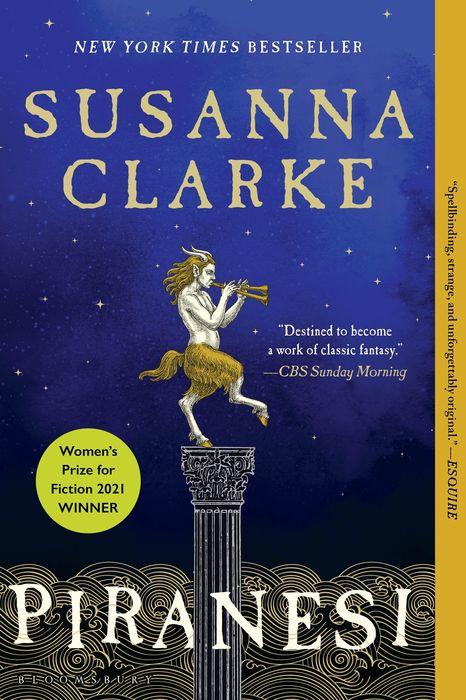
Piranesi by Susanna Clarke

Piranesi by Susanna Clarke
Published September 2020 by Bloomsbury USA
Pages 272

Publisher's Summary: 
Piranesi’s house is no ordinary building: its rooms are infinite, its corridors endless, its walls are lined with thousands upon thousands of statues, each one different from all the others. Within the labyrinth of halls an ocean is imprisoned; waves thunder up staircases, rooms are flooded in an instant. But Piranesi is not afraid; he understands the tides as he understands the pattern of the labyrinth itself. He lives to explore the house. 

There is one other person in the house—a man called The Other, who visits Piranesi twice a week and asks for help with research into A Great and Secret Knowledge. But as Piranesi explores, evidence emerges of another person, and a terrible truth begins to unravel, revealing a world beyond the one Piranesi has always known.

My Thoughts: 
I've been reading...sort of...but I haven't been able to make myself sit down and right a book review for a few weeks. Even when I've enjoyed a book as much as I enjoyed Piranesi. Clarke's first book was the door stopper Jonathan Strange and Mr. Norrell, which I have never picked up for two reasons: 1) it's nearly 900 pages long and 2) the word "magic" appears in the book description. If you've been around long, you know that magic, magical realism, fantasy are book ideas that I tend to veer away from. But Piranesi won the Women's Prize for Fiction in 2020 so, without even reading the description, I requested it from the library. 

And, once again, it's been proven that sometimes a book that leaves reality behind can be just what I need. 

The entire book is told through Piranesi's journals, the journals of a person who lives almost entirely along in a labyrinth of halls and vestibules so expansive that he can walk for hours to reach a hall he has meticulously mapped over his time there. He has managed to figure out how to sustain himself using what the tides bring to him and the few gifts that The Other brings. Piranesi seems content with his life exploring and caring for the 13 human skeletons he has come across in his explorations. But the more he explores, the more he talks to The Other, the more questions he begins to have. And when another human appears in the halls, everything Piranesi has believed in begins to unravel. Who can he trust? Where did the stories in his earliest journals come from? 

Clarke has managed, in under 300 pages, to create a story that Kirkus Reviews calls "weird and haunting and excellent." It is every bit of that and more. While there's nothing here that we can relate to as being a part of our everyday lives, everyone of us can relate to the wonder, the fear, the sadness that Piranesi experiences. And who wouldn't like the idea of a world you could retreat to when the real world becomes too much, a world where magic still exists? This book took me away from the real world and I needed that right now. 

Wednesday, May 26, 2021

Project Hail Mary by Andy Weir

Project Hail Mary
by Andy Weir
Published May 2021 by Random House Publishing Group
Source: my copy courtesy of the publisher, through Netgalley

Publisher's Summary:
Ryland Grace is the sole survivor on a desperate, last-chance mission—and if he fails, humanity and the earth itself will perish.

Except that right now, he doesn’t know that. He can’t even remember his own name, let alone the nature of his assignment or how to complete it.

All he knows is that he’s been asleep for a very, very long time. And he’s just been awakened to find himself millions of miles from home, with nothing but two corpses for company.

His crewmates dead, his memories fuzzily returning, Ryland realizes that an impossible task now confronts him. Hurtling through space on this tiny ship, it’s up to him to puzzle out an impossible scientific mystery—and conquer an extinction-level threat to our species.

And with the clock ticking down and the nearest human being light-years away, he’s got to do it all alone.

Or does he?

My Thoughts:
Andy Weir's written three books and I've read them all. That might seem odd until you think about how few science-fiction books I read. But Weir hooked me with his debut, The Martian, and he gave me more than enough in Artemis to keep me reading his work. 

Weir doesn't need to worry about what I think about this book; it's already a bestseller and is being made into a movie starring Ryan Gosling. But maybe he should because I'm not alone in feeling that this book had so much potential but just missed the mark so many times. 

Perhaps a different editor would have said "hey, this book is 100 pages too long," or "you've got this really sexist stuff in here that won't play well with a good part of your readers" or "there are a couple of gaping holes in this story." Weir's developed a bit of a formula now and part of that requires coming up with a lot of problems that his very clever lead character needs to solve. It seems to mean that some things that shouldn't need to become problems do just so that the lead character can solve them. If you've read or seen The Martian, you'll see the pattern. 

Don't get me wrong, I love the clever character who has to use all of his (or her) wits to survive. And I'm not opposed to reading a whole lot of science stuff to get there. And since I don't know a whole lot about science and this is largely speculative fiction, I don't really care if the science is even right (except that even I know that if you're going to move into zero g, you'd better have your seatbelt on; Ryland Grace doesn't seem to know that). And I enjoyed the back and forth between Ryland trying to survive and Ryland gradually remembering what happened that got him where he is. As much as I liked Ryland (and I did, even when I wanted to slap him for being stupid), he was not my favorite character. Rocky is by far and away my favorite character. Unlike any character I've ever seen in a book, Rocky is an insatiable learner, highly creative and intelligent, a great friend, and surprisingly emotionally sensitive. 

I'm crossing my fingers that when they wrote the screenplay, they winnowed out the parts that didn't make sense or that seemed over the top and left moviegoers with more than enough action and a terrific story. Because there really is a great story here and it did have me racing along, even as I shook my head. Weir has included some things that, literally, made me gasp in surprise and that's always a good thing, right? I Here's where I hope the movie hews to the book - the ending is surprising and unique and I'm afraid that Hollywood will do what Hollywood so often does and ruin the movie by changing the ending. 

In the end, I'm glad I read this one, even as frustrating as I so often found it. 

Monday, February 22, 2021

Falling From Trees by Mike Fiorito - Guest Review

Falling From Trees
by Mike Fiorito
Published February 2021 by Loyola College/Apprentice House
Paperback: 115 pages
Source: my copy courtesy of the publisher, and TLC Book Tours, in exchange for an honest review. 

Publisher's Summary:
Exploring the possibility of sentient knowledge, FALLING FROM TREES by Mike Fiorito is a unique collection of short stories with sci-fi undertones. Perfectly pitched and paced, they are a refreshing addition to the short story genre in the tradition of Italo Calvino, Stanislaw Lem, and Philip K. Dick. Fiorito’s stories grab the reader from the very first sentence and never let go. In clear, provocative and often poetic prose, they explore love, consciousness, identity and the human condition—and succeed in elevating the commonplace to the surreal. Fiorito invites us to interrogate our thinking. “These are not cynical tales,” he writes in the book’s preface. “In fact, they celebrate our potential salvation.”

Heartfelt, with longing and humor, Fiorito’s stories are written in short bursts of other-worldly auras as they knowingly vacillate between science fiction, speculative and literary genres. A few of the stories portray quasi-realistic scenes from the lives of couples and families. Others create worlds that are strange and sad, hopeful and poignant, brilliant and mysterious.

In “Climbing Time,” the first story in FALLING FROM TREES, aliens reach out to individuals with Asperger’s, communicating through vivid, wordless dreams. Other stories contemplate the disastrous impact of climate change. The interconnected “Pale Leviathan” and “Tomorrow’s Ghost” depict the ferocity of the sun invading homes cooled with “freezing air units” and the claustrophobia of a world where children are forced to stay indoors. “The Numbers Man,” “A Star in Time,” and other interconnected stories follow the enigmatic alien Smith through believable yet mysterious encounters with humans in a homeless encampment, a National Park, a beach town and a bar.

While often fantastic, the twenty-one stories in FALLING FROM TREES are ultimately about our lives and the relationships that mean the most to us. “Fiorito teaches us we need not look across the universe for universal truth,” writes Chad Frame, Director of the Montgomery County Poet Laureate Program. “Indeed his characters are as genuine and relatable as they are vast and mysterious. Through them, we can come to understand our place in it a little bit better.”

My Thoughts:
Sometimes when I get pitched a book, I know instantly it's a book for me. Other times I know instantly that it's a book my husband will enjoy. This book fell into the later category. For a guy who has trouble focusing for long, short stories are perfect and when those short stories fall into a variety of styles, they're even better for convincing a guy to sit down and read. Here are my husband's thoughts on Falling From Trees:

Falling From Trees by Mike Fiorito is an interesting little short story book that is a quick, fun read.  It technically falls into the science fiction genre. Even though the stories develop quickly, the stories have great character development, continuity and threads of various common topics flowing through them.  

The author has the theme of aliens helping the people of Earth save themselves from various forms of destruction, particularly around ways we are killing ourselves off or randomness of the universe destroying our world.  Climate and even politics, in particular, pop up periodically in many of the stories but you don't feel over counseled or preached to as the messages are imbedded in interesting stories.

While this sounds depressing it has a very positive and upbeat tone in most cases with a strong feeling of hope that we can save ourselves or be saved from otherworldly beings.  The stories tie together with, as I said, similar underlying themes and characters.   I like the tone of the characters and stories; and, even though other worldly in many cases, they are something more believable.  I particularly enjoyed the first story, Climbing Time, about how those with Asperger's are the people able to communicate with aliens; The Three Bridges, about an astrophysicist meeting a magician; and Earth To Earth, about a character in the Mojave desert. 

Falling from Trees is an interesting and fun read that can be enjoyed by a broad spectrum of ages and men or women.  It has my seal of approval!

Thanks to the ladies of TLC Book Tours for including us on this book tour. For other opinions, please check out the full tour

About Mike Fiorito 

Mike Fiorito is an Associate Editor for Mad Swirl Magazine and a regular contributor to the Red Hook Star Revue. Mike is the author of Call Me Guido published by Ovunque Siamo Press. He is also the author of Freud’s Haberdashery Habits published by Alien Buddha Press. Mike lives in Brooklyn, NY with his wife and two sons. He is currently working on a novel.

Monday, March 30, 2020

The Vanished Birds by Simon Jimenez

The Vanished Birds by Simon Jimenez
Published January 2020 by Random House Publishing
Source: my copy courtesy of the publisher, through Netgalley, in exchange for an honest review

Publisher's Summary:
A solitary ship captain, drifting through time.

Nia Imani is a woman out of place. Traveling through the stars condenses decades into mere months for her, though the years continue to march steadily onward for everyone she has ever known. Her friends and lovers have aged past her. She lives only for the next paycheck, until the day she meets a mysterious boy, fallen from the sky.

A mute child, burdened with unimaginable power.

The scarred boy does not speak, his only form of communication the haunting music he plays on an old wooden flute. Captured by his songs and otherworldly nature, Nia decides to take the boy in to live amongst her crew. Soon, these two outsiders discover in each other the things they lack. For him, a home, a place of love and safety. For her, an anchor to the world outside of herself. For both of them, a family. But Nia is not the only one who wants the boy.

A millennia-old woman, poised to burn down the future.

Fumiko Nakajima designed the ships that allowed humanity to flee a dying Earth. One thousand years later, she now regrets what she has done in the name of progress. When chance brings Fumiko, Nia, and the child together, she recognizes the potential of his gifts, and what will happen if the ruling powers discover him. So she sends the pair to the distant corners of space to hide them as she crafts a plan to redeem her old mistakes.

But time is running out. The past hungers for the boy, and when it catches up, it threatens to tear this makeshift family apart.

My Thoughts:
I requested this from Netgalley but for the life of me I can't remember why. It's not entirely uncommon for me to not remember what a book is about when I start reading it but I when I started reading this book, it wasn't even something that I would normally choose. Sci-fi? Me? Still, I have read and enjoyed sci-fi and Jimenez pulled me into his story immediately. Or, should I say his first story. Because The Vanished Bird is not so much a novel as a series of closely connected short stories that Jimenez will bring full circle by the time the book ends.

For a while, though, we're not so certain where the book is going. The book begins on the planet Umbai-V, where we first meet Nia when she arrives there to pick up a harvest and she first meets young Kaeda. Her ship arrives on the planet every 15 years, although only a few months has passed for her between visits. He is smitten and when she returns 15 years later, the two of them make love. It feels like we're reading a love story; and we are, but not the love story we're expecting. Because, of course, Kaeda is aging more than 15 times as fast as Nia. And Nia's heart will soon belong to the young boy.

So when Fumiko makes her a job offer, Nia chooses trying to save the boy over the crew which had become her family and sets out with a new crew. Fumiko thinks the boy make have a power she is certain the corporation she has spent her life working for will exploit for profit. While she has spent 1000 years helping the corporation dominate the universe, she will not stand by quietly and watch them destroy the boy.

Now, as a person who hasn't read much sci-fi, I can only guess as to how true fans will respond to this book. But I believe it will give them everything they want in a sci-fi novel - space travel, world building, time travel, a whole lot of science, and a lot of action. But the book's strength is in the fiction part of that genre name, in its characters and their relationships. It's a book about incredible greed and incredible love. About the power of one person and the power of connections.

So while I can't remember what made me request this book, I'm certainly happy that I did. It's reminded me that it's good to go out of your comfort zone; there are good stories to be found everywhere.


Monday, February 19, 2018

Frankenstein, or the Modern Prometheus by Mary Shelley

Frankenstein. or the Modern Prometheus by Mary Wollstonecraft Shelley, read by Simon Vance*
Published: originally in 1818
Source: bought the audiobook at my local library book sale

Summary:
Frankenstein tells the story of committed science student Victor Frankenstein. Obsessed with discovering "the cause of generation and life" and "bestowing animation upon lifeless matter," Frankenstein assembles a human being from stolen body parts but; upon bringing it to life, he recoils in horror at the creature's hideousness. Tormented by isolation and loneliness, the once-innocent creature turns to evil and unleashes a campaign of murderous revenge against his creator, Frankenstein.


My Thoughts:
Frankenstein is one of those books that I've long felt like I "should" read but I really didn't have any interest in it. This was, of course, entirely based, almost entirely, on the movie adaptations I've seen of it. I envisioned a great lot of discussion of the piecing together of body parts, long passages of trial and error. But when I found the audiobook for only $2 at the library book sale, and it was only seven discs long, I decided to knock this one off the need-to-read list.

Certainly this is the perfect book for the R.I.P. challenge in the fall, but it is so much more than a horror story. Is it a science fiction story, then? Not entirely, even though science plays a big part in it early on and some sources say that it may well be the first real science fiction story written. For me, Frankenstein is more a psychological morality tale than anything else. It is certainly a book that remains relevant.

Recently scientists cloned monkeys; certainly there have to be those who think that humans can't be far behind. Mary Shelley seems to suggest we should rethink that. What of the consequences? Victor Frankenstein was certainly a man who allowed his obsession and intelligence to carry him into uncharted waters without thought of the ramifications.

Over the years, people have mistakenly called the creation "Frankenstein." More recently, the popular opinion has become that Victor is the real monster. I defy you to read this book and not come away from it still wondering about that.

Certainly Victor, immediately upon seeing what he had created, walked away, leaving his creation to fend in a world Victor knew would not accept him. On the other hand, the creation is a thinking being, who educates himself and then chooses violent revenge. And would it be right or wrong for Victor to create a mate for his Adam, as the creation demands?

There is so much to think about in this book and there are no easy answers.

*If you have never read this book, I highly recommend the audiobook. Simon Vance is, as ever, amazing. He truly makes the story come alive. Even though I often sat in my car a little longer than necessary to keep listening, I was never tempted to pick up a paper copy of the book so that I could keep reading because I wanted Vance to read me the book.

Monday, November 6, 2017

Artemis by Andy Weir

Artemis by Andy Weir
Published November 2017 by Crown/Archetype
Source: my copy courtesy of the publisher, through Netgalley, in exchange for an honest review

Publisher's Summary:
Jazz Bashara is a criminal.

Well, sort of. Life on Artemis, the first and only city on the moon, is tough if you're not a rich tourist or an eccentric billionaire. So smuggling in the occasional harmless bit of contraband barely counts, right? Not when you've got debts to pay and your job as a porter barely covers the rent.

 Everything changes when Jazz sees the chance to commit the perfect crime, with a reward too lucrative to turn down. But pulling off the impossible is just the start of her problems, as she learns that she's stepped square into a conspiracy for control of Artemis itself—and that now, her only chance at survival lies in a gambit even riskier than the first.


My Thoughts:
A couple of years ago, we gave Weir's The Martian to Mini-him for Christmas. He read it, passed it along to us, and it sat on the shelf for two years. Until a couple of months ago when I read it and thoroughly enjoyed it. Just in time to find out that Weir's latest, Artemis, was available for review so I immediately downloaded it. Then got very nervous that it wouldn't live up to its predecessor. So, how did it live up to my expectations?

Set in space? Check.

Yes, yes, I know the whole point of grown up books with descriptive words is to paint a picture in the reader's mind of what the scenes look like. But, dang, I really wished this was a picture book so you know I can't wait until this gets turned into a movie. Which you know it will be.

Filled with humor? Check.

It's official. I'm pretty much in love with Andy Weir's sense of humor.

Loaded with tension? Check.

This time the it's not just space that's trying to kill our hero. There are actual people with actual weapons. And there's murder, and chase scenes, and a cop trying to take down our girl.

Also loaded with science? Check.

As with The Martian, I have no idea if all of the science rings true. It mostly sounds plausible enough and Weir writes it interestingly enough to make me want to read it and try to understand it.

But, this is also the only real problem I had with Artemis. It's set 100 years from now, right? But, on several occasions, Weir refers to devices and such that we use now. Based on the way that the world has changed in the past 100 years, I can't help but think that people wouldn't still be watching cable TV; that even for the older generation, laptop computers might be archaic; and that fiber optics might have been replaced by something we can't even imagine yet. Still, that's all a small enough thing, because...

Book I couldn't put down because it was so much fun? Check!

I adored Jazz, with all of her faults. And this time, Weir's lead character got to have real interactions with his other characters and I thoroughly enjoyed the relationships Jazz had with the men in her life. Did I like it as much as the first book? Maybe not quite; but, to some extent, that was only because I knew something of what to expect from Weir. Still, it's a a book I will happily recommend to anyone who enjoyed The Martian. In fact, I might just have to make this one a Christmas present for Mini-me as well!


Monday, September 18, 2017

The Martian by Andy Weir

The Martian by Andy Weir
Published:
Source:

Publisher's Summary:
Six days ago, astronaut Mark Watney became one of the first people to walk on Mars.

Now, he's sure he'll be the first person to die there.

After a dust storm nearly kills him and forces his crew to evacuate while thinking him dead, Mark finds himself stranded and completely alone with no way to even signal Earth that he’s alive—and even if he could get word out, his supplies would be gone long before a rescue could arrive.

Chances are, though, he won't have time to starve to death. The damaged machinery, unforgiving environment, or plain-old "human error" are much more likely to kill him first.

But Mark isn't ready to give up yet. Drawing on his ingenuity, his engineering skills—and a relentless, dogged refusal to quit—he steadfastly confronts one seemingly insurmountable obstacle after the next. Will his resourcefulness be enough to overcome the impossible odds against him?

My Thoughts: 
Well, damn, that was fun! Doesn't seem like it should have been, does it? You expect drama. You expect science. You get plenty of both of those. But Weir also imbues Mark Watney with a terrific sense of humor which keeps this book from slipping into complete hopelessness.

It may also turn out that I like science fiction much more than I think I do.


via GIPHY

I have no way of knowing how much of the "science" in this book is accurate, but it certainly read as accurate and believable and I bought into it entirely. I may have skimmed over some of the scientific explanation (ok, I did skim over some of the lengthier passages) but most of it was fascinating. While Watney was a well-trained, scientifically-minded person, he wasn't going to survive simply based on his own training. He had to rely as much on his own instincts and common sense as science and he is not infallible, all of which make him easier to relate to than the real astronauts we watch on t.v.

The book doesn't entirely focus on Watney, though. No way is he going to survive being left on Mars without a lot of help from Earth. The politics, ingenuity, and hard work involved on Earth are nearly as interesting as what Watney experiences. The crew that evacuated without Watney is also an integral part of the story, although they are not as fully developed characters as they were in the movie adaptation of the book.

Speaking of that movie, I liked it a lot when I saw it. I like it even more now that I've read the book. It includes all of the important details of the book, fleshes out the crew of Watney's mission, and Matt Damon is perfectly cast as Watney. It's understood that it would take a small army on earth to do what needs to be done to save an astronaut lost in space, but the movie did pull back on that piece of the story and focused on fewer Earth-bound players. It's a sacrifice that didn't really impact the story.

I'd give both the book and the movie adaptations high marks. Mini-him, who was given this book for Christmas a couple of years ago, agrees. Now the book gets passed on to The Big Guy. It's definitely a book you want to put into another person's hands.

Saturday, June 19, 2010

Mama Shepp's Family Recommends...

Ten years or so ago, the pilot light went out on my furnace. The only thing to do while I waited for help was to light the fireplace and spend some time in my robe and slippers in front of the computer. What's all that got to do with this book, you ask? Hold on...I'm getting to that. On a lark, I did a search on my paternal grandmother's name. It's something of an unusual name and I didn't really expect to find anything but, what the heck, there was nothing better to do. Lo and behold, I discovered the family of my great-grandfather's brother. Excited, I called my mom and told her. She took it and ran...and discovered an enormous family of cousins that we didn't even know existed. Including a cousin in Arizona and her husband, who shall hereafter be known as the Arizona cousins. Catchy, I know. I love to see her Facebook posts--he is a wonderful photographer so she posts great shots of nature in their area that is like nothing we have here. And, did I mention, they read.

Arizona cousin was raving about Kim Stanley Robinson's The Years of Rice and Salt on Facebook the other day so, of course, I had to check it out. Here's what she says about the book:


"The Years of Rice and Salt," an outstanding novel by Kim Stanley Robinson, examines the possible rise of civilization without Europeans (who all die of plague in the 14th century). Using the device of reincarnation to hold the story together, the story examines religion, philosophy, culture, history, and math and science. The characters are vital and charismic. The ending is dramatic. Take your time reading through this one. It's well worth it."

Kim Stanley Robinson is best known as an award-winning science-fiction writer of the Mars trilogy. Anyone who's been following this blog for long would, therefore, understand why I had never heard of him. Other than some Ray Bradbury years ago, I really don't touch the stuff. But this one really intrigues me. And if this is science fiction, then maybe I need to rethink my position on that genre!