Showing posts with label social issues. Show all posts

Tuesday, March 4, 2025

The Museum of Failures by Thrity Umrigar

The Museum of Failures
by Thrity Umrigar
368 pages
Published September 2023 by Little, Brown and Company

Publisher's Summary: 
When Remy Wadia left India for the United States, he carried his resentment of his cold and inscrutable mother with him and has kept his distance from her. Years later, he returns to Bombay, planning to adopt a baby from a young pregnant girl—and to see his elderly mother again before it is too late. She is in the hospital, has stopped talking, and seems to have given up on life.

Struck with guilt for not realizing just how ill she had become, Remy devotes himself to helping her recover and return home. But one day in her apartment he comes upon an old photograph that demands explanation. As shocking family secrets surface, Remy finds himself reevaluating his entire childhood and his relationship to his parents, just as he is on the cusp of becoming a parent himself. Can Remy learn to forgive others for their human frailties, or is he too wedded to his sorrow and anger over his parents’ long-ago decisions?

Surprising, devastating, and ultimately a story of redemption and healing still possible between a mother and son, The Museum of Failures is a tour de force from one of our most elegant storytellers about the mixed bag of love and regret. It is also, above all, a much-needed reminder that forgiveness comes from empathy for others.

My Thoughts: 
This is the sixth of Umrigar's books that I've read; any new book she writes will automatically be added to the TBR list. Why? Because I can reliably count on her to write books that explore relationships - between parents and children, between spouses, between friends. Because she writes complex characters with empathy. Because she tackles complex social issues, particularly class and gender. And because she always teaches me more about the country of India and Indian culture. 

The Museum of Failures gave me all of those things. 

One reason Remy has spent so little time in India since going to the U.S. was the idea (initially introduced to him by his beloved father who urged him to get out of India) that, as a country, it is a museum of failures; failures that are all too obvious to Remy when he visits. The other reason is his relationship with his mother, who has always been cold and distant, even cruel at times. 

When he arrives in India to look into adoption (his American wife believes they should adopt a baby from India so that it looks more like one of them), he discovers that his mother has been admitted to the hospital and is very ill. The cousin he pays to look out for her doesn't appear to have been taking care of either his mother or her apartment. His frustration mounts when the young girl who was going to let Remy and his wife adopt her baby backs out and with the care his mother is receiving in the hospital. 

In dealing with all of these situations, and surrounded by old friends,Remy learns a lot about himself, his family, and his country. But there is a cost to be paid for what he learns when a long buried secret is revealed; now he must learn to forgive and understand. 

There's a lot going on in this book and a lot of introspection on Remy's part. Sometimes he felt like too much, too many complications in one place. And I have to admit that I wasn't wild about the ending, which just seemed a bit too tidy for me. But Umrigar's books are always satisfying reads. I love reading about this culture with all of its many facets. Here, Umrigar, as ever, makes readers see that you have to truly know someone and what they've been through in life to understand them. 

Thursday, June 27, 2024

All You Have To Do Is Call by Kerri Maher

All You Have To Do Is Call
by Kerri Maher
Read by Lauryn Altman
13 hours, 15 minutes
Published September 2023 by Penguin Publishing Group

Publisher's Summary: 
Chicago, early 1970s. Who does a woman call when she needs help? Jane.
 
The best-known secret in the city, Jane is an underground health clinic composed entirely of women helping women, empowering them to embrace their futures by offering reproductive counseling and safe, illegal abortions. Veronica, Jane's founder, prides herself on the services she has provided to thousands of women, yet the price of others' freedom is that she leads a double life. When she's not at Jane, Veronica plays the role of a conventional housewife-a juggling act that becomes even more difficult during her own high-risk pregnancy.
 
Two more women in Veronica's neighborhood are grappling with similar disconnects. Margaret, a young professor at the University of Chicago, secretly volunteers at Jane as she falls in love with a man whose attitude toward his ex-wife increasingly disturbs her. Patty, who's long been content as a devoted wife and mother, has begun to sense that something essential is missing from her life. When her runaway younger sister, Eliza, shows up unexpectedly, Patty must come to terms with what it really means to love and support a sister.
 
In this historic moment, when the personal was nothing if not political, Veronica, Margaret, and Patty risk it all to help mothers, daughters, sisters, and friends. With an awe-inspiring story and appealing characters, All You Have to Do Is Call celebrates the power of women coming together in the face of seemingly insurmountable odds.

My Thoughts: 
It didn't take me very long to figure out why my friend had recommended this book to me. She is well aware of my feelings about this subject and knows how I love a book that ties the past to events currently happening. 

She also knows how much I love to learn something new when I'm reading. Here I learned about the Jane Collective which was, according to Wikipedia, an underground service in Chicago, affiliated with the Chicago Women's Liberation Union, which sought to address the increasing number of unsafe abortions performed by untrained providers. As in the book, the service was started by a woman who went with another woman when she got an abortion and then began helping other women to get safe abortions. Eventually, when demand became too great for her to handle alone, she brought in others to help. Eventually, many of the women in the collective learned how to do D&Cs so that they could provide services to women who were too poor to afford other services and to women of color. 

In this book, we see the toll that kind of work would have had on the women involved. At a time when abortion was illegal, secrecy was paramount as so much was at stake. None of it would have been possible without the bond the women involved created, a great deal of strategy to keep things as secret as possible, and the help of officials and medical professionals who supported the work. It was a great deal of stress and we see how that plays out in the lives of these women, both those who provide the service and those who need to use it. 

The book is filled with interesting relationships between women: Veronica's with Patty, who doesn't know about Veronica's work and wouldn't support it; Siobhan's relationship with Veronica as they work together to provide the kind of care that Siobhan didn't get; Margaret's relationship with Phyllis, the work colleague who opens Margaret's eyes to life as a black person at that time and to the group she has become so passionate about helping; and Patty's relationship with Eliza, the sister who disappeared after their father died and who balks at Patty's attempts to mother her. 

To an extent, Maher is preaching to the choir with this book - I don't know that any reader who isn't already open to the idea would pick it up and have their mind changed. But I loved learning this history and being reminded of what life will once again be like for so many women if the country returns to a time when safe abortions are no longer legal. Kudos to Maher for tackling this piece of history. 

Thursday, May 2, 2024

Poverty, by America by Matthew Desmond

Poverty, by America by Matthew Desmond
304 pages
Read by Dion Graham
5 hours, 40 minutes
Published March 2023 by Crown Publishing Group

Publisher's Summary: 
The United States, the richest country on earth, has more poverty than any other advanced democracy. Why? Why does this land of plenty allow one in every eight of its children to go without basic necessities, permit scores of its citizens to live and die on the streets, and authorize its corporations to pay poverty wages? 

In this landmark book, acclaimed sociologist Matthew Desmond draws on history, research, and original reporting to show how affluent Americans knowingly and unknowingly keep poor people poor. Those of us who are financially secure exploit the poor, driving down their wages while forcing them to overpay for housing and access to cash and credit. We prioritize the subsidization of our wealth over the alleviation of poverty, designing a welfare state that gives the most to those who need the least. And we stockpile opportunity in exclusive communities, creating zones of concentrated riches alongside those of concentrated despair. Some lives are made small so that others may grow. 

Elegantly written and fiercely argued, this compassionate book gives us new ways of thinking about a morally urgent problem. It also helps us imagine solutions. Desmond builds a startlingly original and ambitious case for ending poverty. He calls on us all to become poverty abolitionists, engaged in a politics of collective belonging to usher in a new age of shared prosperity and, at last, true freedom.

My Thoughts (and those of others): 
“Provocative and compelling . . . [Desmond] packs in a sweeping array of examples and numbers to support his thesis and . . . the accumulation has the effect of shifting one’s brain ever so slightly to change the entire frame of reference.”—NPR 

 “[Poverty, by America is] a book that could alter the way you see the world. . . . It reads almost like a passionate speech, urging us to dig deeper, to forget what we think we know as we try to understand the inequities upon which America was built. . . . A surprisingly hopeful work.”—Minneapolis Star Tribune

“A powerful polemic, one that has expanded and deepened my understanding of American poverty. Desmond approaches the subject with a refreshing candidness and directs his ire toward all the right places.”—Roxane Gay

“This book is essential and instructive, hopeful and enraging.”—Ann Patchett

Yes, yes, yes, and yes. This book is every bit of all of those things. It's another book that makes me so angry while I'm reading it; so hopeful that maybe, just maybe, we can start making that changes needed to, at a minimum, reduce poverty; and, so disappointed in myself for not knowing more about this subject and doing more to help. 

Desmond doesn't just offer up an accounting of the failures of this country, its leaders, and its citizens. He offers solutions. Solutions that seem reasonable and doable, if only we could get our priorities straight and see how lifting everyone up with help all of us. 

But in me, Desmond is preaching to the choir. I'm open to listening to what he has to say and can see the logic in his thinking. Unfortunately, I doubt that the people who most need to read this book will ever pick it up. 

This book made me feel smarter, more informed. In fact, as I was listening to it, the issue of the minimum wage came up in a discussion and I was able to contribute an idea that I had learned from listening to this book. My only issue with this book - I wish I'd had it all in print so that I could have highlighted passages to save and refer back to later. There is so much here I want to make sure I don't forget. 

Thursday, March 14, 2024

The Last Romantics by Tara Conklin

The Last Romantics
by Tara Conklin
Read by Cassandra Campbell
12 hours, 14 minutes
Published February 2019 by HarperCollins Publishers

Publisher's Summary: 
In the spring of 1981, the young Skinner siblings — fierce Renee, dreamy Caroline, golden-boy Joe, and watchful Fiona — lose their father to a heart attack and their mother to a paralyzing depression, events that thrust them into a period they will later call “the Pause”. Caught between the predictable life they once led and an uncertain future that stretches before them, the siblings navigate the dangers and resentments of the Pause to emerge fiercely loyal and deeply connected.

Two decades later, the Skinners find themselves again confronted with a family crisis that tests the strength of these bonds and forces them to question the life choices they've made and what, exactly, they will do for love.

Narrated nearly a century later by the youngest sibling, the renowned poet Fiona Skinner, The Last Romantics spans a lifetime. It's a story of sex and affection, sacrifice and selfishness, deeply held principles and dashed expectations, a lost engagement ring, a squandered baseball scholarship, unsupervised summers at the neighborhood pond, and an iconic book of love poems. But most of all, it is the story of Renee, Caroline, Joe, and Fiona: the ways they support each other, the ways they betray each other, and the ways they knit back together bonds they have fractured.

My Thoughts: 
The Last Romantics is a book about the things that tie a family together and the things that tear them apart, which makes me very glad to have chosen it as one of this year's book club selections. There's a lot to discuss here, including both the strengths and the weaknesses (in my opinion, of course) of the book. Let's get those (again, in my opinion) weaknesses out of the way first. 

The Weaknesses: 
  • Fiona works, for most of the book, for a climate watch group, which is all very well and good. Except that the book alternates between 100+-year-old Fiona telling a group of fans about her family history while outside it's clear that climate change has, indeed made a powerful impact on the Earth. Except that's not really touched on all that much and it doesn't really impact that story in any way. It could have been left out or incorporated more. 
  • So the entire reason for Fiona to tell the audience her family's story is to explain to them who the "Luna" that appears in her most famous poem was to her family. We finally get to that point late in the book and then I felt like we got bogged down in that piece of the story. I wanted the story to be about the siblings and not veer off into Luna's story; and then I found the girls' obsession with finding Luna very strange and unlikely. 
The Strengths: 
  • I do love me a good story about siblings - about their relationships with each other and about who each of them are in their own lives. 
  • These are particularly strong characters. While Fiona is clearly the main character of the book, each of her siblings are well-developed and any one of them stands on their own. We can clearly see how the young child they were grew into the adults they became and how The Pause impacted that growth. 
  • There are a lot of themes explored in the book and they never feel forced. 
  • I very much liked the way Conklin tied up the book. You all know I enjoy a book that doesn't necessarily tie everything neatly with a bow at the end. 
I'm so looking forward to hearing what my book club members think of this one! 

Thursday, March 4, 2021

A Children's Bible by Lydia Millett

A Children's Bible
by Lydia Millett
Published May 2020 by Norton, W. W. and Company, Inc.
Pages: 240

Publisher's Summary:
An indelible novel of teenage alienation and adult complacency in an unraveling world. Pulitzer Prize finalist Lydia Millet’s sublime new novel—her first since the National Book Award long-listed Sweet Lamb of Heaven—follows a group of twelve eerily mature children on a forced vacation with their families at a sprawling lakeside mansion. 

Contemptuous of their parents, who pass their days in a stupor of liquor, drugs, and sex, the children feel neglected and suffocated at the same time. When a destructive storm descends on the summer estate, the group’s ringleaders—including Eve, who narrates the story—decide to run away, leading the younger ones on a dangerous foray into the apocalyptic chaos outside. 

As the scenes of devastation begin to mimic events in the dog-eared picture Bible carried around by her beloved little brother, Eve devotes herself to keeping him safe from harm.

My Thoughts:
"From the wraparound porch, with its bamboo torches and hanging ferns and porch swings, moth-eaten armchairs and blue-light bug zappers, the barks of laughter carried. We heard them from the treehouses and tennis courts and from the field of beehives a slow neighbor woman tended in the daytime, muttering under the veil of her beekeeping hat. We heard them from behind the cracked panes of the dilapidated greenhouse or on the cool black water of the lake, where we floated in our underwear at midnight."
A group of liberal, educated, self-absorbed friends has rented a great house, built by a robber baron, for the summer, bringing along their children who they proceed to ignore for weeks. The adults sleep, drink heavily, do drugs, and have sex with others in the group. The children disdain them, refusing to acknowledge which of the parents are their own. The kids fear growing into their parents and accepting their values, such as they are. 

The tone of the book turns much darker when a massive hurricane almost turns the house into an island, knocks out power and drops a massive tree branch into the attic. It becomes almost immediately apparent to the children that their parents are not going to save them so they load into some of the cars with supplies and head out with the help of a caretaker. Their hope of reaching the home of one of the families is quickly dashed when it becomes clear the roads are impassable. The caretaker guides them to a farm he has worked on and there they establish a kind of sanctuary, aided by a three other adults who wander in off the Appalachian Trail. But in the aftermath of the now almost nonstop storms, and the continuing failure of society and the infrastructure, things become much more dangerous. 

Narrator Eve's younger brother, Jack, is given a copy of A Children's Bible by one of the mothers. As a boy who has never had any exposure to religion, Jack's reaction is to view the book as an allegory.
“God’s a code word,” he explains to his sister. “They say God but they mean nature. . . . And we believe in nature. There’s lots the same with Jesus and science,” he says. “For science to save us we have to believe in it. And same with Jesus.”

Millet's story is also an allegory, with many parallels to the Bible: birth in a barn, plague, a flood that covers the earth, Bethlehem, Noah, Sodom and Gomorrah, a crucifixion, and angels.  Those allusions don't necessarily lead anywhere but they do serve to make readers understand that we are reading a modern telling of Revelations. The Bible allegory is Millet's tool for exploring climate change and also feels like the ultimate children versus parents. The children are rightly angry at the many ways the parents have failed them, particularly in ignoring what was happening to the world they were leaving for their children. It's a wake up call for those of us who think we are doing enough by recycling, not buying bottled water, and applauding solar energy. 

Source: checked out from my local library

Thursday, February 11, 2021

Caste by Isabel Wilkerson

Caste: The Origins of Our Discontents
by Isabel Wilkerson
Read by Robin Miles
Published August 2020 by Random House Publishing Group

Publisher's Summary:
“As we go about our daily lives, caste is the wordless usher in a darkened theater, flashlight cast down in the aisles, guiding us to our assigned seats for a performance. The hierarchy of caste is not about feelings or morality. It is about power—which groups have it and which do not.” 

In this brilliant book, Isabel Wilkerson gives us a masterful portrait of an unseen phenomenon in America as she explores, through an immersive, deeply researched narrative and stories about real people, how America today and throughout its history has been shaped by a hidden caste system, a rigid hierarchy of human rankings. 

Beyond race, class, or other factors, there is a powerful caste system that influences people’s lives and behavior and the nation’s fate. Linking the caste systems of America, India, and Nazi Germany, Wilkerson explores eight pillars that underlie caste systems across civilizations, including divine will, bloodlines, stigma, and more. Using riveting stories about people—including Martin Luther King, Jr., baseball’s Satchel Paige, a single father and his toddler son, Wilkerson herself, and many others—she shows the ways that the insidious undertow of caste is experienced every day. She documents how the Nazis studied the racial systems in America to plan their out-cast of the Jews; she discusses why the cruel logic of caste requires that there be a bottom rung for those in the middle to measure themselves against; she writes about the surprising health costs of caste, in depression and life expectancy, and the effects of this hierarchy on our culture and politics. Finally, she points forward to ways America can move beyond the artificial and destructive separations of human divisions, toward hope in our common humanity.

My Thoughts: 
I took three pages of notes while reading this book, notes I will keep to refer back to over time. That says a lot about how much I learned from this book and how important I think it is, especially now as I'm working to become a better person. 

I first came across the idea of a caste system in the U.S. in Michelle Alexander's The New Jim Crow and was eager to learn more about. Like, what's the difference between a system that keeps certain people down based on caste and one that does it based on race? 

According to Wilkerson, "Any action or institution that mocks, harms, assumes or attaches inferiority or stereotype on the basis of the social construct of race can be considered racism. Any action or structure that seeks to limit, hold back or put someone in a defined ranking, seeks to keep someone in their place by elevating or denigrating that person on the basis of their perceived category can be seen as casteism." 

Wilkerson contends that race is an American social construct, developed apart from logic or science, a concept developed to keep the hierarchy as it is in order to maintain the upper caste's ranking, advantage, and privilege, designed to elevate some above others or to keep others beneath the upper caste. Two things distinguish caste, according to Wilkerson: the policing of roles expected of people based on what they look like, first, and second the monitoring of boundaries, the disregard of the boundaries of the subordinate caste or the passionate construction of boundaries by the dominant caste to keep the hierarchy in place. 

Wilkerson has clearly done her research but Caste doesn't feel like a work of research. Wilkerson blends the larger historical picture with intimate, and often personal, anecdotes. She compares the caste system in the U.S. with that in India and in Nazi Germany. Did you know that the Nazis looked to the U.S. handling of how to determine if someone was black when they were looking for ways to deal with their Jews? According to Wilkerson, there are eight pillars of caste, among them Purity vs. Pollution, Occupational Hierarchy, and Terror as Enforcement. That last one plays a big role in the book and one of Wilkerson's examples struck home. In September 1919, Will Brown, a black man arrested on suspicion of attacking a white woman, was brutally murdered outside of the courthouse in Omaha. I knew the story but Wilkerson included details I'd never heard. Finding that kind of story about your city in a book such as Caste is quite the gut punch. It's not the only time I had a visceral reaction while reading this book. 

I can't recommend this book highly enough for anyone who wants to gain a deeper understanding of how we've come to the point where some Americans will storm the U.S. Capital in an effort to retain their position in the hierarchy. Robin Miles does a marvelous job reading Caste but I can't help but wish I had read it in print, in a book I own. I have a feeling I'm going to be coming back to this book again and again. 

Source: audiobook checked out from my local library

Monday, January 25, 2021

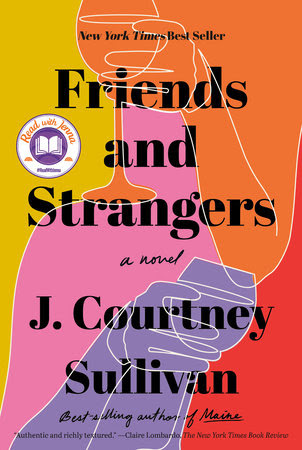
Friend and Strangers by J. Courtney Sullivan

Friends and Strangers by J. Courtney Sullivan 
Published June 2020 by Knopf Doubleday Publishing Group 
Source: checked out from my local library 

Publisher's Summary: Elisabeth, an accomplished journalist and new mother, is struggling to adjust to life in a small town after nearly twenty years in New York City. Alone in the house with her infant son all day (and awake with him much of the night), she feels uneasy, adrift. She neglects her work, losing untold hours to her Brooklyn moms' Facebook group, her "influencer" sister's Instagram feed, and text messages with the best friend she never sees anymore. Enter Sam, a senior at the local women's college, whom Elisabeth hires to babysit. Sam is struggling to decide between the path she's always planned on and a romantic entanglement that threatens her ambition. She's worried about student loan debt and what the future holds. In short order, they grow close. But when Sam finds an unlikely kindred spirit in Elisabeth's father-in-law, the true differences between the women's lives become starkly revealed and a betrayal has devastating consequences. 

My Thoughts: 
Ron Charles, of The Washington Post, says that says "Sullivan approaches her story with deep-seated compassion for both sides." That may well be true, but I must say that I couldn't muster that same compassion for Elisabeth. Poor Elisabeth, Sullivan seems to be saying, her life has been upturned with a move from the city and a new baby. I had trouble feeling sorry for poor Elisabeth, though. 

I got that she had an unpleasant family life growing up, with two parents who were more involved in their own lives than those of her children, and that it affected her whole life. But much of what you might have expected Elisabeth to have learned seems to have escaped her. Her inability to communicate well with anyone in her life is astonishing and trust seems to be something that's a one-way street for Elisabeth. I've been in Elisabeth's shoes - home with a new baby and no friends to reach out to during the day (my friends were all working). It was lonely. But I also knew that it had been my choice, after much discussion with my husband. Discussions with Andrew seem to be lacking in Elisabeth's life. 

In her own loneliness, Elisabeth takes advantage of Sam in ways that create conflict for Sam. Sam, as she nears the end of her college years, loves the idea of having an adult friend, someone who seems to life figured out. But there is also a feeling of obligation on Sam's part and a fear of saying "no" to the person who holds the pursestrings. 

And there's where I felt like this book really got it's traction - the difference between classes, the haves and the have-nots. Elisabeth's ignorance of the fact that she doesn't have to worry about money because she has always had it, the way both Elisabeth and Sam think they know best how to help those lower than them on the economic ladder, the way the changing economy destroyed Andrew's father's business and the college town that is a shell of itself outside of the college core. Ron Charles has high praise for Friends and Strangers. I wish I had liked it as much as he did because there was a lot to explore in this one.