Sunday, October 7, 2012
Sunday Salon - October 7
Greetings from chilly Omaha! I hate it but we've had to turn the heater on already. It's going to be time this week to pull out the flowering plants and put away the pots for the year; the potted herbs have already come inside. I'm not getting as much reading done as I'd hoped to during the FrightFall readathon but there's still today, right?
Here's What I'm:
Listening To: The Center of Everything by Laura Moriarty which I picked up for $2 at my library's weekly book sale. I didn't even know until this week that they had books on CD. There weren't a lot there that I was interested in but with an ever changing selection, I'm betting there will be at least one more I want when I'm done with this one.
Watching: "Legally Blonde: The Musical" at the playhouse in my hometown. We usher there several times a season and they put on some really terrific shows.
Cooking: Bruschetta with the last ripe tomatoes we're going to get out of our garden this season. It's gotten so cold; we had our first freeze last night. We have a brown grocery bag full of green tomatoes wrapped in newspaper that should ripen for us for a couple more weeks but they aren't quite as good as the one picked at just the right time.
Making: A mess in my basement as we continue to work on major rearranging, settling Mini-him back in, and decluttering. I'm definitely not the garbage man's best friend right now but the Goodwill is loving me!
Grateful for: The beautiful fall foliage. I'm working hard to enjoy them this year; the past few years I've only been able to see them as the harbinger of months of brown bleakness.
Happy about: That I have a good vacuum. We're loving these cats but if I'm going to be able to keep them, I'm going to have to be able to keep the hair cleaned up. And, dang, there's a lot of fur!
Looking forward to: A trip to Half-Price Books. I was planning to go on Thursday but we had to switch vehicles and the books I had ready were in my vehicle on the other side of town. Say, do they have audio books?
Labels:
Sunday Salon
Friday, October 5, 2012
Fairy Tale Fridays - Names To Know
Over the past two years, we've talked about some names to know when you're serious about learning more about fairy tales. We've talked about some of the artists, some of the compilers, some of the authors, and once, an academic, Maria
Tartar.
Today I'd like to introduce you to a few more of the who's-who in the academic world of fairy tales and folklore. Like so many of these posts, this one was not at all on my radar when I sat down to write a post. As I was reading some of my go-to blogs for fairy tale news, I chanced to discover that a Fairy Tale prize had been awarded in Europe which got me to wondering, "just how many people are out there still trying to learn more about fairy tales and to spread the word?"
I suppose if any continent were going to have a Fairytale prize it would be Europe.The 2012 winner of the prize is Wolfgang Mieder, professor of German and folklore at the University of Vermont. Mieder says the explosion of fairy tales in movies, books and series may actually be diluting the tales potency. With so many tales available, one of the things that carried fairy tales through the centuries, "the connecting element is lost." It's good to know that Mieder does have hope for the tales, although he seems to lament the fact that the tales are no longer passed orally. "If you ask someone on the street to tell a fairytale, very few people could do it. Even though we know fairy tales, we're no longer used to telling them."
"In fairy tales, age-old problems - normal, day-to-day problems people
have - are allegorized in a poetic, symbolic language. We can identify
with one another across boundaries," according to Mieder, who has been studying fairy tales for over 40 years.To learn more about how fairy tales address modern problems, check out this article at DW.
Jack Zipes, Professor Emeritus at the University of Minnesota, agrees that fairy tales are still relevant. "They are a means of communicating about serious problems, such as rape (Red Riding Hood) and abandonment of children (Hansel and Gretel)," according to Zipes. He does believe that the symbolism of fairy tales can make it difficult to see how "remarkably they comment on society." It's this challenge that seems to make the study of fairy tales so rewarding.
Here on Fairy Tale Fridays, we've talked before about the sanitization of fairy tales. Zipes is wholeheartedly against it. "The sanitizaton process and political correctness can be very dangerous because they lead to censorship, police states, radical fundamentalism, etc." I think we can safely assume, as we celebrate Banned Books Week, that Zipes is also opposed to the banning of books.
Ruth B. Bottigheimer, a professor at Stony Brook University in New York, is a lady who is raising eyebrows in the field of fairy tale studies. It's her contention that fairy tales were not handed down orally but were, instead, passed down in print. "Literary analysis undermines it [oral tradition], literary history rejects it, social history repudiates it, and publishing history (whether of manuscripts or of books) contradicts it." She specifically points to the Cinderella-type tales as an example, stating the "economic conditions and legal restrictions" of mid-16th century Venice led to this type of tale and collections of tales from this time are the first record of this type of tale. This is bound to be a hot topic of debate among literary scholars. In the world of fairy tales, it's akin to the first scientists who said that no, in fact, the world was not flat.
Tartar.
Today I'd like to introduce you to a few more of the who's-who in the academic world of fairy tales and folklore. Like so many of these posts, this one was not at all on my radar when I sat down to write a post. As I was reading some of my go-to blogs for fairy tale news, I chanced to discover that a Fairy Tale prize had been awarded in Europe which got me to wondering, "just how many people are out there still trying to learn more about fairy tales and to spread the word?"
I suppose if any continent were going to have a Fairytale prize it would be Europe.The 2012 winner of the prize is Wolfgang Mieder, professor of German and folklore at the University of Vermont. Mieder says the explosion of fairy tales in movies, books and series may actually be diluting the tales potency. With so many tales available, one of the things that carried fairy tales through the centuries, "the connecting element is lost." It's good to know that Mieder does have hope for the tales, although he seems to lament the fact that the tales are no longer passed orally. "If you ask someone on the street to tell a fairytale, very few people could do it. Even though we know fairy tales, we're no longer used to telling them."
Jack Zipes, Professor Emeritus at the University of Minnesota, agrees that fairy tales are still relevant. "They are a means of communicating about serious problems, such as rape (Red Riding Hood) and abandonment of children (Hansel and Gretel)," according to Zipes. He does believe that the symbolism of fairy tales can make it difficult to see how "remarkably they comment on society." It's this challenge that seems to make the study of fairy tales so rewarding.
Here on Fairy Tale Fridays, we've talked before about the sanitization of fairy tales. Zipes is wholeheartedly against it. "The sanitizaton process and political correctness can be very dangerous because they lead to censorship, police states, radical fundamentalism, etc." I think we can safely assume, as we celebrate Banned Books Week, that Zipes is also opposed to the banning of books.
Ruth B. Bottigheimer, a professor at Stony Brook University in New York, is a lady who is raising eyebrows in the field of fairy tale studies. It's her contention that fairy tales were not handed down orally but were, instead, passed down in print. "Literary analysis undermines it [oral tradition], literary history rejects it, social history repudiates it, and publishing history (whether of manuscripts or of books) contradicts it." She specifically points to the Cinderella-type tales as an example, stating the "economic conditions and legal restrictions" of mid-16th century Venice led to this type of tale and collections of tales from this time are the first record of this type of tale. This is bound to be a hot topic of debate among literary scholars. In the world of fairy tales, it's akin to the first scientists who said that no, in fact, the world was not flat.
Thursday, October 4, 2012
Telegraph Avenue by Michael Chabon
Published September 2012 by HarperCollins Publishers
Source: my copy courtesy of the publisher and TLC Book Tours
Archy Stallings and Nat Jaffe , co-owners of Brokeland Records, a used vinyl record store in Oakland that serves as a gathering place for the community, are struggling to keep their dream alive. Former NFL star Gibson Goode is coming to town and bringing his own record store, a three-story behemoth that is certain to put Brokeland out of business. But it's tough to fight a guy who's beloved as a hero and savior of struggling African-American neighborhoods and Goode is not the only pressing problem the men are facing.
Gwen Stallings and Aviva Roth-Jaffe are the Berkeley Birth Partners, midwives trying to earn the respect of the medical community in 2004. The pair are highly successful until complications during a home birth result in legal problems that threaten the business. Gwen is very pregnant and very pissed at a husband who can't remain faithful. Aviva has lost respect for her husband and doesn't understand her quirky, gay son.
The eccentric denizens of Brokeland neighborhood, a father Archy wishes would just disappear, and a certain senator from Illinois all serve to propel Chabon's novel of race, gender, class, and commerce forward. it's both a supremely ambitious and yet oddly small story.
Having read Chabon's The Yiddish Policeman's Union and The Amazing Adventures of Kavalier and Clay, I had high hopes for Telegraph Avenue. The man's a genius with the written word, there's no doubt about it and, as before, his writing is impressive here. Is there any other author who would attempt a twelve-page sentence? Seriously, twelve pages. One sentence. An entire section of the book that incorporates every major character in the book. I'm still not sure if it is a work of brilliance or pure arrogance.
At 200 pages in, though, I still was not able to connect to the story. It felt disjointed and I was not connecting with any of the characters. Certainly the characters are complicated but how am I supposed to care about Archy when he is an unfaithful husband who has abandoned his son? At 250 pages, I was ready to follow Archy's lead and abandon the book. But I pressed on, from a sense of obligation and the hope that Chabon would still be able to draw me in as he did so well with his other books.
Unfortunately, he never did and I was left wondering if I just didn't get it, if I was just not smart enough to understand what Chabon had done. If that's the case, I can take solace in knowing that I am not alone. I've read a number of reviews where readers had a similar ambivalence about Telegraph Avenue. Then I read this from "Library Journal:"
Thanks to TLC Book Tours for including me on this tour. For other opinions on this one (which are bound to be varied!), check out the full blog tour. Salon.com has a great interview with Michael Chabon about Telegraph Avenue which actually may explain some of the problems I had with the book. For one thing, it was originally intended to be a television series. I think I would have liked that better.
Published September 2012 by HarperCollins Publishers
Source: my copy courtesy of the publisher and TLC Book Tours
Archy Stallings and Nat Jaffe , co-owners of Brokeland Records, a used vinyl record store in Oakland that serves as a gathering place for the community, are struggling to keep their dream alive. Former NFL star Gibson Goode is coming to town and bringing his own record store, a three-story behemoth that is certain to put Brokeland out of business. But it's tough to fight a guy who's beloved as a hero and savior of struggling African-American neighborhoods and Goode is not the only pressing problem the men are facing.
Gwen Stallings and Aviva Roth-Jaffe are the Berkeley Birth Partners, midwives trying to earn the respect of the medical community in 2004. The pair are highly successful until complications during a home birth result in legal problems that threaten the business. Gwen is very pregnant and very pissed at a husband who can't remain faithful. Aviva has lost respect for her husband and doesn't understand her quirky, gay son.
The eccentric denizens of Brokeland neighborhood, a father Archy wishes would just disappear, and a certain senator from Illinois all serve to propel Chabon's novel of race, gender, class, and commerce forward. it's both a supremely ambitious and yet oddly small story.
Having read Chabon's The Yiddish Policeman's Union and The Amazing Adventures of Kavalier and Clay, I had high hopes for Telegraph Avenue. The man's a genius with the written word, there's no doubt about it and, as before, his writing is impressive here. Is there any other author who would attempt a twelve-page sentence? Seriously, twelve pages. One sentence. An entire section of the book that incorporates every major character in the book. I'm still not sure if it is a work of brilliance or pure arrogance.
At 200 pages in, though, I still was not able to connect to the story. It felt disjointed and I was not connecting with any of the characters. Certainly the characters are complicated but how am I supposed to care about Archy when he is an unfaithful husband who has abandoned his son? At 250 pages, I was ready to follow Archy's lead and abandon the book. But I pressed on, from a sense of obligation and the hope that Chabon would still be able to draw me in as he did so well with his other books.
Unfortunately, he never did and I was left wondering if I just didn't get it, if I was just not smart enough to understand what Chabon had done. If that's the case, I can take solace in knowing that I am not alone. I've read a number of reviews where readers had a similar ambivalence about Telegraph Avenue. Then I read this from "Library Journal:"
"VERDICT Ambitious, densely written, sometimes very funny, and fabulously over the top, here's a rare book that really could be the great American novel. Highly recommended."This is clearly a book that may very well be great...or maybe not.
"...Chabon’s preference for retro—the reader is seldom a page away from a reference to Marvel comics, kung fu movies, or a coveted piece of ’70s vinyl—quickly wears out its welcome. Worse, Chabon’s approach to race is surprisingly short on nuance..." - Publishers Weekly
Thanks to TLC Book Tours for including me on this tour. For other opinions on this one (which are bound to be varied!), check out the full blog tour. Salon.com has a great interview with Michael Chabon about Telegraph Avenue which actually may explain some of the problems I had with the book. For one thing, it was originally intended to be a television series. I think I would have liked that better.
Tuesday, October 2, 2012
Banned Books Week
Happy 30th anniversary, Banned Books Week!
I get parents' desire to protect their kids, I do. I understand that, particularly with teenagers, you can't always be with your kids and it's possible that they'll get their hands on books you might not want them reading. Thanks to Sheila, at Book Journey, for hosting "Jump On The Banned Wagon!"
In the 1980's I railed against Tipper Gore's and the Parents Music Resource Center's fight to put parent advisory labels on record albums. I cheered as first Frank Zappa, then Dee Snider, and finally even John Denver testified before a Senate committee against the labels and censorship.
Little more than a decade later, I found myself grateful to have those warning labels in place. Mini-him was a handful, CD's are small, and earbuds make it possible to listen to music without having your parents hear it. Knowing that he couldn't buy the CD's with the warning labels on them himself and that I would know whether or not I need to pre-listen to a CD before buying him one with a label, made my life easier. I got to choose what he listened to - sort of. I couldn't stop him from listening to music I objected to when I wasn't around and I had no control over what earned the advisory. And I still had a problem with that.
Just as I have a problem with one person or a small group of people determining what is available to my kids, or me, to read. When it comes to books, the people who challenge books, who want them banned, are not content simply to place an advisory label on them. They want them entirely unavailable.
One of my boys' favorite books growing up was Alvin Schwartz's Scary Stories to Tell in the Dark, one of the most commonly challenged books (in this case, the entire series was challenged) in the very decade in which they were reading it. It was, obviously, challenged because it's scary. Well, duh. It tells you that right in the title, parents. If you see your child reading this book, it should be immediately obvious that this may be a book you'll want to check for yourself to see if your kid is mature enough to read it. You certainly shouldn't need someone else to do that for you. By the way, the stories really are scary, hardly toned down at all from the original folklore from which they are drawn.
Anyone out there ever gone camping? What is the number one thing kids want to do when they go camping? Well, after they eat enough s'mores to make themselves sick. They love to tell scary stories around a campfire. Did the same parents who challenged this book also ban their children from going camping?
There are a lot of ways in which I am not a "cool mom." I monitored the movies my kids watched, the video games they played, the places they went. My seventeen-year-old still has to give me the phone number of the friend she is with just in case I can't reach her at her number because I will be checking up on her.
I have also keenly been aware that I could not protect my children forever; sooner or later my children would need to be making their own decisions. In fact, it was one of my most profound duties as a parent to teach them how to do that. So, while, I monitored what they were exposed to, I also allowed them to watch things, to listen to thing, and to read things that would allow us to talk to them about more mature subject matter. As the parent, I decided what those things would be. Even though my children are all grown up now, I will continue to insist on a parent's right to make those decisions for themselves.
In the 1980's I railed against Tipper Gore's and the Parents Music Resource Center's fight to put parent advisory labels on record albums. I cheered as first Frank Zappa, then Dee Snider, and finally even John Denver testified before a Senate committee against the labels and censorship.
Little more than a decade later, I found myself grateful to have those warning labels in place. Mini-him was a handful, CD's are small, and earbuds make it possible to listen to music without having your parents hear it. Knowing that he couldn't buy the CD's with the warning labels on them himself and that I would know whether or not I need to pre-listen to a CD before buying him one with a label, made my life easier. I got to choose what he listened to - sort of. I couldn't stop him from listening to music I objected to when I wasn't around and I had no control over what earned the advisory. And I still had a problem with that.
Just as I have a problem with one person or a small group of people determining what is available to my kids, or me, to read. When it comes to books, the people who challenge books, who want them banned, are not content simply to place an advisory label on them. They want them entirely unavailable.
One of my boys' favorite books growing up was Alvin Schwartz's Scary Stories to Tell in the Dark, one of the most commonly challenged books (in this case, the entire series was challenged) in the very decade in which they were reading it. It was, obviously, challenged because it's scary. Well, duh. It tells you that right in the title, parents. If you see your child reading this book, it should be immediately obvious that this may be a book you'll want to check for yourself to see if your kid is mature enough to read it. You certainly shouldn't need someone else to do that for you. By the way, the stories really are scary, hardly toned down at all from the original folklore from which they are drawn.
Anyone out there ever gone camping? What is the number one thing kids want to do when they go camping? Well, after they eat enough s'mores to make themselves sick. They love to tell scary stories around a campfire. Did the same parents who challenged this book also ban their children from going camping?
There are a lot of ways in which I am not a "cool mom." I monitored the movies my kids watched, the video games they played, the places they went. My seventeen-year-old still has to give me the phone number of the friend she is with just in case I can't reach her at her number because I will be checking up on her.
I have also keenly been aware that I could not protect my children forever; sooner or later my children would need to be making their own decisions. In fact, it was one of my most profound duties as a parent to teach them how to do that. So, while, I monitored what they were exposed to, I also allowed them to watch things, to listen to thing, and to read things that would allow us to talk to them about more mature subject matter. As the parent, I decided what those things would be. Even though my children are all grown up now, I will continue to insist on a parent's right to make those decisions for themselves.
Monday, October 1, 2012
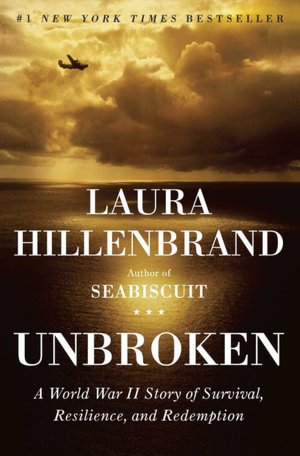
Unbroken by Laura Hillenbrand
Unbroken: A World War II Story of Survival, Resilience, and Redemption by Laura Hillenbrand
Published November 2010 by Random House Publishing
Source: my copy courtesy of my parents - who bought it to read for my book club meeting (I worked that well, didn't it?)
Louis "Louie" Zamperini was a bad boy. Not precocious. Not misguided. Bad.It was a miracle he wasn't hauled off to juvenile detention as a six-year-old. It's a wonder his parents didn't try to give him away. Yet for all of the trouble he caused at school, all of the things he stole, all of the fights he got into, his family never gave up on him.
When Louie was a teenager, his brother, Pete, decided Louie needed a direction and started training him to be a runner. What a runner he turned out to be. Before long, Louie was setting distance running records running for his high school. He was so good that he was accepted to USC, where he soon become a nation contender at the mile. Zamperini was so good he began training for the Olympics. In 1936 he made the U.S. team, competing in Berlin and impressing Hitler. Sure that if he worked four more years, he could medal, Louie focused all of his attention on the 1940 Olympics.
World War II was the end of Zamperini's dream. Louie enlisted in the Army Air Corp and was stationed in the Pacific theater as a bombardier on B-24 aircraft. In a mission over the tiny island of Nauro, the plane Zamperini was flying on was hit nearly 600 times, barely making it back to base. Those who survived were quickly assigned to another B-24, the Green Hornet. Even among planes that were unreliable and dangerous, the Green Hornet was considered a lemon. On their first flight, out over the Pacific Ocean, the plane crashed. Only three men survived. After 47 days only two men remained, surviving only by their wits, the food they could catch (birds and small fish) and rain water. As terrible as that ordeal was, things got much worse when the pair (Zamperini and pilot Allen Phillips) reached the Marshall Islands and were immediately captured by the Japanese. The two were held in brutal prisoner of war camps until the end of the war, in August 1945. First in a prison where the prisoners were not acknowledged as prisoners of war and therefore not registered, Zamperini was later transferred to two other camps where he was the particular target of the extremely sadistic Mutsuhiro Watanabe (known as The Bird).
After he returned from the war, Zamperini returned to a hero's welcome. But without a college degree (he never finished at USC), finding a real job was difficult. Louie made and lost money in numerous schemes but never enough to sustain him for long. In 1946, after a brief courtship, he married the much younger Cynthia Applewhite. But marriage and being a father were not enough to save Louie from his demons. Constantly haunted by nightmares of The Bird, Louie drank more and more. Eventually Cynthia left him, planning to get divorced. But when she returned to work on doing that, her efforts to help Louie became his salvation.
Zamperini worked tirelessly after that time to help wayward young boys, just as he had long ago been helped by his brother and to preach forgiveness. He has been awarded numerous honorary degrees and in 2011 appeared on the Tonight Show. The daredevil kid inside has never completely disappeared - there is a picture in the book of 81-year-old Louie skateboarding.
Unbroken is the story of man's unbelievable capacity for cruelty but, ultimately, the story of man's unbelievable capacity for survival and forgiveness. It should come as no surprise (although if you want it to be, you should skip ahead to the next paragraph) that, in the end, Zamperini was able to forgive his tormentors. There would not, surely, have been a book had he not found it possible. I did not - I remained angry for Louie long after I finished the book. It made me understand why my dad, who grew up in during the war, refused to buy a Japanese car for most of his life.
Laura Hillenbrand suffers from chronic fatigue syndrome and was only able to talk to Zamperini by phone as she worked on the book. Louie had previously written his own book and Hillenbrand drew on a wealth of other resources to craft a book that evokes strong emotion and never lags, even when writing about the 47 days in the ocean. She is certainly helped by a compelling story and a unique lead character, but Hillenbrand does not make this solely Louie's story. Throughout the book, Hillenbrand incorporates and memorializes the men that played a part in Louie's life, making this a book about much more than one man.
Unbroken was the Omaha Bookworms September selection and we invited parents to join us to read and discuss the book. It made for a wonderful book club selection, particularly with the multiple generations. We talked a lot about the story and about Hillenbrand's writing.
Several things stood out for us. Both my mom and I had marked that same page where Hillenbrand talked about the way in which the Japanese camps sought to deprive Zamperini and Phillips of the one thing that had sustained them during their time in the ocean, their dignity. Hillenbrand says:
While we did think it was implausible that so detail could be recalled (even considering that Louie kept diarys), none of us felt that this detracted from the book. Certainly, the fact that we had guests helped to keep our discussion on track but this was one of the best discussions of a book the Bookworms have ever had. We all highly recommend it for all book clubs.
Published November 2010 by Random House Publishing
Source: my copy courtesy of my parents - who bought it to read for my book club meeting (I worked that well, didn't it?)
Louis "Louie" Zamperini was a bad boy. Not precocious. Not misguided. Bad.It was a miracle he wasn't hauled off to juvenile detention as a six-year-old. It's a wonder his parents didn't try to give him away. Yet for all of the trouble he caused at school, all of the things he stole, all of the fights he got into, his family never gave up on him.
When Louie was a teenager, his brother, Pete, decided Louie needed a direction and started training him to be a runner. What a runner he turned out to be. Before long, Louie was setting distance running records running for his high school. He was so good that he was accepted to USC, where he soon become a nation contender at the mile. Zamperini was so good he began training for the Olympics. In 1936 he made the U.S. team, competing in Berlin and impressing Hitler. Sure that if he worked four more years, he could medal, Louie focused all of his attention on the 1940 Olympics.
World War II was the end of Zamperini's dream. Louie enlisted in the Army Air Corp and was stationed in the Pacific theater as a bombardier on B-24 aircraft. In a mission over the tiny island of Nauro, the plane Zamperini was flying on was hit nearly 600 times, barely making it back to base. Those who survived were quickly assigned to another B-24, the Green Hornet. Even among planes that were unreliable and dangerous, the Green Hornet was considered a lemon. On their first flight, out over the Pacific Ocean, the plane crashed. Only three men survived. After 47 days only two men remained, surviving only by their wits, the food they could catch (birds and small fish) and rain water. As terrible as that ordeal was, things got much worse when the pair (Zamperini and pilot Allen Phillips) reached the Marshall Islands and were immediately captured by the Japanese. The two were held in brutal prisoner of war camps until the end of the war, in August 1945. First in a prison where the prisoners were not acknowledged as prisoners of war and therefore not registered, Zamperini was later transferred to two other camps where he was the particular target of the extremely sadistic Mutsuhiro Watanabe (known as The Bird).
After he returned from the war, Zamperini returned to a hero's welcome. But without a college degree (he never finished at USC), finding a real job was difficult. Louie made and lost money in numerous schemes but never enough to sustain him for long. In 1946, after a brief courtship, he married the much younger Cynthia Applewhite. But marriage and being a father were not enough to save Louie from his demons. Constantly haunted by nightmares of The Bird, Louie drank more and more. Eventually Cynthia left him, planning to get divorced. But when she returned to work on doing that, her efforts to help Louie became his salvation.
Zamperini worked tirelessly after that time to help wayward young boys, just as he had long ago been helped by his brother and to preach forgiveness. He has been awarded numerous honorary degrees and in 2011 appeared on the Tonight Show. The daredevil kid inside has never completely disappeared - there is a picture in the book of 81-year-old Louie skateboarding.
Unbroken is the story of man's unbelievable capacity for cruelty but, ultimately, the story of man's unbelievable capacity for survival and forgiveness. It should come as no surprise (although if you want it to be, you should skip ahead to the next paragraph) that, in the end, Zamperini was able to forgive his tormentors. There would not, surely, have been a book had he not found it possible. I did not - I remained angry for Louie long after I finished the book. It made me understand why my dad, who grew up in during the war, refused to buy a Japanese car for most of his life.
Laura Hillenbrand suffers from chronic fatigue syndrome and was only able to talk to Zamperini by phone as she worked on the book. Louie had previously written his own book and Hillenbrand drew on a wealth of other resources to craft a book that evokes strong emotion and never lags, even when writing about the 47 days in the ocean. She is certainly helped by a compelling story and a unique lead character, but Hillenbrand does not make this solely Louie's story. Throughout the book, Hillenbrand incorporates and memorializes the men that played a part in Louie's life, making this a book about much more than one man.
Unbroken was the Omaha Bookworms September selection and we invited parents to join us to read and discuss the book. It made for a wonderful book club selection, particularly with the multiple generations. We talked a lot about the story and about Hillenbrand's writing.
Several things stood out for us. Both my mom and I had marked that same page where Hillenbrand talked about the way in which the Japanese camps sought to deprive Zamperini and Phillips of the one thing that had sustained them during their time in the ocean, their dignity. Hillenbrand says:
"This self-respect and sense of self-worth, the innermost armament of the soul, lies at the heart of humanness; to be deprived of it is to be dehumanized, to be cleaved from, and cast below, mankind."As inconceivable as the type of treatment the Japanese guards meted out is, Hillenbrand does a marvelous job of trying to explain it. The culture of Japan itself made the Japanese feel contempt and revulsion for soldiers who surrendered or were captured. All Japanese were raised to believe that to be captured in war was shameful and this thinking made it acceptable to abuse, enslave and murder captives. Hillendbrand also writes that "some of the worst abuses inflicted on captives and POWs may have arisen from the guards' discomfort with being abusive."
While we did think it was implausible that so detail could be recalled (even considering that Louie kept diarys), none of us felt that this detracted from the book. Certainly, the fact that we had guests helped to keep our discussion on track but this was one of the best discussions of a book the Bookworms have ever had. We all highly recommend it for all book clubs.
Subscribe to:
Posts (Atom)