Sunday, December 5, 2010

Sunday Salon - December 5


Happy December!  Do you all have a good start on the holiday preparations?  My goal is to try to get the house decorated today and start making cookie doughs.  Shopping has already begun and the Christmas cards are started.


I decided this week to continue hosting the Gilmore Girls Reading Challenge for another year.  I have to admit that I've sort of failed at my own challenge: I had a specific list of books that I wanted to read for it, but I've had to resort to reading entirely different books in hopes of reaching my goal of 20 books off the list.  I still want to read all of those books that I didn't get to so this is the best way to encourage myself to do so.  I've made some changes to the challenge this year--instead of 5, 10 and 20 books to read for the different levels, next year the three levels will be 4, 6 and 10 books.  Next year you'll also be able to substitute in some movie adaptations to try to reach that goal as well.


I had a couple of squeal moments Friday thanks to my first Fairy Tale Fridays in which I referenced the Omaha Lit Fest, Tim Schaffert and Kate Bernheimer.  I opened my email Friday evening to discover emails from both Schaffert and Bernheimer!  Schaffert left a comment saying that "The Little Mermaid" is not only his favorite fairy tale but also his favorite short story.  I remember him mentioning that at the Lit Fest; it was also his starting off point for the fairy tale he contributed to "My Mother She Killed Me, My Father He Ate Me."  You'll be hearing more about that story later.

Bernheimer wrote to say that she does have a definition of fairy tales: "they are works of art with a fairy-tale feel, the "affect" of fairy tales."  She also directed me to some essays that she's written about fairy tales which are fascinating.  I'll be talking about them this week on Friday.

 Finally, happy birthday to my sister tomorrow!  I won't say how old she is, mostly because I'm hoping that she'll keep quiet about how old I am!

Saturday, December 4, 2010

Checking off the "You've Got Mail" Challenge


With my recent frenzy of reading children's books, I've reached my goal for the "You've Got Mail" Challenge.  I love that movie so much, though, I was really tempted to keep the picture on my blog just to bring a smile to my face every time I saw it.  I read:

Maurice Sendak: Pierre: A Cautionary Tale Told In Five Chapters And A Prologue
                           Where The Wild Things Are
Ludwig Bemelman: Madline
                              Madeline And The Gypsies
                              Madeline And The Bad Hat
                              Madeline's Rescue
                              Madeline In America
E. B. White: Stuart Little
                   Charlotte's Web
L.M. Montgomery: Anne Of Green Gables
Kay Thompson: Eloise
Lewis Carroll: Alice's Adventures In Wonderland
Roald Dahl: James And The Giant Peach
Shel Silverstein: Where The Sidewalk Ends
Jane Austen: Northanger Abbey

I'd actually only planned on reading 10 books for the challenge but those Madeline books just sucked me in!

Friday, December 3, 2010

Fairy Tale Fridays - Just Exactly What Is A Fairy Tale?

The American Heritage Dictionary defines "fairy tale" as "a fanciful tale of legendary deeds and creatures, usually intended for children."  Wikipedia says that they "typically feature folkloric characters fairies, goblins, elves, trolls, giants or gnomes and usually magic or enchantment.  Often the story will involve a far-fetched sequence of events."

Fairy tales rarely make reference to religion or any actual people, places or events and unlike folklore, they were generally never believed to be based on truth. One site I found says that fairy tales were not originally intended for children due to their bawdy and violent nature.  On the other hand, other sites say they were first intended as stories for children. 

Interestingly, when I was at the Omaha Lit Fest this fall none of the panelists could actually give a concise definition of "fairy tale."  Not Timothy Schaffert who teaches about and writes fairy tales.  Not Keven Brockmeier who writes fairy tales.  Not Kate Bernheimer who compiled the book "My Mother She Killed Me, My Father He Ate Me," writes fairy tales and is the editor of three fairy tale anthologies.  Schaffert said "I just know one when I read one."  My plan of attack, then, will be to take the guess work out by picking up books that tell me they are fairy tales. Bernheimer did say that fairy tales have everyday magic and an absence of depth in the characters.  She also added that they are tales of survival of the weakest despite great brutality.

The Grimm Brothers, Jacob and Wilhelm, are perhaps the most famous tellers of fairy tales.  They first started collecting the tales as a way to preserve their Germanic heritage.  Once they say how popular the tales were with young people, they started to soften them up a bit but never to the point where they completely lost their appeal for adults.  Here's one version of "Little Red Riding Hood" that retains more of its violence.

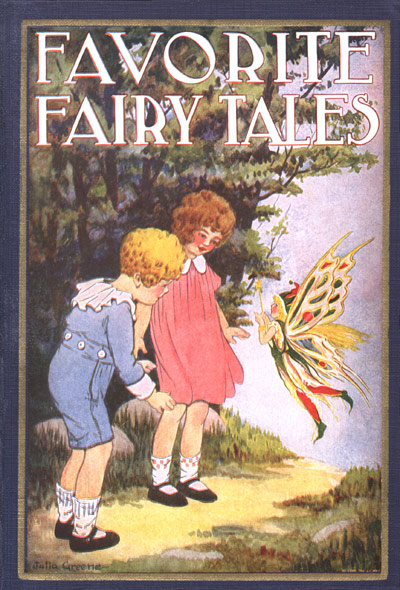
Are you interested in reading some of those fairy tales you remember from childhood?  Project Gutenberg has an ebook version of "Favorite Fairy Tales."  These are probably the adaptations you remember reading--just enough violence and threat to make them scary but not so graphic.  


I see I'm not the only one who's become infatuated with fairy tales lately.  The New York Symphony recently put on a reading of the new fairy tales in Kate Bernheimer's recent collection "My Mother She Killed Me, My Father He Ate Me."  Gregory Maguire, author if Wicked, did the introduction.

Which were your favorite fairy tales growing up?

Thursday, December 2, 2010

Pierre: A Cautionary Tale In Five Chapters And A Prologue and Where The Wild Things Are by Maurice Sendak

Pierre: A Cautionary Tale In Five Chapters And A Prologue by Maurice Sendak
Originally published in 1962
Source: we own it

"Pierre" is the story of young Pierre who refuses to do anything his parents tell  tell him to do and never says anything more than "I don't care."  It's just that attitude that gets him into trouble when he meets a lion.  As he always does, Sendak blends dark (Pierre is eaten by the lion) with light and his poetry with his delightful artwork, all combined to teach the reader a moral.

Where The Wild Things Are by Maurice Sendak
First Published in 1963
Source: a gift for my son when he was born

One night Max puts on his wolf suit a creates mischief of one kind and another, earning a trip to his room without supper.  While there Max forest grows in Max's room and a private boat comes by and takes Max away to where the wild things are.  Max soon tames the wild things and becomes their king but after a time he is forced to send them off to bed without their supper and decides he wants to be "where someone loved him best of all."

My favorite part of our copy of this book is the inscription our friend wrote in it when they gave it to my son:
"Always remember..., even when you are a "Wild Thing" you can always go back to be where someone loves you best of all."
It's a simply story with a wonderful lesson and I'm so happy that our friend made it a personal message, one all children need to know.

I re-read both of these books for the "You've Got Mail" Challenge.

Wednesday, December 1, 2010

Angela's Ashes by Frank McCourt

Angela's Ashes by Frank McCourt
368 pages
Published 1996
Source: I own it

Malachy McCourt had barely arrived in America before he met Angela Sheehan.  Soon she was pregnant and the two were "convinced" that they should marry by Angela's cousins.  Cousins who ever after told her what a terrible man her husband was.  They were right; Malachy McCourt was an alcoholic who was never able to keep a job for more than three weeks and frequently drank his entire pay for a week before he went home.  This was the life that Frank was born into.  Within a couple of years he was joined by brothers Malachy, Oliver, and Eugene and sister Margaret, the apple of her father's eye.  For Margaret, their father stopped drinking and had she lived who knows how the McCourt family's life might have changed.  But she didn't; Malachy started drinking more than ever and Angela sank into a deep depression.  Eventually her cousins convinced the family to return to Ireland, where things went from very bad to much, much worse.
"When I look back on my childhood I wonder how I survived at all.  It was, of course, a miserable childhood: the happy childhood is hardly worth your while.  Worse than the ordinary miserable childhood is the miserable Irish childhood, and worse yet is the miserable Irish Catholic childhood."
A miserable childhood it was.  There were more children born and more children died.  McCourt's father continued his drinking ways, forcing the family to rely for years almost exclusively on the assistance of various agencies (in his defense, it played hugely against him that he was from the North living in Limerick). There was rarely much more to eat than bread and often not enough coal to boil water for tea.  Frank suffered from typhoid fever and the worst case of conjunctivitis that I've ever heard of.  During his three month confinement with the typhoid, he spent most of his time alone in a ward of the hospital where there were no other patients and his mother was not even allowed to visit.  His life at home was so bad, that when he was finally able to return home he found himself longing for the quiet, the warmth and the cleanliness of the hospital.
"I think my father is like the Holy Trinity with three people in him, the one in the morning with the paper, the one at night with the stories and the prayers, and then the one who does the bad thing and comes home with the smell of whiskey and wants us to die for Ireland."

With the second World War going on, many of the Irish father's went to London and began sending home money to the other families on the lane,  When Malachy goes to London, the McCourts finally think their luck has changed.  But not one dime ever arrives from England.  Not only that, but with Malachy gone, the family was no longer eligible for the assistance they had relied on for years.  Now the family become more and more reliant on a family that didn't want to help and a church that kept turning its back on them.
"This is my mother, begging.  This is worse than the dole, the St. Vincent de Paul Society, the Dispensary.  It's the worst kind of shame, almost as bad as begging on the streets where the tinkers hold up their scabby children, Give us a penny for the poor child, mister, the poor child is hungry, missus."
I cannot imagine how any of the McCourt children survived this life.  Yet survive Frank and three of his brothers did.  Frank decided at fourteen to quit school, despite a passion for learning, to become a telegram boy, a job that not only helped his family survive but also allowed him to begin saving money for his eventual escape back to  America. 

Oh Frank McCourt, how I love this book!  I read it the year it won the Pulitzer and it earned a hard to earn spot on my permanent bookshelf.  Which means that, theoretically, I will someday re-read a book.  But I have a hard time ever making myself do that.  How could a book that's sitting on that shelf ever live up to my memory of it?  This one did.

This time I was struck by the fact that McCourt frequently repeated things.  Where I might have thought on the first read that this was done to effectively emphasize his points, this time I did find it excessive.  Still that was the only fault I found with the book.  McCourt spares no one in this book, finding fault with both of his parents, his larger family, the government, and the Catholic church.  But while the book can frequently feel angry, it is more often filled with humor and compassion.  McCourt brings his story to life: the malodor of the outhouse that's shared by the block but right next to the McCourt's house, the sting of the fleas, the misery of living in a house where for six months of the year, the family was forced to live on the second floor due to the flooding on the first floor.  McCourt is a master of the English language and writing in dialect.  I actually responded to my husband one night while reading this with an Irish accent.  Back on the shelf this book will go.  Someday I know I will read it again.